Skip to content
Formerly, HistoryMiami Museum

The Silver Meteor and the Champion were the two sleek trains that came to Miami from the Northeast in the early 1940s.

My first trip to Miami was with my parents, Harry and Jeanette Levine, and my younger brother, Yale. Leaving Metuchen, N.J., on a drizzly morning in February, we traveled all night, through the Carolinas and Georgia. The next morning we arrived in “God’s Country.”

It sure was a big change: Palm trees and the pink sidewalks that Miami Beach was known for in those early Art Deco days. The rainbow of colors — turquoise, pink, mandarin orange, chartreuse — were beyond belief.

We rolled out of bed and were at the beach in just minutes. On the way back home we would stop at Lee’s Health Bar for a cold piña colada fruit drink or a frosty chocolate malt or milkshake.

My younger brother and I enrolled at Miami Beach High School. My two older brothers were away in the service, one in the Army Air Corps and the other in the Navy. The first few weeks our family stayed at the La Flora Hotel on Collins Avenue. Shortly after we moved to Normandy Isle.

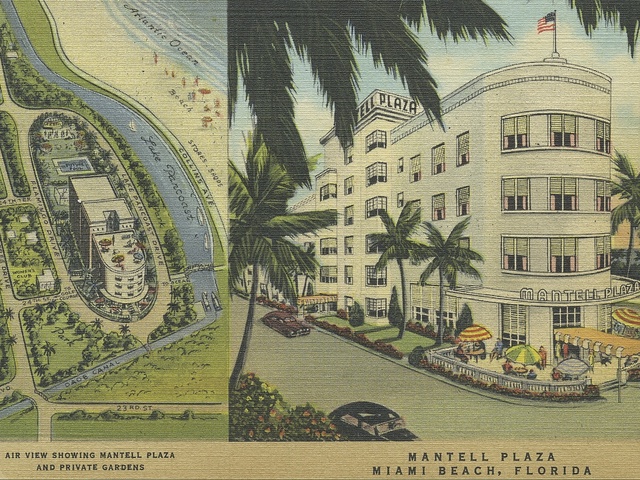
In 1946, our family bought The Neron Hotel at 1110 Drexel Ave. across from the old City Hall, where the cannon still sits as a memorial to our veterans. Now the Miami Beach Police Department and other city offices take up the block. When I pass that area, I think, “What a shame that the Neron did not survive to take its place among the other Art Deco hotels.”

Beach High was great in those days. We were one big family. Carl Wagoner was our principal. Our teachers did a pretty good job of putting a lot of knowledge into these impressionable kids. Most of us went on to become quite successful, including a movie director, state Supreme Court justice, U.S. Treasurer and Army general.

Among the teachers I remember was Helen Davis. Margaret and Anne Gilky (the Gilky sisters), Margaret Roberge and Harold Ruby were a few of the other fine teachers we had at Beach.

On September 1947, on the 14th Street beach, after one of our hurricanes, I met my mermaid and my life changed forever. Eleanor Lieberman (Ellie) was 16 and I was 17. We fell in love and were married in 1952 by Rabbi Irving Lehrman at Temple Emanuel. Ellie lived in Miami and went to Miami High. This was the beginning of our “MacArthur Causeway romance.”

Among my many wonderful memories: My mother used to go to Pier 5 in Miami where Bayside is now to buy fresh fish every day. Ralph Renick, the first TV voice in Miami at Channel 4, would sign off the news every day: “And may the good news be yours.”

Other memories include the Miami News building, Grand Union, Kwick Check, Food Fair, Tropicaire Drive Inn, Jordan Marsh, Riviera Theatre, the Miracle Theatre.

There was the Howard Johnson’s with fried clams and ice cream. The Jackie Gleason show with the June Taylor dancers. Royal Castle hamburgers at 15 cents, birch beer at 5 cents. License tags that had numbers for county size: Dade 1. Liberty 67. And UM football games Friday nights in the Orange Bowl.

In Miami Beach, we had the Cinema Theatre, which is now Mansion. At the Cinema, I was an usher, a doorman and finally an assistant manager during my later years at Beach High and my early years at the University of Miami. I also worked at the Lincoln and Sheridan theaters. The Sheridan was on 41st Street.

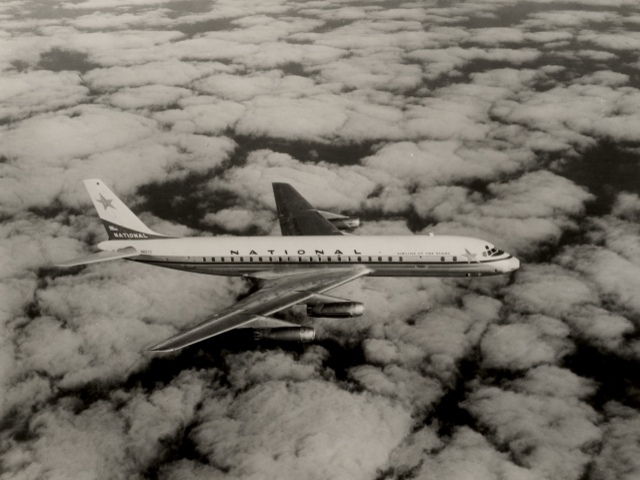
I delivered telegrams by bicycle to all the hotels and guests. Because there was no Internet, this was the alternative to snail mail. Yale and I were cabana beach boys at the Delano and National hotels.

This was our Miami Beach: a small town of the 1950s Art Deco area, where life was simple, where you knew most of the people personally and our biggest decisions were over where to go to college.

Some of this dream was shattered temporarily on Sept. 28, 1954, after I received greetings from Uncle Sam: “We Want You.”

I was a graduate of UM, married with one child, at that time, and was in our family’s furniture manufacturing business. This did put a crimp in my future plans for the next 24 months.

But I’m happy to report that I did survive this temporary interruption in my growing family’s plans.
Some might say that I was made to serve in public office. I don’t know, but I have lived an interesting and good life.

I learned so much doing what I did, what I still do. I looked back at an old calendar from when I was a city commissioner in Miami Beach, the first woman to serve in that position. It was full of occasions and events: meetings, breakfasts, lunches, cocktails, dinners. I loved it and I still do.

I grew up in the Bronx and my husband, Sidney, was from Brooklyn, which was like a planet in itself in those days. We moved to Miami Beach in 1960 because it was just too cold up in New York. My parents were already snowbirds, coming down each winter. It was beautiful. We never closed our doors or locked anything up.

We left a grayish city for the colors of Miami Beach and quickly saw the potential in the city. It was full of retirees in those days and we were in the prime of our 30s.

Miami Beach, and even Miami, was like a secret that just needed to be told.

In the 1970s, we realized the great potential Miami Beach had and, as residents, our vision saw what the area could become for the world.

Once my two oldest sons were in high school and the youngest was starting school, I had a lot more free time and I wanted to get involved. I ran for commissioner because I thought the best man for the job was a woman.

In those days, they were called councilmen, but that changed once they had a woman in office!

I served as commissioner for two years, 1977 to 1979. I look back to the days of campaigning as a time where I was able to get a lot done to help the city, but it was after I left office that I was really able to make an impact. My husband followed and became a three-term commissioner. We were the first couple to both serve in that position.

I served as chairman on the Miami Beach Chamber’s education committee for more than 12 years, the Miami-Dade Cultural Affairs council and so many other positions. My husband and I wanted to see Miami Beach reach its potential and be the city it has become today. I had to learn all about politics; I came from the PTA.

In office and as a private citizen, I always believed in the importance of education. I worked to keep the library in Miami Beach where it is. When they tore down South Beach Elementary, it broke my heart. They didn’t have enough children living in Miami Beach to have a school there in those days. Of course, that has all changed and now Miami Beach is full of families of all ages. It’s wonderful to see.

Today, I am still advocating for my community. I believe that everyone should do their part. I am president of Miami Jewish Health Systems Hazel Cypen Tower tenants’ council and co-president of their foundation’s women’s auxiliary. We raise money to make improvements and I make sure that the tenants’ opinions are heard in an organized manner. I was asked to run for the position after living there only six months; I guess I had made an impression. I’ve been serving for seven years now; there are no term limits here.

I’ve also seen the city of Miami change. Sidney and I had a vision and feel that it has come true. I think that the Latin influence has been a tremendous cultural addition that has enhanced the city so much. It is what makes Miami, Miami. The dream I had of seeing this city become a truly international destination brings me such joy, but there are still advancements that need to be made.

Midtown and Wynwood have changed so very much in recent years; it’s beautiful.

I hope Overtown will be next. It’s a pity that the people who live there have had to suffer so much, but there has always been a vision to fix it up and ensure that everyone has access to the same great education we worked so hard to get around the city. I hope to live to see the day that that plan is in place.

In the summer of 1939, our Catskills vacation was cut short when the hotel we were staying in was destroyed by fire, leaving my family with just the clothes on their back.

Returning to the Bronx, Arthur “Art” Bressler, my dad, was determined to try his luck in Florida and turn this misfortune into a positive.

The night before he was to leave for Miami, my dad took our last $800 and put it in the torchlight fixture for safekeeping. Shortly thereafter, we smelled smoke and just in time, retrieved the smoldering cash.

From this inauspicious beginning, my dad embarked to Florida in his Willys automobile while my mother (Celia), brother (Howard) and I waited to join him after he established himself in a business.

Starting with a dry cleaning/tailor shop in the heart of Miami, my dad tried his best for several months to make a go of the faltering business. Unfortunately, he had no choice but to close the doors and with the last remaining money bought the Cafe Royale at Northwest 36th Street and 22nd Avenue.

Shortly thereafter, my mother, brother and I joined my dad, where we rented a small semi-detached house in Allapattah, an area completely at odds with our familiar neighborhood in the Bronx and our Jewish family and friends. For many years, my mother could not acclimate herself to this new environment and had one foot back in New York.

My formative years at Andrew Jackson Junior High in Allappatah and later at Miami Senior High bring fond memories of the “old” Miami. We enjoyed Sunday strolls in the lushly landscaped Bayfront Park, beach parties at Haulover with my friends, roller skating at the rink on Biscayne Boulevard and taking the jitney over to 14th Street beach.

The World War II years were financially productive for the Cafe Royale and my dad quickly learned to cook up a mean chili. Both my mother and dad worked long and hard to provide the necessities for their family. They eventually bought a home in Miami.

Over the ensuing years, my dad tried his hand at many different enterprises with the Imperial Bar and Package store across from the old Dade County Courthouse being his last venture.

He was well-suited for the business with his outgoing, charismatic personality. He knew many of the judges and politicians who frequented the courthouse and his warm personality with a smile and a joke attracted many around him.

Always the entrepreneur, and never having musical training, he nonetheless taught himself to play a Gene Krupa style of drums and nightly filled the lounge.

When my dad passed away in 1977, the chapel was filled to overflowing with family and the many friends he encountered over the years. Although he is gone now, his zest for living and optimistic spirit will long endure.

Eleanor Bressler Udoff resides in Aventura.

Back during the mid-1950s, my parents migrated from rural Georgia, with five young kids in tow. Seeking a better life with more opportunity for their children, they sold most of their possessions, left family and friends behind and struck out for the big city.

Getting to Miami was quite a journey for us, with many stops along the way. But there was no doubt that our destination was Miami.

We arrived during the summer of 1955. For an African-American family, there were still many limitations in place at that time, barriers that would literally take years to come down. As young kids, we didn’t really understand it all.

My parents would often sit us down and try to explain to us about the harsh realities of life during those times. My father would tell us stories of his life and the many things he’d gone through as a young black man living in the Deep South. Now, living in this strange new city, they kept us very close, not wanting us to ever fall into harm’s way. In spite of this, they were determined to make the most of our new life.

We moved in with my mother’s older sister in Coconut Grove, where my aunt Irene lived in a small duplex just off Grand Avenue. We were all packed into this little two-bedroom duplex, and my aunt made pallets for us kids to sleep on in the living room. It was like a slumber party every night; we had so much fun.

I was third from the oldest, barely 5 years old, but I have such vivid memories of those days. Everything was a new adventure for me. I’d never seen a palm tree before, and I remember seeing my uncle open a coconut for the very first time. My aunt used to make the most delicious coconut candy. Some evenings we would walk up to Grand Avenue just to watch the traffic and see the hustle and bustle of the city.

We soon moved into our own apartment, just off U.S.1 in Coconut Grove. By that time, my father had landed a job working for General Tire Company in North Miami Beach.

My mother was attending nursing school at that time. With five small kids at home, that was not an easy task. My mom did eventually graduate and began working at Mercy Hospital.

There were times when my dad’s car would break down and my mom had to pick him up from work. She would let us kids tag along just for the ride. For us, driving down Northeast 163rd Street was like touring a vacation paradise.

I remember seeing the tourists walking around and frolicking in the pool at the Howard Johnson’s right at the cloverleaf interchange. There was a McDonald’s just down the street (that McDonald’s is still there) and sometimes mother would stop in for a rare treat.

I began first grade, with great reluctance, at George Washington Carver School. I hated school and would have preferred to stay home with my mom watching Captain Kangaroo or Popeye’s Playhouse.

Over the next few years we moved a few more times, until we were settled a bit further north, in an area called West Little River. My parents purchased the most beautiful and spacious home (at least to us) – three bedrooms, two bathrooms and a Florida room. We were in heaven.

We invited friends over and our cousins would sleep over sometimes. By that time, my older sister had married and moved out. I was in middle school by the mid-1960s and had made a few friends, and those relationships lasted many years after high school. I’ve known my closest and dearest friend since second grade.

By then, school was a lot of fun, and I had some of the most wonderful teachers. I especially enjoyed the many field trips to so many exciting places in Miami – the Science Museum, Parrot Jungle, The Serpentarium, Tropical Hobbyland, Crandon Park Zoo and Miami Seaquarium, just to name a few.

My parents really never had a lot of money, but they did manage to give us the most memorable childhood. Thank goodness it didn’t take a lot of money to have a good time in those days. There was always something to look forward to.

We were rewarded with spending money for doing our chores and helping out around the house.

My sister and I would take the Number 25 bus all the way downtown to go shopping. That was such a fun ride. We’d have lunch at one of the dime stores like Woolworths or McCrory’s lunch counter. Those charbroiled cheeseburgers and root beer floats alone were worth the trip. Other times, we’d enjoy Saturday afternoons at Virginia Key Beach with a big picnic basket.

If there was a new movie out, my dad would load us all into the car and head to the drive-in theatre. We wore our pj’s and made our Jiffy Pop popcorn before leaving home. It was so wonderful back in those days with so much to do.

By 1969, I was a senior at Miami Central High and ready for graduation. I registered at Miami-Dade Community College North campus and started work for the telephone company, a job that lasted more than 25 years. Both of my parents and three of my siblings have now passed on, my mom most recently.

Today, my husband and I are still enjoying life to the fullest here in Miami. More than 50 years ago, my parents wanted to provide a better life with more opportunity for their children in Miami, and I must say that was accomplished, many times over.

Today, I enjoy cooking big meals and having my children and grandchildren over to visit. That says it all. Life is great because the best time is now.

It feels like a high speed chase west on the ironically named Dolphin Expressway, veering south on what follows as a seamless string of highway on the “Palmetto,” the Don Shula expressway, and the Ronald Reagan Turnpike, all certifiable assaults on the nervous system.

I pass hurling arcs of overpasses and barrier walls painted in something vaguely resembling sandy or sunset colors. After the Walmart /Home Depot/BJs/ Outlet Center super-section in Homestead, I hook onto U.S.1 southbound and I’m off the highway, in Florida City, closer, at least, to what will become familiar territory for the next month. This drive is happening in May 2014 when I spent the month living in Everglades National Park as part of the Artist in Residence in the Everglades (AIRIE) program.

On the way down, I travel the familiar traverse on State Road 9336, past produce distribution centers, dollar stores, Mexican restaurants, and a church with a gigantic cross reclining on a grassy man-made berm.

As I near the park, the vista opens up at Southwest 192nd Avenue with wide agricultural fields. I can smell the fertilizer. I continue south, turning west at the state prison, past the well-kept migrant workers’ housing, and a small nondescript house with a large driveway that becomes a lively taqueria on the weekends. The variety continues past the Benito Juarez Park, a cluster of orchid growers, agricultural land for sale and a straight shot west across the C-111 (a canal originally built in the 1960s to transport Aerojet moon rocket engines so big they had to be barged). In a few minutes I arrive at the offices at the Ernest Coe Visitor Center to check into the cabin I will call home during the month of May.

My cabin quickly becomes home base after mopping, unpacking and re-arranging of furniture. It’s a piece of a larger housing settlement for park employees, built as part of “Mission 66,” a federal program begun in 1956 to improve the buildings in the national park system after the post-war visitor boom. The project introduced the concept of the visitor center, building the mid-century structures at Flamingo and the observation tower in Shark Valley.

I set up a field office with maps, a coffee machine, and a bottle of bourbon. I dine outdoors for the first two weeks, before the rains start and the mosquitoes emerge with ferocity. I continue the domestication and colonization of my immediate surroundings by setting up a studio in the large screened porch called the “chickee,” using the long string of picnic tables for painting, collaging, and journal-keeping.

Portions of the land-bound park have been domesticated as well, keeping us people in check, by making this subtropical nature preserve accessible through paved roads, cleared trails, and lovely laid-out paths such as those at Anhinga, Gumbo Limbo, and Mahogany Hammock. These carved out areas of accessible nature are places I frequent, and they feel part of my extended “house” in the Everglades.

But most of the park is water. Days I spend on a 24-foot flat boat, in the western boundary of the Everglades via the back-country waters, were glorious ways of experiencing a landscape untethered from the pace of the other coast. I saw rare orchids and animals. I learned that Martha Stewart laundry bags are a favorite for catching live pythons, and about the difficulties of detecting the invasive species with conservation drones (in part, because their body heat is close to the ambient temperature).

The trips were also archaeological tours, past ancient Tequesta and Calusa mounds, homesteaded settlements, factory remains, boat wrecks, shards of what might be pottery, and the hydrology stations themselves.

Tamiami Trail is my route to exploring another network of national, state and local preserves. It’s effectively a dam blocking the natural freshwater flow to the Everglades. At the time I’m there, a one-mile portion has been recently elevated to allow water flow as part of the restoration initiative. The road’s bridging, along with the canal structures and air-boat vendors, are all a part of the constructed landscape.

I’d originally intended to write more about the sublime experiences from within the park, too many to name — things like the bright lime green color of the coastal prairie in late May, or looking for meteor showers at 2 a.m. in Taylor Slough, or the slithering landscape of black snakes and mangrove root systems on the Bear Lake trail, where I was swarmed the first day after the rains started because I didn’t have a clue how bad the mosquitos could get (I counted 95 bites that night).

But my time weaving in and out of the designated park area made me acutely aware of the human intervention that allowed me to navigate these parts, and how we were alternately destroying, preserving, or trying to reconstitute this ecosystem.

My proximity to this part of the Urban Development Boundary gave me a more immediate sense of how the park was pressed, controlled, and restricted from every which way. Wilderness here is a construct, a negotiation between a real need for these sacred places of refuge for all sorts of creatures (including the human sort) with the political and economic imperatives required to make it happen.

I had taken countless photos of the landscapes that never matched up to the experience of being there. Yet I came to see my seemingly boring and repetitive pictures as historic glimpses into this particular version of the Everglades. Past versions included homes to ancient Indians, and later, 19th Century homesteaders. Previous iterations were experienced and impacted by loggers, speculators, mid-century vacationers, and invasive species of all sorts that had become native.

Ten thousand years ago, it was land still under the ocean. It is a landscape that has experienced all sorts of system collapse, but exists in a form that still protects and connects to some deeper part of ourselves.

It was the depths of the Depression, 1937, when my parents Manny and Grace LaCalle pulled into Miami with their two girls in the back seat of the car.

After many jobs and homes in five other states, my father had an offer from Schenley Distillers. They shipped all their belongings and drove to Miami from New York.

He began as a window trimmer, decorating the windows of liquor stores. His hard work was rewarded by promotion to salesman and eventually he was offered the position of sales manager for the state of Florida. It would mean relocating to Jacksonville.

After thinking about it and talking it over with my mother, he realized that people save all their lives so they can retire to Miami. He was here now, why would he leave? He refused the promotion and was never offered another.

Summers in pre-air-conditioned Miami were so hot – especially if you were used to New York weather – that our mom would take us to NYC on the Silver Meteor as soon as school let out for the summer.

By 1940, the LaCalles had saved enough to buy a home. Sts. Peter and Paul Church was new and proposed to build a school, but my parents had experienced similar proposals in New York where the schools were not started for 20 years, so they built their home across the street from Coral Way Elementary School. The following year, Sts. Peter and Paul School opened and my sister and I had to walk more than a quarter of a mile each way to school.

The following year, the Japanese attacked Pearl Harbor. The family heard the news on the car radio on a sunny Florida Sunday as we were driving around the Air Base in Opa-locka.

Since my father fell into a very small demographic, too young for World War I and too old for World War II, he and my mother volunteered in Civil Defense, him as an air-raid warden and her as a switchboard operator, as she had experience from working for Bell Telephone.

1941 was also the year that a song my grandfather, Joseph LaCalle, composed rose to number one on the Hit Parade. This song, “Amapola” (Spanish for poppy), had been used by the New York school system for teaching purposes and was included in “The Three Tenors Concert,” the best-selling classical recording of all time. The Three Tenors liked it so much they recorded it in their second concert. Andrea Bocelli also sang it as the first number on his recording “Amore.”

My sister, Dolores, and I attended Gesu High School in downtown Miami because of a shortage of teachers at Sts. Peter and Paul School during the war years. Gesu High was torn down subsequently to pave a parking lot, Miami style.

I studied at Barry College after graduating from Gesu High School and Dolores attended a nursing school in West Palm Beach.

After completing 30 years with the City of Miami, during which time I was the legal administrator to the city attorney, I entered a 15-year career as a professional actress. Most recently, I was a cast member of the movie, “Bart Got a Room.”

Dolores’ family moved to the north part of the state and now live in the Mount Dora area.

My daughter presently resides in Ft. Lauderdale after raising a family in Rochester, NY. One of my sons is an electrician in Sarasota, FL. My other son is an instructor with Miami-Dade Transit; his wife, who was born in Cuba, is the operations manager of a local company.

n 1963, I made my first trip to Miami.

I had just graduated from college and was invited to visit by the man who would become my husband, Richard Rosichan. At the time, he lived in Bay Heights with his parents, Arthur and Claire Rosichan. I was young and had lived my whole life as a northerner. I could not believe my eyes when I saw my first Miami house, filled with beautiful paintings and tasteful décor — the “marble” floors, the den filled from ceiling to floor with books, the tropical patio and what I perceived with my northern eyes as exotic landscaping.

Over time, and as our relationship became more serious, I returned to Miami and was introduced to neighbors and family friends. When we got married, I was teaching school in Buffalo, New York, and Richard quickly finished his degree at the University of Buffalo. For the next eight years, and no matter where we were living, studying and working, we spent every winter vacation in Miami.

My favorite event was going to the sumptuous New Year’s day celebration at a neighbor’s home just down the street. Upon our arrival, we were always handed a glass of homemade eggnog, which in my memory is still the best I have ever had.

My in-laws had no pool, but they used to rent a cabana at the Executive House in Miami Beach. I loved going there and felt like a “fancy” lady. It is hard to believe in this day and age, but when we went swimming, Claire always reminded me to keep my face to the sun so I could go back north with a healthy tan.

Less than 10 years and two children later (Amy and Lori), Richard and I moved to Miami (no more “face in the sun”). By that time, my mother-in-law was suffering from a serious illness. We didn’t want to inflict two active toddlers on our in-laws, so while we were waiting to close on our house, we lived in various places, including an efficiency apartment and two weeks at the KOA campground in Homestead.

While waiting to establish ourselves, we started a small business — Rider-Driver Exchange — a service to connect young folks who needed a ride up north with a driver who needed assistance with driving. We were quite successful in getting people together, putting up signs on a community bulletin board in Coconut Grove, but we had a cash-flow problem. We rarely got paid!

We finally settled in the Buena Vista neighborhood, just north of the Design District. In those days, most of the stores in the Design District were closed to the public. In order to get in, you had to either go with or be sent by a decorator. Richard and I had to be content with just looking. The neighborhood was quiet and sedate, with large two-story houses, but that did not last.

Years after we moved, the neighborhood was revitalized, the Design District became fashionable and open to all, with interesting decorating stores, restaurants and boutiques. During our Buena Vista years, we established new careers, Richard working as a research consultant and I working in the business center of a prominent law firm.

In 1983, we moved to Alton Road in Miami Beach. The city was in decline, and we were lucky to buy at just the right time. In those days, the median was filled with flowers, and the golf course was beautifully landscaped with more flowers. Sometimes wedding parties would stop to have pictures taken with the golf course as a backdrop.

Frequently, passers-by would stop and ask directions to a restaurant, and we were hard pressed as to how to direct them. There was the Villa Deli, a neighborhood institution, and Kim’s Chinese (both now gone), and Bella Napoli and Masters Pizza (still going). In the other direction was a Howard Johnson’s and, of course, Wolfie’s on Collins Avenue.

Lincoln Road was a wasteland, and Ocean Drive was in serious decay. Over time, of course, there was a dramatic turnaround, and the rest is history.

Each of these neighborhoods represents a thousand family dramas, comedic and dramatic, of our family’s life — young love, family growth, teenage turmoil, empty nest and now grandchildren. I have been truly blessed.

I’ve been trying to leave Miami for a long time now.

Miami was my home after I left Haiti. Creole was in every corner, familiar faces spilled out of supermarkets and Quick Marts, and botanicas haunted every jitney bus and crowded every small church between businesses. I felt at home, lakay as we say in Haiti.

I loved the symbiosis of Haitian and Latin culture, be it Cuban or Dominican, because our food and our body language, our passion and our mannerisms, in many ways mirror each other. Miami was a pilon, a mortar and pestle, and the people under the pestle were the ingredients that brought out flavor.

Miami started to lose that flavor when I lost my job during the recession and my mortgage went under. Thirty percent of residences foreclosed in my building. My morale took a big blow and suddenly, I’d had enough. Enough of the neighbor’s 7 a.m. music displacing the art on my walls, enough of the mother and son-in-law caught in a daily soap opera of Te voy a matar next door, and enough of the sour faces that old lady made every morning down in the lobby, waiting for me to ask her how she was feeling just so she could tell me her ailments.

I was tired of the angry letters that came in the mail from our disgruntled new resident who was angry at the association for “lying about the pet policy.” The elevator hadn’t been inspected since 2007, and I was tired of having to climb seven flights of stairs. I dreaded board meetings, where one of our residents, a mustached veteran, consistently interrupted with objections and motions that always led to physical fights and, most recently, required the presence of the condo-board attorney as well as the local police.

I dreaded the woman who thought she was doing us a favor by chain-smoking in the stairwell where we carried our groceries up and down up the steps, leaving cigarette butts in her wake. When I came home, or left for work, I tried to avoid the neighbor who never spoke a word to me but sat there at the entrance, smoking by the carton and staring straight ahead even when I greeted him. He, too, was angry with the condo board, and was plotting ways to sue them by forming a coalition of residents calling themselves “the justice seekers.”

I didn’t even want to take my dogs out, for fear of having my neighbor call me from his second-floor apartment. “Hey! Pssssssst! HEY!” Every time I looked up, I saw his silhouette behind the screened patio gesturing for me to join him for a drink, and throwing his hands up in the air, exasperated, when I refused.

Drunkards were in every corner outside, downing six packs of Keystone and smashing bottles of Corona against the ground in a kind of blind rage aimed at their own condition, leaving the shards on the asphalt for dogs to cut their paws. They urinated behind trees and squatted on the embankment of the canal to relieve themselves, with no regard for mangrove crabs and iguanas, or humans for that matter.

I avoided the man who pushed his obnoxious shi-tzu around in a shopping cart because he threw eggs at other people’s cars. When my neighbor two doors down insisted on bringing my dogs chicken bones from his dinner plate, his mouth and fingers sticky with sauce, I dreaded taking them but accepted the offering with a feeble “thank you.”

When I became pregnant and gave birth to my son, I sunk even deeper into a new darkness of post-partum depression. My neighbors saw me pregnant, and when my baby spent a month in intensive care, they all wanted to know what had happened. I avoided them even more. I wouldn’t open the door for anyone.

It was when my husband and I came back home with the baby that I finally noticed a change in our neighbors. Suddenly, we were Joseph and Mary harboring baby Jesus. My neighbors were the Wise Men, come to see him bearing gifts and cards, and smiles. There were baby tubs and mobiles, even strollers and bouncy chairs at our door. Suddenly, the neighbors I felt uneasy with were friends.

No. Suddenly, my neighbors became family.

The “justice seeker” greets me happily and now opens the door for me when he sees me coming crushed under the weight of grocery bags. The mustached meeting interrupter who gave us the silent treatment now addresses my husband with a “hello.” The letter-writer hasn’t mailed us manifestos threatening to call “Help Me Howard” in a while. Now, at the end of a long day when I rush home to see my baby’s face and kiss him, part of that longing includes a yearning for a waft of that Cuban coffee from my neighbor’s kitchen right before he stops by to offer me bones.

Yes, my building is the manger, and it feels like everyone has morphed overnight into benevolent creatures full of good will.

Or is it me who changed?

Perhaps it is this new love that opened me up to them. To letting them tickle my son’s toes, to lending them aluminum foil, to handing them holiday cards and dialing their family overseas when their eyesight fails them. They are family.

I’m working now, and my baby is healthy, and I spend less time thinking of moving away. Now, at least for a while, Miami is lakay. Miami is home.

I started my life insurance career in Norfolk, Va., then transferred to South Florida in early January 1964 to manage my company’s Miami district office.

I had previously rented a small, new house in Coral Gables for my wife Barbara and two young daughters, Jane, 7, and Margaret, 5. What we didn’t know was that there was a minimum size requirement for houses, and to qualify, the builder put a bomb shelter underground, in the garage, covered over by a steel plate so a car could still park. It was an airless hole in the ground, and fortunately we never had to use it.

At the end of the first year we all posed for a picture against a palm tree at Tahiti Beach, now a private enclave, and placed our photo on our New Year’s card, which we sent to our Virginia friends to wish them a warm new year.

After a few years, Barbara started what became a successful interior design practice while continuing her studies of languages, and was among the first to enroll in the new Alliance Française in downtown Miami.

Early on we joined the original Coral Oaks Tennis Club, then owned by the tennis pro Leo Fullwood. I still play in the mornings with “the Dumbheads,” a name conferred upon them by Leo, a group of men who show up for round-robin tennis each morning.

I was given the opportunity to invest with a man in Key West who was diving for sunken Spanish gold. My money is still at the bottom of the ocean, but a year later, Mel Fisher discovered a vast quantity of Spanish bullion and jewels.

Some friends and I went scuba diving in the Keys, only to find upon surfacing a waiting police officer who suspected us of robbing the crab pots. After we were searched and found empty handed, we were released.

Several years after our arrival, the insurance company I worked for moved their offices into a new high-rise office building built in downtown Miami after World War II, the Ferre Building at 100 Biscayne Blvd. From my office, I had a beautiful view of the seaplane as it arrived each day from Bimini. In those days, you could literally shoot off a cannon on Biscayne Boulevard in the summer and hit no one. Parking was no problem. All that was soon to change.

I still miss the fine dining at the Pub on Coral Way, and my favorite wedge of lettuce and the three choices of dressing. Fortunately, we can still go to Whip ‘n Dip on Sunset Drive for our favorite ice-cream desserts.

Eventually, we bought a home in the Gables, conveniently located near Sunset Elementary, Ponce Junior High, Coral Gables High and the now-defunct Deerborne School.

To this day, I’m like a walking Chamber of Commerce, but from the beginning, my wife Barbara would complain about the heat and humidity. I would reply, “Off to Fargo, North Dakota!” reminiscent of Jackie Gleason’s “To the Moon!” remark to Alice in the then-popular “Honeymooners” TV show. I finally mailed my comments to the Fargo newspaper asking for their sympathy, and they not only printed my letter but also put it on the radio, prompting a flood of letters to my wife, inviting her to come to beautiful Fargo and stay with them.

The years were passing too quickly. We moved to our second home on Hammock Lake and resided there almost 30 years, where my mother-in-law swore she saw an alligator in the lake and we were hesitant to let the children go swimming. I remember going for the newspaper one morning and seeing snow that melted as it hit the ground. It was the only time in my 50 years that that had occurred. Many trees and plants were damaged, but the following spring was the most beautiful I can remember.

I loved to garden in our lakeside yard. Hurricane Andrew in 1992 did minimal damage to our house but destroyed all my plants. We started all over and it was so beautiful the next year that it made The Villager’s Garden Tour.

Eventually, I became the South Florida agency manager for my company and retired Jan. 1, 1990. Then I volunteered for 10 years as a docent at Zoo Miami, taking people on private tours and carrying animals to schools and nursing homes. In 2014, Barbara and I will celebrate our 60th year of marriage, which we can partially attribute to limiting our games of mixed doubles in tennis, as the photo attests. I fell in love with South Florida from day one and look forward to that love affair continuing into the rest of my life.

I am sitting here in our den and weathering another tropical storm. Fortunately it is one of the smaller, less significant ones, but interestingly enough, it is on the 20th anniversary of Andrew.

I was born in Miami and so storms and hurricanes are just some of those things that we have to endure for the pleasure of living here all the rest of the year.

When I was a child, I lived in Shenandoah. My Aunt Anna had moved here when she married a man I never knew, William Mankes. They started a bottled gas company on Flagler Street, near the courthouse, which was the tallest building downtown at the time. It was also close to the train station, our major source of transportation. I remember sitting in front of the store on a curb watching the Orange Bowl Parade. We had great seats.

William Mankes passed away very shortly after they moved here and my aunt was left to run the business. She had a large family in Connecticut and she sent for my father Robert Brenner to come help her. Soon after, almost everyone moved here.

My aunt married a man named Ben Meyers, and in doing so, she became Anna Brenner Meyers. She had been a teacher and a nurse before she came here, and at some point she also became an attorney. She later met many political figures, was involved in politics and once ran for mayor. I remember handing out leaflets and stomping for her. She did not win, but she did serve on the Dade School Board for many years. She also received many, many honors (too numerous to recount). In her later years, a building in downtown Miami was named for her.

One of my best memories of my mom Rose was our Saturday girls’ outing to Burdines Tea Room. She would always order a Snow Princess for me. It was an ice cream sundae with candy pearls on it. After lunch, we would go into the bookstore and I could add to my collection of the orange-covered Bobbsey Twins set. After that, we would go to the Olympia Theater (now, Gusman). We would see a stage show and then a movie — our rendition of Radio City. Some years later, I would take my little sister, Helene, on the number 9 bus. It was so safe; I was 10 years old.

Also, when I was 9, my dad was on a radio show. I don’t remember the name, but he decided I should go into show business and he put me on the show. That did hook me into theater for quite a long time. My Dad used to put on shows at the Coral Gables Jewish Center, and other venues later on. He continued acting and directing for many years. Early in his life, he had been in vaudeville and the Federal Theater. The Federal Theater, which was created during the Depression, had many actors who later became very well known.

We had moved to Coral Gables and lived around the corner from the Coral Gables Youth Center. My sister grew up loving that place and later worked there. Also, living around the corner were our good friends, the Barrishes and the Skops. I was encouraged to send my story after reading other Miami tales.

I choose to remember the really good things about Miami, but there was a lot going on in those days. I remember “KKK” on temple buildings, signs where certain people could not be seated in restaurants, waiting for colored water to come out of the fountain, and some people purposely walking to the back of the bus to be seated. But the great thing was, there were so many other people to counteract that.

When I rode with my bus driver, Paul, after dark, he would drive me off his route on Le Jeune to deposit me safely in front of my house. I have been fortunate enough to have spent my entire life here, watching Miami grow and seeing cultural changes that have totally enhanced our jewel. These memories of my Miami will stay with me forever.

Translate »