| This entry is part of the Miami Migration Short Essay Contest. The program, created by Cátedra Vargas Llosa, was designed to engage young people in South Florida in the art of writing while reflecting on their migration experiences. My name is Nicole Aguiar and I am Cuban, but I was born and raised in Miami. My parents were the first people in my family who had the courage to search for a better life and immigrate to the U.S. I am grateful every day for the sacrifices that they made to give me a better life. I’ve grown up hearing the story of how my parents had to give up everything they had to escape communism. The story starts with my dad, who was a doctor in a small town called Limonar in Matanzas, Cuba. My dad had always hated communism, he didn’t agree with the Cuban government and how they didn’t care for their citizens. He experienced it firsthand whenever he had to care for a really sick patient and he knew that he could save their life, but the hospital didn’t have the resources to do so. He would experience it when he had to care for malnourished babies, because there was no formula. He really realized how horrible communism was when my grandpa, (his father-in-law) became extremely sick with cancer, would have violent seizures, and there was nothing he could do to save him, because the hospital could not give him the surgery he needed. My dad moved in with my mom after they got married and he always considered her family his own, especially since his own parents had passed away when he was younger. My grandpa did eventually pass away, and life became a lot more difficult for my family. Just because my dad wasn’t a communist, they took away his job at the hospital. They also kicked my mom out of her job, because at the time she was a high school history teacher. My mom’s sister was the one that now had to support the family. My parents knew that they could not keep living like this, so they tried to escape Cuba on a motorboat in the middle of the night. My dad was able to escape on his third try, but before that, the police had thrown rocks at him, and he got put in jail for 18 months just for trying to leave. My mom’s sister had to bail him out of jail. My mom tried to leave on a motorboat 17 times, but she would always get caught. My parents’ immigration story is also a love story, because they were separated for 3 years before my dad could make enough money to get my mom to the Mexican border. He would always send my mom money for food and necessities, tell her how much he loves her, and that they would be reunited soon. My mom had to go on a 9-month long journey from Brazil, to Panama, to Mexico, where she eventually crossed the border. My parents were finally reunited, and they couldn’t be happier. A couple years later, I was born. My parents are my biggest inspiration. Every summer when I go to Limonar to visit the rest of my family, I hear stories about how my dad saved someone’s life, or how my mom welcomed people into their home, and just overall how much they helped their community. They truly have the most beautiful hearts, always helping everyone they can, whether its sending food or money to Cuba, or taking in a cousin that just immigrated from Cuba, they’re always happy to help. It was because of them that I learned the beauty of life, and that even when life gets hard, your family will always support you. |
Category: Miami Stories
| This entry is part of the Miami Migration Short Essay Contest. The program, created by Cátedra Vargas Llosa, was designed to engage young people in South Florida in the art of writing while reflecting on their migration experiences. I’m Gabriela Alcala, a 15-year-old girl that wants to show the people that Moving to another country is not just about changing the place where you live. It’s about leaving behind your house, the history of your family, and everything you know. My story begins in Colombia, a beautiful country full of life and welcoming people, but also where my family and I live surrounded by violence and fear. Armed groups made life dangerous every day, and families like mine never felt safe. In 2008, everything changed for us when my grandparents’ farm was burned down by a group of armed men. They threatened to kill my family, and from then on, life was never the same. We lost not only our land and the animals, but also our sense of peace. Over time, things only got worse. Relatives disappeared or were killed, and every day we felt insecure. After many years of living this way, we finally decided to leave. In 2022, we came to the United States. I was only 11 years old, excited but also nervous about what awaited me. Starting school here was one of the most difficult parts. I sat in class without understanding a word on my first day in fifth grade. I felt ashamed and alone. That day I realized that learning English was my biggest challenge. At first, it seemed impossible, but gradually, I began to understand more. Every word I learned gave me confidence. Over time, I made friends, started participating in classes, and saw that new doors opened for me. Adapting to life in the United States was not only about then language, but also about the culture. In Colombia, we were very close to the neighbors and family. Traditions and community meant everything. Here, life felt much faster, and people seemed more independent. At first, the difference made us feel out of place. But after, we learned to mix both cultures. We celebrate Colombian traditions at home while enjoying the American ones. Although life here was not how you see it on television. It given us opportunities that we could never have had in Colombia. My parents were able to find better jobs, and we finally felt safe. Education became our new hope, and I understood that if I worked hard, I could build a better future. Migration has been a journey full of challenges, but also full of lessons. I have learned to adapt to overcome difficult times, and how important the family unit is. Above all, it has shown me that even when life feels scary or uncertain, there is always an opportunity to start over. I’m grateful for the opportunity to be here. God has always been there even in the worse moments. I know that the sacrifices my family made were not easy, but they gave me a new life full of hope and opportunities. The changed from Colombia to United States will always be part of who I am. It has made me someone stronger and inspires me to continue working hard for the future I want to build. |
| Wagon’s West Restaurant was an American western-style diner tucked into Suniland Plaza on South Dixie Highway, one of those local fixtures that felt like it had always existed, even before you were born. Living in Pinecrest meant you were technically part of Miami, but far enough removed that the skyscrapers of Brickell seemed like a distant civilization. Head thirty minutes north and you’d meet a skyline of steel and glass; drive just ten minutes south and the city’s glow dissolved into the quiet, almost enchanted darkness of Old Cutler Road, lit only by the moon and the occasional flicker of a stoplight. By the time high school rolled around and I finally got my license, I became the designated driver by default, my car was the biggest. Those nights felt endless. We could’ve gone anywhere in Miami, yet somehow we never drifted far from Pinecrest. Our world was mapped by muscle memory: my house, your house, school, Publix, Suniland Plaza, Sunset Place, The Falls. We were all just 2 to 15 minutes apart, a small constellation of teenagers who thought we knew the whole universe. And at the center of that universe was Wagon’s West. It was only a twelve-minute drive from school. The place itself always smelled like coffee, toast, and griddle heat. The walls were crowded with Western memorabilia and decor that made absolutely no sense in humid, tropical Miami, yet somehow fit perfectly. The food was simple in the best way: pancakes, bacon, hash browns, and every breakfast staple you could want. A simple menu that never tried to reinvent itself because it was already perfect. What made Wagon’s West truly special, though, was the atmosphere, the lived-in nostalgia of it. The clatter of plates. The low amber lighting. The worn-down booth cushions that dipped slightly in the middle from overuse. The tacky, lovable signs with jokes that made you roll your eyes and smile at the same time. My father introduced me to the place long before it became a hangout with friends. I remember sitting on a barstool, stretching my neck to watch the cooks work the massive flat-top griddle. I remember the warmth of his hand patting my head just as a plate of sunny-side-up eggs landed in front of me. With every buttery bite, the smell of his black coffee drifted into my nose, weaving itself into the memory. In high school, my friends and I would squeeze into a booth, tossing our keys into a messy pile in the center of the table like some kind of ritual offering. As we ate, we talked about everything and nothing; gossiping about classmates, family frustrations, and trivial drama. Wagon’s West was our refuge, a place overflowing with decorations that almost overstimulated the senses, and yet comforted us all the same. When we graduated high school in 2021, we scattered as everyone moved away for college. But every school break, winter, summer, Thanksgiving, we returned as if on a pilgrimage. Wagon’s West wasn’t just a restaurant; it was the anchor point that made home feel like home. The diner closed in 2023, before any of us finished college. Miami moved on, as it always does, but those mornings and afternoons remain suspended somewhere, untouched, intact, waiting for us in memory. *The author requested to remain anonymous. |
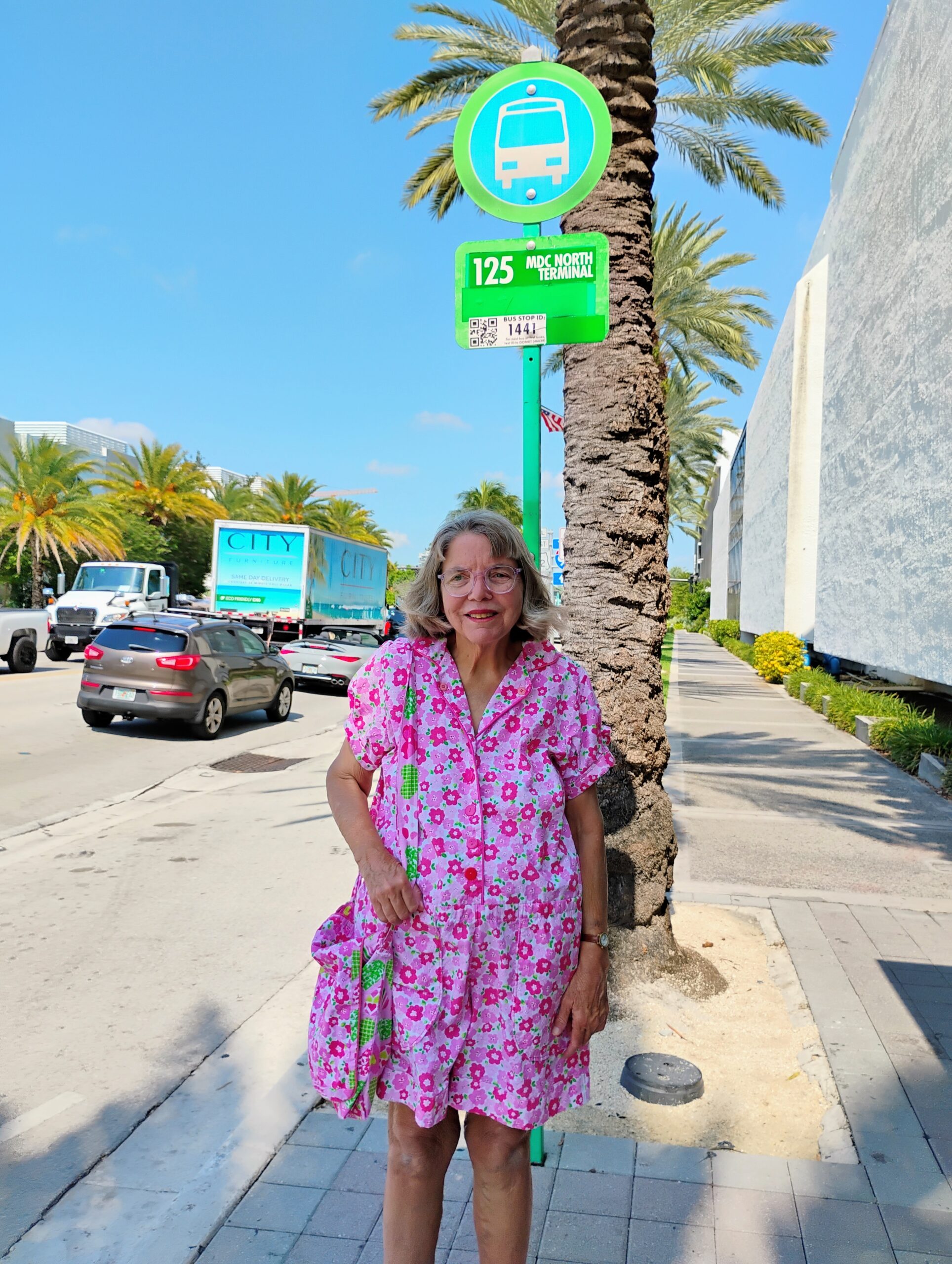
To quote the Grateful Dead, “What a long, strange trip it’s been.” That’s the way I feel about my 66 years of riding the bus in Miami.
In other major urban hubs, like Chicago, New York, Washington and Atlanta, commuting is socially accepted and commonplace. But here in Miami, I’ve always felt there is a certain stigma to being a non-driver. I’ve felt this way since childhood.
I began riding the bus at age 6 in 1959. My mother had me ride daily after school from Van E. Blanton Elementary to Little River Library where she worked. I was so small I had to stand on tiptoe to put my dime in the coin box. Bus fares for children were 10 cents and 27 cents for adults. The fare-coin boxes were illustrated with praying hands that read, “Lord – what wilt thou have me to do?” and “All colored move to the back of the bus.” To a tiny schoolgirl just learning to read, it seemed a mixed message.
Even the bus advertisements reflected that discriminatory era, from the oppressive “Playtex Living Girdles make you look 5 pounds thinner” to “Be a Marlboro man!”
Time brought change. The era of Rosa Parks, John F. Kennedy, Lyndon Johnson and the 1964 Civil Rights Act ended segregation of riders. Even the sexist culture of America was undergoing a “metamorphosis.” Fewer women felt the need to wear constricting girdles and smoking became less definitive of “manliness.” However, despite advances of equality regarding race and gender, I feel there has always been a culture of discrimination against non-drivers. But bus riders fought for their rights! Here are some examples in Miami’s history:
In 1963, Little River’s government leaders proposed that all bus benches along 79th Street, from N.W. 7th Avenue to Biscayne Boulevard be eliminated “because they take away the prettiness of our thriving shopping district of department stores, dime stores, banks, drugstores and movie theaters.” Shoppers, workers and housewives, black and white, protested, saying, “After a long day’s work on our feet, we need to sit down when waiting for the bus!” City leaders hastily backed down.
In 1969, bus fares had climbed to 35 cents for adults and 15 cents for students. The County proposed the student fare be applicable only on school days from 7:30 a.m. to 4:30 p.m. This meant students would be paying 20 cents more per ride during off hours. (20 cents might not sound like much today, but in perspective, a candy bar back then was a nickel, and a ticket to see the Doors concert was $6.00). Parents and students howled in protest and student fare stayed in place regardless of time of day.
In 1985, the Miami-Dade County proposed “Network 86,” with massive bus cutbacks called “streamlining.” I became a “Network 86 Forum Participant,” encouraging fellow bus riders to attend a town meeting. Most of my neighbors and fellow passengers were white, elderly and Jewish, (in sharp contrast to North Dade’s current population, which is primarily Haitian and Creole speaking). Network 86 participants eagerly protested at North Miami City Hall, exclaiming “We lived through famines, World War II and the Holocaust! We won’t be swept under the rug by you young whippersnappers with cars!” We all calmed down, heard each other’s viewpoints and compromised. One agreement was that since Routes “10” and “12” were almost identical, the “12” was eliminated. There was even a pleasant surprise: we’d have a new route directly to Aventura Mall! All other North Dade buses remained intact and the proposed cuts were scrapped.
In the 1980s, President Ronald Reagan cut federal transportation funds nationwide and singled out Miami’s Metrorail, saying it would have been “cheaper to buy everyone a limousine.” He, of course, had arrived in Miami in a chauffeured motorcade!
In the summer of 2023, Miami-Dade County made their so-called “exciting” announcement: There’d be a “Better Bus Network,” with ‘more efficient, streamlined service.”
However, seeing their new Route Map, I was shocked! Routes 2, 10, 16, 19, 93 and 297 had been cut. In addition, they curtailed Route 3 so it no longer serves a vast area of North Miami Beach. What does this mean for North Dade commuters? Without the routes listed above, only the 9 remains to travel between downtown and the 163rd Street Mall terminal. Most North Dade riders now have to walk as far as a mile to catch the one remaining 9. It is so crowded bus drivers often have to bypass people waiting at stops. I have heard similar cutbacks have also occurred in other parts of Miami Dade County.
I will not give up hope that the voices of riders will be heard. A Facebook page, “Miamians Against the Better Bus Network,” has been created. There are now 465 members protesting the cutbacks. I hope that more Haitians will join in the protest, as they would be powerful allies. To date, the County has not reinstated the cut routes.
What a long, hard road it has been. The journey continues!

January 1st, 1959 was like any other in New York City, but one family was celebrating more than the arrival of the new year: aboard the Norwegian freighter M.V. Hoegh Cape were several passengers from the other side of the world. Among them were my mother, father, and me–an infant twenty-three days shy of my first birthday. Lacking the financial means to buy airplane tickets, my parents got a berth on the freighter (as many poor families did in that era) from Bombay, India, to return to the U.S., where they had met and gotten married. My mother had gone home to Madras to be with family so that I could be born with her mother and family nearby. Mom got a job as a music teacher in Dade County’s public school system. She was the only Indian teacher in Miami in 1959, and it’s possible my father was the only Swedish-American boat builder and sculptor. They rented a tiny cottage in Coconut Grove’s Ye Little Wood. By the mid-1960s, Dad’s copper sculpture became well-known around Miami, and several private collectors bought his graceful shorebirds, gulls, and various other unique works to display in their homes, from Coral Gables to Fort Myers. Dad’s astrological globe–partially rebuilt over the decades because of vandalism–still adorns the entrance to the Gables By The Sea community on Old Cutler Road. My father was deeply connected to the ocean, and we spent at least two days a week on his homemade sailboats, exploring Biscayne Bay and the Keys. We would spend overnights on long weekends, sailing down to Elliot and Sands Keys, cooking aboard, and snorkeling. During several summers, we sailed across the Florida Straits to the Bahamas, living aboard for weeks at a time in the Abacos and Berry Islands. As a 13 and 14-year old, these were the most memorable adventures of my life. We would stay until it was time to go back to school. Mom admirably ignored racism and got her Ph.D. from the University of Miami and rose to become a prominent principal and administrator with Dade County Schools. With my Swedish and Indian background, I was exposed to different cultures and foods at an early age. Still, my life as a young man in Miami was as American as any typical kid could be: I fell in love with football at age nine, but music was also a huge part of my life because of my mother’s classical influence. I played the cello at ten, taking lessons from one of the Miami Philharmonic’s premier cellists; Mom took me to countless concerts, when I wasn’t going to Miami Dolphin games with friends. I taught myself guitar at fourteen, and by fifteen was playing in rock bands around town. I attended Palmetto Junior High, then spent two years at Ransom School–then all-boys–for 8th and 9th grade before returning to public schools and graduating from Palmetto Senior in 1975.
I was a music major at Dade Community College (Now MDC) and later changed my major to Criminal Justice when the law enforcement bug hit me at nineteen years old. By twenty-one, I was in the police academy with the Opa-Locka Police Department. I later joined Metro Dade Police, and worked as a uniformed officer and homicide investigator for the next twenty-seven years, retiring in 2006. My mother had passed away from pancreatic cancer in 1996, and Dad became too old to sail after the third boat he built was wrecked by Hurricane Andrew. Dad passed away just before my retirement in 2005. I had since married and raised two sons, and in 2003, my then-wife and I adopted a baby girl from Russia. After retirement, I worked in real estate and later began teaching criminal justice at Coral Reef Senior High School. After four years of teaching, I left and worked in the security industry, returning to Ransom-Everglades for one year as their Director of Security before returning to Coral Reef to resume teaching. By that time, I had re-married to an aspiring teacher, an Indian divorcee with three children. Remarkably, she was hired by Ransom Everglades in 2005, and we moved north from Kendall to be closer to her job. Sadly, my Russian daughter died in a car accident at age 16. That was 2020, the year of COVID; the disease wasn’t much more than fleeting afterthought after the terrible loss of Linnea. We both still teach and enjoy our five children–and now, two grandchildren (who live in Boston). We are happy empty-nesters who enjoy life and we travel to India to visit my wife’s parents each summer. Miami, my upbringing, my young adventures on the water, and my law enforcement career, are all inextricably woven in a rich tapestry (to borrow from Carole King) that I have memorialized in a recently finished autobiography entitled “Badge, Tie, and Gun Life and Death Journeys of a Miami Detective.” This book is with a literary agent and we are currently pitching it to various major publishers. I continue to write, working on my second novel now. Miami is a remarkable and unique place. I have tried to capture its growth–as well as mine–in my book. The Miami I grew up in was a quiet, Southern town. It has grown into a vibrant and diverse cyclorama of Latin American culture and financial promise. I live across the street from a Metrorail station, and when I ride it, I look out the window and see my younger self at
almost every corner.
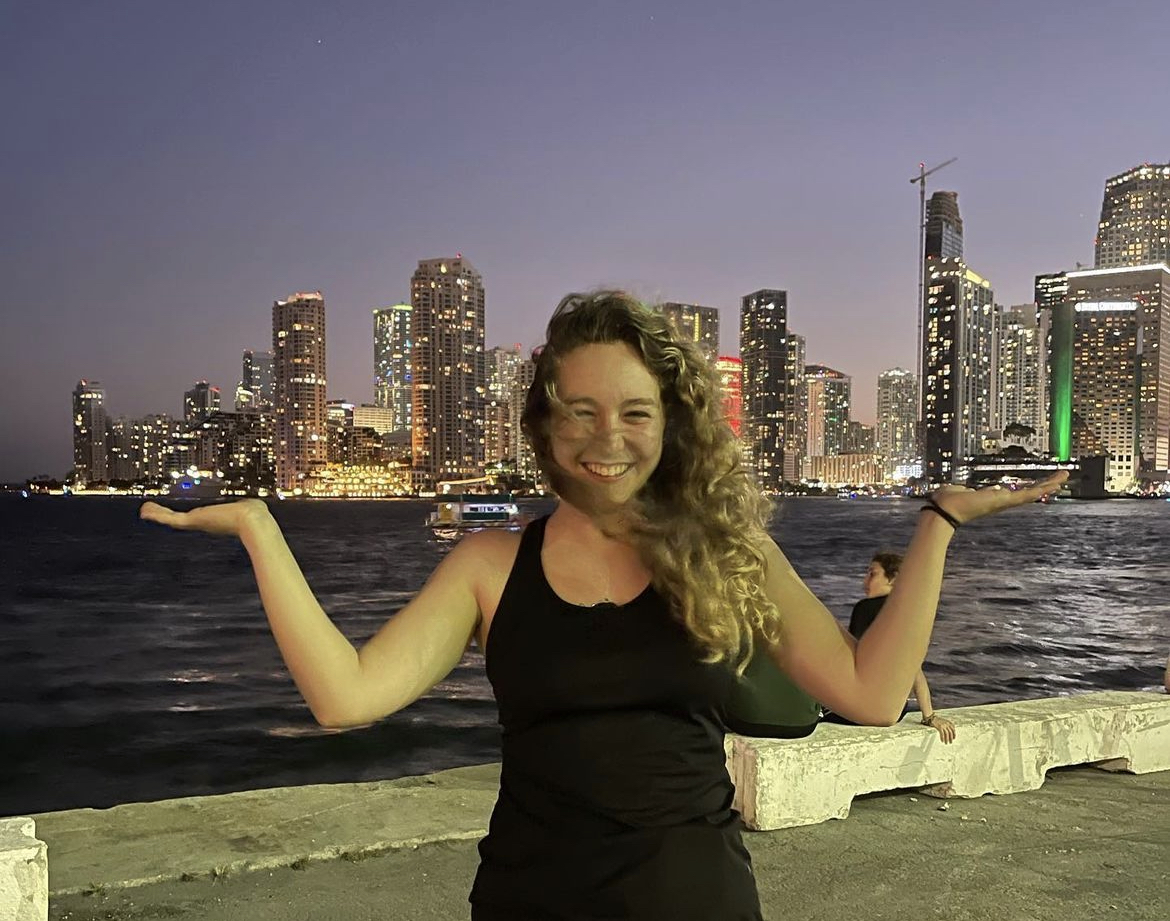
I grew up in Weston, a suburb outside of the Fort Lauderdale area. Growing up, I never really went into Miami, and drove to Fort Lauderdale or Naples to get to a city. Now, I am a student at the University of Miami, and currently live in Coral Gables. Miami has become a home to me, and I have realized that there really is no place like Miami. Miami is so unique, and is a place where culture, history, and people thrive. I feel like every day I experience something new, and connect with someone I would have never met if it weren’t for Miami. The people in Miami are what makes Miami so special, and sometimes, just having the city of Miami in common with someone allows you to relate to one another. I also feel as though there is a constant sense of Miami pride, inside and outside of the city. Often times I will see someone wearing UMiami gear in a different state, and throwing up the U will always spark up a conversation. Something that will always make me feel like a Miamian and give me a sense of Miami pride is when I drive on I-95 passing through Brickell and Downtown. I often make this drive coming US-1 on the way to either the University of Miami Medical school, the beach, or somewhere else downtown. There is nothing quite like this drive, or the view that comes with it. When you pass through Brickell and Downtown on I-95, you have a perfect view of all of the high rises and the ocean behind them. It is beautiful during the day and at night, with all the lights from the buildings shining through the dark. Whenever I make this drive, I get this indescribable feeling, and I am so grateful to be living in this beautiful city and get to experience it every day. I feel a sense of hope and contentment, knowing that this place is my home.
This entry is part of the inaugural My Miami Migration Short Essay Contest. The program, created by Cátedra Vargas Llosa, was designed to engage young people in South Florida in the art of writing while reflecting on their migration experiences.
“Immigration isn’t a two-way street; it’s a labyrinth. It’s winding and endless, with walls of uncertainty and echoes of homes left behind.” – Panamanian American author Cristina Henriquez
The topic of immigration and its realities is often unseen by many people. Few truly experience migration. While I may write as if immigration is a positive subject, it carries unseen challenges, obstacles, and pain. From my perspective, however, I have always felt it as beneficial. Everything I experienced shaped who I am, and for that, I am forever grateful.
My story began early—so early that I was not even aware of my family’s transfer to another country. Born to a Venezuelan mother and an Italian father, I moved to Miami with my family at just six months old.
Leaving my native country so young and living in a Spanish-speaking household while the outside world spoke English left me confused. I was told I barely spoke until I was five. Starting school helped me pick up English while practicing Spanish at home. That routine held steady for five years until it was time to renew our visa.
My father’s worker visa allowed us to stay in the U.S., but as a child, I did not fully understand its importance. Every five years, the visa required renewal, which meant leaving the U.S. and visiting the American embassy in our home country. Unfortunately, the U.S. embassy in Venezuela had closed due to political tension. Fortunately, my father, sister, and I had Italian citizenship, allowing us to apply in Rome.
The trip to Italy was beautiful. I saw monuments and landmarks but did not comprehend what was unfolding. At the embassy, our visa application was rejected. My parents got anxious—my father scratched his head in frustration, and my mother called everyone, saying, “We’re not coming home.” I did not understand the gravity of the situation. I thought it was just a setback. It was not. This was not something easily fixed.
We had to live outside the U.S. Asa family, we could choose Venezuela or a European Union country. We chose Sicily, settling in a small town where relatives helped us adjust. Those years were rough. Secluded in a traditional village, we endured family fights and cultural challenges, but I believe it was for the best. Those struggles taught me everything I needed to know about my family and myself.
After three years in Balestrate, we decided to move to Spain, a Spanish-speaking country. Initially, we settled in a small town, but later moved to Madrid. Moving so often was exhausting. In four years, I attended four schools and lived in four cities. Life finally stabilized when we reapplied for the visa and got accepted. I did not know how to react—I had grown so accustomed to living abroad that it felt normal.
Returning to the U.S. was bittersweet. It was not clear whether it was the right choice for me, but it was necessary for my father’s business.
And that is what has brought me to where I am today. While my parents and sister often reflect on that time as a dark chapter in our lives, I see it differently. The people we met, the new languages my sister and I learned, and the challenges we overcame shaped us in ways I would not trade for anything. Our memories and experiences define who we are and help us grow. With that in mind, I know that whatever I face in the future, I will embrace it as an opportunity to learn and evolve.
This entry is part of the inaugural My Miami Migration Short Essay Contest. The program, created by Cátedra Vargas Llosa, was designed to engage young people in South Florida in the art of writing while reflecting on their migration experiences.
En seiscientas palabras no cabe toda mi historia, pero mágicamente en una maleta sí. Todo comenzó a mis ocho años, cuando por primera vez vi a una de las personas que más amo irse con una maleta y un propósito. Eran aproximadamente las ocho de la noche en el aeropuerto de Maiquetía en Caracas, Venezuela. Vi llorar a mi mamá como nunca antes. Jamás pensé que un ser humano podría derramar tantas lágrimas, hasta que yo misma lo viví. Nunca supe cómo expresar lo que sentí aquella noche. Me invadía un dolor inmenso, no sabía que pasaba ni por qué mi familia lloraba; lo único que sabía era que mi papá se había ido. No sabía si regresaría, teníamos esa vaga esperanza en ese entonces de volverlo a ver en persona. Después de ese momento, se volvió regular ver a más y más familiares, amigos y conocidos irse del país, cada vez eran más y más las lágrimas derramadas en el suelo del aeropuerto. Ese suelo tan bonito y artístico con mosaicos que resonaba con las ruedas de las tantas maletas que vimos partir. Luego de tantas lágrimas ese hermoso suelo, también se deterioró junto con la gente de mi hermoso y lastimado país.
Durante años de despedidas y lamentos, fueron muchas las maletas que vi irse. Algunas eran nuevas, otras llenas de polvo y viejas, algunas no llevaban mucho tiempo guardadas, y otras eran unos simples morrales escolares, ya que no permitían llevar mucho por persona. Eso es otra de las cosas de las que me había percatado durante ese tiempo, ¿Qué tanto se nos permitía llevar? El porqué de todo esto aún se me hace un misterio, un misterio que quizá nunca quiera resolver. A veces pensaba que la vida no me sonreía durante esos años de soledad. Aunque mi madre estuvo conmigo durante todo ese tiempo, y yo con ella, sentía que ese vacío que había dejado mi padre nunca se llenaría hasta verlo en persona y que me diera respuestas. ¿Por qué todo había ocurrido de esta manera?, ¿tenía que ser así?,¿Cómo cabe una vida en una maleta? éstas preguntas aún me comen la cabeza de vez en cuando a pesar de saber algunas de sus respuestas.
Una de esas respuestas me llegó después de siete años cuando me tocó a mí poner mi vida entera en una maleta. Aún me pregunto qué habría pasado si hubiese guardado cosas diferentes a las que tengo hoy conmigo. Ese día sentía que mi mundo se venía abajo, por una parte, estaba la emoción de ver a mi padre nuevamente, y por otra, el dolor de la despedida de amigos y familiares. Decir adiós a mis amigos fue lo que más me dolió; lo que yo habría dado por llevarlos conmigo.
Esta vez era mi turno de pasar por el ahora decaído piso del aeropuerto, con mi morral escolar encima y mi maleta en mano. Sonaban aquellas ruedas en camino a un nuevo futuro, que ni yo misma me esperaba fuese tan brillante. He pasado por mucho, pero no me define lo malo, sino la manera en la que lo he vencido todo y he encontrado formas de disfrutar mis procesos junto con esos que más me aman. He ido llenando poco a poco una nueva maleta con esperanza y amigos nuevos, sueños y experiencias que me hacen cada día mejor. Mantengo mis afectos intactos a mis amigos eternos. Al final, no importa cuántas cosas lleves, lo importante es que puedas rehacer tu vida así sea a partir de una maleta.
This entry is part of the inaugural My Miami Migration Short Essay Contest. The program, created by Cátedra Vargas Llosa, was designed to engage young people in South Florida in the art of writing while reflecting on their migration experiences.
“Mom, the light went out again.” For millions in Venezuela, this phrase is a routine part of life, a
reminder of flickering hope in a country burdened by instability. But for me, it symbolizes the
tension between two worlds I’ve navigated my entire life—one illuminated by privilege, the
other shrouded in struggle.
Born into a Venezuelan immigrant family, my story begins in the vibrant, sun-soaked streets of Puerto Rico. Yet, life unraveled with the 2008 financial crisis. My family lost everything. We packed our lives into suitcases and moved to Miami, clinging to the hope of stability as my older brother fought to stay alive. His fragile body was damaged by eosinophilic esophagitis, and at school, it made him a target. Kids shoved him into lockers and punched his delicate stomach. Their laughter echoed in the hallways, mocking his pain. At six years old, I made a choice: I would protect him. I became his shield. I grew up overnight. No one touched him again.
At home, the air was thick with the aroma of arepas and the sounds of “Gaita” playing. My mother, an
immigrant and single parent, carried the weight of two worlds on her back. She was exiled from her family for breaking an arranged marriage and fled to the U.S.to build a life from nothing. Her hands—once adorned with delicate jewelry in her youth—were calloused from years of hard work. Yet, her spirit was unbroken. She reminded me daily that sacrifice was the price of freedom and that strength was born from struggle.
In Miami, I learned to straddle two worlds. At school, I navigated the sharp-edged maze of American culture. At home, I held tightly to our Venezuelan traditions. I danced to bachata with my grandma while mastering the English alphabet, switching between languages and balancing precariously between two cultures became my new life. The tension was exhausting but transformative. It taught me the power of adaptability and the beauty of connection.
As a first-generation Latina aspiring to a medical career, my identity is inseparable from my ambition. My mother’s sacrifices carved a path for me to dream beyond survival. She showed me that it’s not enough to endure; you must also rise. Her journey from ostracization to resilience has fueled my belief in second chances and the power of transformation.
Navigating my dual identity has shown me the power of growth through adversity. Whether it’s protecting my brother, adapting to new environments, or honoring my mother’s journey, I have learned to embrace challenges as opportunities to grow. As I pursue a career in medicine, I aim to extend this mindset, helping others not only heal but also transform their lives. My immigration story is not just about resilience; it’s about hope, second chances, and the unwavering belief that we can always dare to grow.
Even though I didn’t grow up in Venezuela, it lives in me. It’s in the crackling sound of arepas on the stove, the whispered prayers of my family during hard times, and the grit I carry in every step forward. Since I was 11, I’ve worked with the “I Love Venezuela Foundation,” providing aid to families who face challenges I’ve only glimpsed. These experiences have been my anchor, reminding me that fulfillment lies in lifting others.
My story is one of duality—of light and shadow, struggle and triumph. I will foster communities that celebrate resilience, bridging cultural divides and offering hope to those who need it most.
Because the lights may go out, but the spirit never dims.
This entry is part of the inaugural My Miami Migration Short Essay Contest. The program, created by Cátedra Vargas Llosa, was designed to engage young people in South Florida in the art of writing while reflecting on their migration experiences.
I was packing my things, in my suit bag I put everything that was important: my clothes, my
documents, my memories and “saudade”. Saudade is a word in Portuguese that means
melancholic due to the removal of a person, thing or place, or the absence of previously lived
pleasant experiences. At that moment I was teleported to my childhood.
Let’s start from the beginning. I was born in Brazil in a city called “Uberlandia”. My parents’ jobs made our family move frequently, so I never had long-term friends or something like this. It was always me, my sister, my mom and my dad. When I got to the sixty city, my parents made me a promise : this would be the last one.
For the first time, I began to create bonds, something I had always feared, because I felt like my relations had an “expiration date”. And that was my life for 5 years, trying to make friends, near to my family ,in my hometown. Everything felt perfect. Too perfect to be true. On a Wednesday night, my whole life changed.
I was studying for a big test that I would have on Friday. My mom entered my room, crying. She opened the door, got into her knees, and started praying. At this moment I already knew. Two weeks earlier, she had mentioned something about moving to Miami, but nothing was certain. I could feel it: we were leaving.
My world paralyzed. My friends. My family. My house. Everything.
The next day, after receiving this news, was even harder. Suddenly, every ordinary thing became the last time, the last day going to my school, the last day with my grandmother, the last day in my house. Those months were hard, packing things, documents and goodbyes. I was searching for schools and I found ISPA. It was a school filled with immigrant students adjusting to their new reality, perfect to me. But there was one small detail: I had only two months to learn Spanish.
Finally I got into the plane, at this point my mom and my sister were already in Miami. It was just me and my dad, entering the airplane that would arrive in our new life. This flight was a goodbye to the old and a hello to the new. Soon it would be just me and my parents, because my sister would go back to Brazil to College. She was always my bestfriend, and saying goodbye to her broke me inside.
The first day was hard, no friends, new country, new language and new life. I knew I had to be strong, for me, for my family. The pain of letting everything behind and starting from zero. The gratitude of a new country with a thousand opportunities. The pain of leaving or the pain of staying?
During my life, with so many changes, I learned that everything is about choosing. Choosing the comfort in the known or possibilities in the unknown. I used to say that I will never be 100% in just one place. There are Ana’s all over the cities that I live in. We are a mosaic of people who have passed by us, always carrying a little piece of others with us. I am a child of the world. I was born to change. And yet, change always brings consequences — saudade.