Skip to content
Named Best Museum 2022
by Miami New Times

I was born in 1946 in Greenwich, Conn. Every winter we would take the train to Miami and stay at the Gulfstream Hotel in Miami Beach.

One could look down the beach and not see another hotel nearby. There were a lot of “snowbirds” (although that term had not been coined yet) who stayed there, among them some of the rich and famous, as well as the infamous.

I had my picture taken with J. Edgar Hoover when I was 4. Sorry to say I lost the newspaper clipping of that photo in my many moves. I had no idea who this pudgy man was or why the photographer was making a fuss over us. There were other children around my age. There was Sherman Billingsley, whose father owned the famous Stork Club in New York. There were the Kresge children, Cary and Kitty. Their family owned Kresge’s 5 & 10 cent stores. The name may not sound familiar now but the K in Kmart stands for Kresge.

My family eventually bought a home in Miami Beach and we moved there full time when I was 6. Growing up in Miami Beach in the 1950s and ’60s was wonderful. I don’t think we realized then what a paradise we lived in. There was the dog track at the end of South Beach. The Art Deco hotels were filled with vacationers from New York and New Jersey. There were the Orthodox Jewish diamond dealers who would come in the long heavy black coats, even in the heat. There were the retired people in their orthopedic shoes schlepping their lounge chairs. Frank Sinatra was singing in the Poodle Room of the Fontainebleau, and once I passed Sammy Davis Jr. on Arthur Godfrey Road. He was this tiny man with two enormous bodyguards.

I went to St. Patrick’s School and then to Carrollton in Coconut Grove. Many of our classmates had fled from Cuba. They taught us the meaning of freedom and added spice to our city. I remember driving to school during the Cuban Missile Crisis, never realizing that we were in such danger. We were just excited to see all the cute sailors and soldiers all over Miami.

I have returned to Miami Beach a few times over the past years. It is not the place I grew up. The small motels vibrate with the beat of Latin music and “the beautiful people” come from all over to lie on the beach. If it weren’t for Joe’s Stone Crabs, I would think I was in the wrong place. I am glad this amazing city has been revitalized. In the 1970s, the hotels showed their age. The shops on Lincoln Road were all closing and parts of it looked like a ghost town.

The people who walk the beach and sidewalks now don’t know what the Stork Club was or that there were such things as 5 & 10 cent stores way before the dollar stores came into vogue. The young ones won’t know who Hoover was, nor will they have heard of Sinatra or Sammy Davis Jr., except through old black-and-white photos or a song they hear in an elevator. I don’t know if 41st Street is still called Arthur Godfrey Road or if people remember that Jackie Gleason did his TV variety show from the Miami Beach Convention Hall.

I do know that I was blessed to have grown up in paradise. I hope those who reside there know how lucky they are and make wonderful memories that will come back to them when they are old and living in New Jersey.

My father, David R. Balogh, is a Miami Beach legend. Most Beach people knew him and many, many shopped at his Balogh jewelry store.

Today, wherever I go, whether Miami, New York City or even Sun Valley, Idaho, I meet people who proudly show off their long-ago-purchased Balogh treasure.

My dad’s story is in many ways typical of the tales of those designated by Tom Brokaw as “the greatest generation,” those men and women who helped us defeat Nazism in World War II and then returned home to create the most prosperous and free nation, not even fathomed by our founding fathers.

I do believe, however, that my dad has some very distinguishing qualities, especially his unusual embodiment of both an ambitious drive coupled with romantic warmth and charm. He was the Navy vet who sent home every paycheck to his loyal wife Sallie. And when he returned from the war, they drove their old station wagon from New York City to subtropical, undeveloped Miami Beach to begin their family life with infant daughter Joan. What drove him to Miami, in addition to his run-down jalopy, was his conviction that Miami Beach was nirvana with its consistently sunny weather, the ocean and the palm trees. This was the venue to start a business and a life.

My parents rented a very small store on Arthur Godfrey Road, as they certainly could not afford Lincoln Road. They began a “mom and pop” antique business. My dad’s optimism led to his conviction that his customers would invest in and celebrate a new, good life with lovely items both to wear and to adorn their homes. He believed both in Miami Beach and in America. He was spot on about his customers, Miami Beach and America.

In addition to his foresight and optimism, he had skills. He had an uncanny business savvy, sensing where and how to buy, and he had a charismatic ability to sell. He loved beauty and believed in investing in real, tangible items. This mom and pop business grew just as he had envisioned; it was enlightening to witness the business morph from a two-person, seven-day-a-week operation into an internationally renowned jewelry store. He opened stores in Coral Gables, Hallandale, the Diplomat Hotel and much later on Madison Avenue in New York City. But the basis of his business and his heart remained in Miami Beach.

As my father’s business grew, so did Arthur Godfrey Road. It was symbiosis; David Balogh and Arthur Godfrey Road fed off each other and grew together. He purchased real estate on the street and involved himself in leadership roles, such as establishing the parking facilities to help all the small businesses and restaurants in the area. He was active in the Miami Beach Chamber of Commerce and many local and national philanthropies, such as Mount Sinai Hospital, juvenile diabetes and the University of Miami. He became imbedded in the fabric of Miami Beach life. My dad retired at age 92, but he still puts on his suit and tie every day and enjoys riding around looking at his properties.

My dad’s dedication and focus went considerably beyond his jewelry and real estate businesses. He was an accomplished musician — a pianist and flutist. He actually met my mom in Astoria, New York, through his music; he was her piano teacher. He played first flute in the Miami Beach Symphony and I remember feeling special to be called up on stage to conduct when the symphony came to my North Beach elementary school. He was so proud that he was able to play under the maestro Arturo Toscanini. My dad’s special motto, still displayed in his closet shelf, is “you never fail until you stop trying,” and this definitely permeated the inner structure of his businesses and his family. Fortunately, I was able to incorporate some of my parents’ strong work ethic and very ambitious, yet measured, approach to life.

I grew up in a very close family and was indoctrinated with family-first values. As with his business life, my dad also fulfilled his familial goals. My younger brother, Bobby, a “chip off the old block,” has built his life in the Miami area. After Yale undergraduate school and then law school, Bobby has taken our father’s real estate interests beyond even David’s expectations. He and his wife, Cara, have molded two talented children, Andrew and Alex, both Yale undergraduates.

I am a practicing psychoanalyst in New York. My husband, Marty, guided by my father, opened his own jewelry business in New York almost four decades ago. We have two wonderful and accomplished daughters. Cara is a Ph.D. and professor of American literature, while her sister, Anna, another “chip off the old block,” is in the real estate business. Clearly, all this was the result of the example he set, the drive he had and the quality and quantity of time he and my mom spent with us.

The Greek hero Achilles was given the choice by his goddess mother Thetis to live either the adventurous, but short life or the long, undistinguished one. My dad, now 94, my hero, never had to make this choice. He has lived both.

Our family moved to Miami Beach from Brooklyn, N.Y., for my grandmother’s health. It was 1943 and Dad was with the Navy in the Pacific, so it was Mom, Aunt Rose, sister Bonnie, Grandma and me.

We settled in a one-bedroom, one-bath apartment on Third Street and Jefferson. Our apartment was close to the dog track, so we could hear the announcer call the races. Bonnie and I would wager on each race while in bed, and we could hear the announcer proclaim the winners. My best friend, Sonja Lovseth, and I played with our dolls, danced in our house, and rode our bikes everywhere.

South Beach Elementary School was three blocks away, and provided the best education one could ask for. We had an assembly program every week and my sister, Bonnie, was assembly leader. I was captain of the safety patrol.

We learned Spanish beginning in third grade, and I can remember singing the Cuban national anthem in the classroom. Señora Ransom always carried a lace hankie and smelled of Old Spice cologne. The teachers were all wonderful – Mrs. Bleich in sixth grade sex education told the girls to be proud of our bodies, Mr. Little and his violin produced operettas, and Mr. Sanders was our handsome and very dignified principal. Mr. Vasey, the custodian, lived in a cottage next to the school, and he was always Santa Claus for the holidays.

Our apartment on Third and Jefferson was downstairs from Ben Cohen, an attorney for the notorious Miami Beach gambling syndicate, which attracted outside gangsters such as Meyer Lansky. He and his beautiful wife, Joan, had a baby girl and I went upstairs to see the baby.

In the bedroom were about a dozen telephones. I remember asking my mother why anyone needed so many phones. There is a window in the Jewish museum with Ben Cohen’s name and Meyer Lansky’s.

Grandma, as an observant Jew, needed to be near the synagogue, which was on Washington Avenue, and today is the home of the Jewish Museum. My sister and I attended the Hebrew School there. On Fridays when I got home from school, I had to help Grandma prepare for the Sabbath. I usually chopped vegetables or turned the grinder for the chopped liver.

When we were done in the kitchen, I would help her in the bath, wash her hair, and scrub her back, which was crooked from osteoarthritis. After her bath I combed her white hair, set the waves, and she rested for a while in her bed. Grandma had very bad asthma. There was always an oxygen tank next to her bed.

Sometimes I polished her nails. When the sun set, she would light the candles and bring in the Sabbath. Bonnie and I would not write, cut, or, later, watch TV for 24 hours.

During WWII, soldiers were stationed on Miami Beach. They marched by our house, singing army songs, which we quickly learned. Mom and Aunt Rose went to dances at hotels used as a USO (a United Service Organization with a mission to support troops).

Dad returned from the war, lived with us a short time, and then my parents divorced when I was 9. Bonnie and I continued to see our father, who worked in the window at Wolfie’s, Pumpernik’s and the Rascal House as a salad and sandwich chef. Sometimes he would take us for lunch at Burdines in Miami.

Walking on Lincoln Road in the 1940s and ‘50s was like walking on the Champs-Élysées, with luxury shops like Lillie Rubin, Saks Fifth Avenue, and so many others. Once my father took me into Saks and bought me red butter-leather sandals and an emerald-green, silk-taffeta cocktail dress. He introduced me to the finer things of life.

Bonnie and I had always wanted a dog, so when we moved to Miami, we got our first dog, a precious Jack Russell named Bing. Next, we got a blue tick hound named Penny.

We would take her to Crandon Park, where she ran for hours along the beach chasing shadows in the sand. We also had a pet duck named Christine. She followed Penny like a shadow and would greet me when I returned from a date in the evening. One day the duck disappeared. We found out several years later that Grandma had made a trade with the butcher.

I attended Ida M. Fisher Junior High on Miami Beach from seventh through ninth grades. One of my boyfriends was Norman Cement, who later became mayor of Miami Beach. In the 1950s, my grandmother and mother bought a duplex in what is now Little Havana.

I did not want to leave my friends, so Mom arranged for me to be picked up in Miami by Mr. Dutton, my music teacher, so that I could finish ninth grade with friends I’d had since second grade. Later, I attended Miami High.

On my own, I applied for a scholarship to the University of Miami, and did not tell my mother until I was accepted. I majored in Elementary Education.
At the end of my junior year, I flew to Nashville to attend the wedding of my friend, Marie Lefkowitz. It was at this wedding I met my future husband, Irwin Kaplan.

We moved to New Jersey in 1956, after we married. We have been married 57 years, have three children, 10 grandchildren, and four great grandchildren.

I was born in Hamburg, Germany, in 1941, during World War II. My father had a sister in New Jersey who sponsored my parents and me to come to the United States. Due to the quota at that time, we had to wait five years to get permission to immigrate. My parents were only allowed a certain amount of money to bring into this country, so we came first class – it was a glamorous ship. Unfortunately, I was seasick most of the cruise. We left April 4, 1952, and arrived on April 15. This April was so stormy our arrival was delayed by two days.

We finally made it to New York and went past the Statue of Liberty. We were all so excited. My aunt and uncle picked us up and we drove to Demarest, New Jersey. My parents went to night school to learn English and I was enrolled in the public school.

Demarest was a small town, and they had never had a foreigner in the school, so they had no clue what to do with me, not knowing English. I was placed in first grade – mind you I was 12 years old – and I felt terrible being there. My aunt helped me learn English at home after school with tools the school gave her. After a few months I was placed in the correct grade.

In 1956 we came to Miami Beach for a vacation and loved it so much that we moved here in 1958.

I worked as a hostess at Maisel’s Restaurant, then known as Junior’s Restaurant, on the corner of 79th Street and Biscayne Boulevard. Having come from up north, I could not believe that the restrooms and water fountains were segregated; “White” and “Colored” signs were placed on them. This restaurant, like Wolfie’s, was very popular. We used to have long lines.

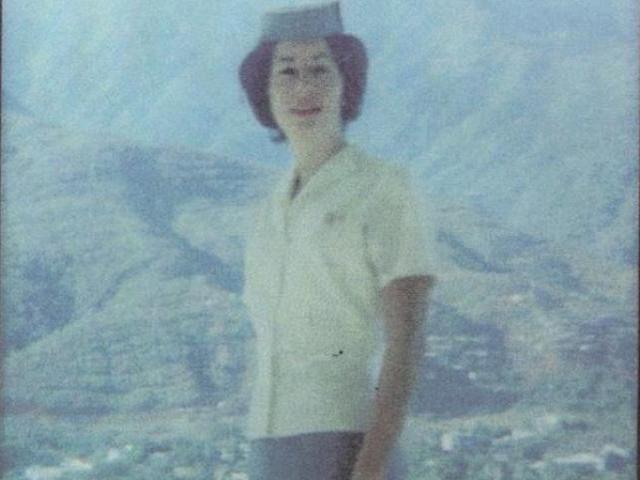
In 1961, I was fortunate enough to be hired as a flight attendant with National Airlines until 1992, when I was made a supervisor of flight attendants for seven years. When Pan American acquired National, I was a purser for them until 2002. I loved all 30 years of flying and looked forward to every trip. My daughter is a flight attendant with Delta and also loves it. My son is in New York becoming a lawyer.

It was a big shock when Pan Am went out of business, and I had to find a new career, which turned out to be in the hotel industry. I became a manager of housekeeping for the Seaview Hotel, then the Grand Bay Hotel, and then Fisher Island. Then I was fortunate enough to receive a call from Royal Caribbean and asked to be a facilities consultant. I traveled to all the ships to teach cleaning and equipment use. Unfortunately, due to the economic situation, several of us were let go.

As you can see, Miami has been very good to me and my parents. “Thank you” to the USA for having accepted us, and allowing us to be able to live here in this great country.

In the years shortly after World War II, my father who was born in Greece would make numerous trips to Miami Beach on vacation. He became a sun worshiper and could not get enough of the sand and sea.

In 1948, he sold his apparel business to his brothers and made Miami Beach his home. Our first apartment was on South Beach facing the ocean on Ocean Drive. Starting at age 3, I knew my daily routine would include an afternoon trip to the beach.

About that time, my father purchased an apartment house, The Indian Creek Manor, on the corner of 67th Street and Harding Avenue. The parking lot was adjacent to the original Pumpernick’s restaurant and a half block from the McFadden Deauville Hotel, which at that time boasted the largest swimming pool in the United States.

My Uncle Dave also fell in love with Florida. He purchased the Rivera Ocean Villa Apartments on the ocean. This is the spot where the current Deauville now stands.

I attended Miss D’s Nursery School until we moved to a new housing development called Golden Shores. This was just south of Golden Beach on A1A. This area quickly became Motel Row, but at that time, A1A was a two-lane road.

A popular restaurant called Grandma’s Kitchen was on the corner of Collins Avenue and 163rd Street.

When I turned 6, I attended Biscayne Elementary School on Dickens Avenue and 77th Street. I attended Nautilus Junior High, Miami Beach High, Miami Dade College and Florida International University.

My years at Beach High were some of the most memorable. Although I was one of the poorest kids in the school, it didn’t matter. My friends had cars and boats, cabanas at the better hotels, and houses with pools and even an extra bedroom if I needed it.

After school, each weekend and summer vacations I worked as a pool boy/lifeguard, up and down the strip — the St. Moritz, Surfcomber, Sands, Carillon, Sterling and others.

While at Miami Dade College, I worked as a delivery boy for Surf Drugs on 74th and Collins.

The area around 48th Street was our hangout. When I wasn’t working, this is where my friends and I would be. At night, we would cruise Collins Avenue, grab a pizza at Fun Fair and eventually wind up at Wolfies 21 on Collins Avenue.

I usually had only enough money for a cup of coffee but would eat an entire bowl of cole slaw and pickles that were on the table. On occasion, when we felt brave enough, we would invade another school’s turf to get the world’s best French fries at a new drive-in called McDonald’s.

I’ve never left South Florida. Over the years, I turned down offers to relocate to Los Angeles and other cities. I met my wife Carol while attending college in Miami. We just celebrated our 42nd anniversary.

We have raised two daughters here and have three grandchildren.

Whenever I have the occasion to be on Miami Beach, it’s like a homecoming. Every corner holds a special memory. Like my father, I still have sand in my shoes.

I came to Miami Beach as a New York transplant along with my father Irwin, mother Fay and older brother George.

Dad was a self-taught gentleman with a sixth-grade education. Our small library was filled with Reader’s Digest books and the music of the classics. When we arrived here in 1944, the only place we could find to rent was an efficiency at 1417 Collins Avenue. I can never forget this place because in the same bed I shared with my brother, we twice found scorpions.

Dad’s first job in this beautiful resort town was working as a bookie for an illicit gambling syndicate in the South Florida area. Dad didn’t want to embarrass his family by getting arrested; fortunately the opportunity to start a fruitful career in the hotel industry came upon him.

Starting as a hotel clerk at the Edison Hotel on Ocean Drive, he quickly rose to the position of manager. I was 11 years old at the time, enjoying being able to hang out with my dad often. This is where I spent my first hurricane, helping to feed hotel guests. We opened the coffee shop with our family doing our best to operate it, with me taking the orders.

I learned a lot at that old hotel. I could run the telephone switchboard, the elevator (they were manually run), and could even man the desk to sign in the guests. As a matter of fact, that is exactly what I did on V – J (Victory over Japan) Day in 1945, when the war ended. All the staff went out to celebrate, leaving me in charge to manage the hotel. It wasn’t too long as I remember, that Dad started his move north on Collins Avenue.

The next hotel was called the Alamac. There, I learned to dance the tango at the age of 12. This beautiful blond lady who had a dance studio on the premises asked if I would like to learn. Since I I had a crush on this woman, I jumped at the chance. She had me dance with her in the evening, on the patio, where the guests enjoyed the beautiful weather. I believe she wanted to show that if she could teach a 12-year-old boy to tango then anyone could learn.

The next hotels up the line were small, twin, side-by-side structures on Collins Avenue called the Seacomber and the Surfcomber. Dad managed both at the same time. Next came a hotel south of what became the Fontainebleau . Dad’s new position was to run the Sovereign Hotel where again, I occasionally had a chance to help operate a telephone switchboard. I had a chance to meet some celebrities such Una Merkel and Charles Atlas, the bodybuilder featured on the back cover of so many comic books and magazines touting his exercise program.

Later on, the last of the hotels in my father’s career turned out to be The Raleigh, at 17th Street and Collins Avenue. It wasn’t as famous as it is today, but it was a beautiful place.

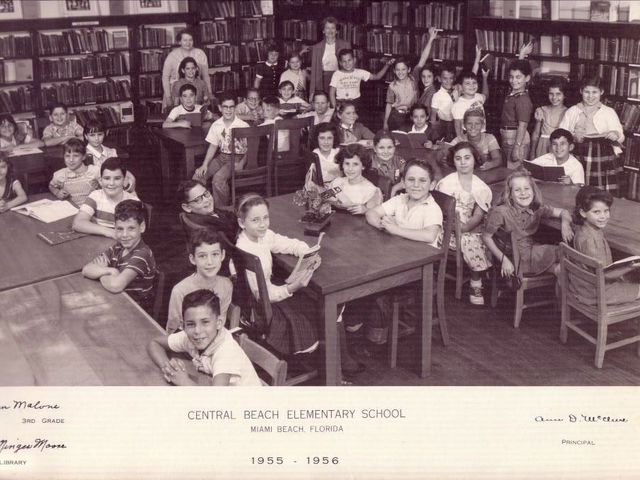
I started schools in Miami Beach at Central Beach Elementary, moving on to Ida M. Fisher Junior High, and Miami Beach Senior High at the same location. At lunch time, my friends and I would go to the Dolly Madison ice cream parlor on Española Way. Next door was a place where I would play the pinball machines and buy comic books throughout the ninth grade.

With a love for photography, I was able to convince my parents to let me attend Lindsey Hopkins vocational school (which at that time was called Miami Technical High) for 10th through 12th grades. While in school, I had part-time jobs at several movie theaters in the area; I ushered at the Beach, Lincoln, and Sheridan theaters. The pay then was 35 cents an hour.

We eventually moved out of the efficiency and rented apartments on Marseille Drive in Normandy Isle. We were close enough that my mother would suggest that she and I go fishing at all hours of the night on the 79th Street Causeway bridge. These were some of the most memorable nights I remember about my late mother.

When I got my driver’s license and dated, friends and I would travel around town to places such as the Big Wheel drive-in where we could get a whole bag of French fries for $1. We would go bowling at the Coliseum on 16th Street and Douglas Road, or across from the old Sears store at 13th Street off of Biscayne Boulevard. Swimming at the Venetian Pool was a must for me and my date. We loved the grotto cave where we could “neck” (just a lot of kissing).

After high school, I entered the military, got married, and after nine years of service returned with two sons to the place I loved the most, Miami. In the years that followed, my careers have taken me from being a business owner of “Herb’s T.V.” for over 25 years, to teaching high school starting at the age of 55 for another 19, at Miami Jackson, and later, Hialeah High.

Now as a great-grandfather of two, I am living my retirement years in South Florida where I belong. Recently, I was at a North Miami car dealership, and found on the wall a very large B&W; picture taken circa 1945 of the Edison Hotel, my dad’s first manager’s job; I could not get over it.

This is an interesting story about a creative, talented man (my dearest husband of 50 years), Herbert Marks. He had an office on Lincoln Road for 60 years. His talent for show business started as a boy when his family had a theater in Boston where they had movies and let talent try out.

When Morris Landsberg had five hotels, Herbert produced full-length Broadway shows and he had all guests come to the Deauville to see the productions. Leon Leonidoff from Radio City Music Hall designed the stage.

Herbert also had a Lou Walters review at the Carillon and, of course, big bands at all the hotels. Herbert supplied talent for [Jackie] Gleason and booked big names into the Olympia Theater. He booked shows at the Indian Creek Club, private clubs, La Gorce Surf, the exclusive Everglades in Palm Beach, the Whitelaw Hotel and Boca Raton Hotel.

Herbert also supplied talent for big conventions. He got Sammy Davis for an automobile convention. He also provided entertainment for the children’s wear conventions, started in the ’60s by Sam Kantor.

Herbert managed the McGuire Sisters and got them on the Arthur Godfrey show. He had water shows at the McFadden Hotel (now the Deauville), was the booking agent for the Olympia Theater (where I danced many times) and supplied the talent for Miss Universe. Once, he took the producers to see a circus act and the car got stuck in the mud, but the elephants lifted the car up. Herbert also helped Bob Hope produce shows in Miami to raise money for Parkinson’s Disease.

It’s good to remember the heyday of Miami and Miami Beach. I am 92 and enjoy the memories of the Golden Era here.

A few tidbits about me: I was a dancer. I was the opening act for Dean Martin and Alan King. When I worked with Dean in Philadelphia we used to go dancing after hours. He did not drink whiskey but did drink iced tea. He put on the act of drinking all the time, but that was not true. He proposed to me then. I was too young to take that responsibility. It would have been fun I’m sure, but my mom said no. I kept in touch with him and called him years later when he and his family were interviewed by Edward R. Murrow (in Philly).

I continued working many nightclubs in Miami and Miami Beach, including the Copacabana, which was run by Bill Miller, and the Kitty Davis Airliner, which was a very popular club down here in Miami Beach. The service men loved going there. I was also voted “Miss Olympia.”

The Biltmore Hotel was a veteran’s hospital and I volunteered there as a “gray lady,” which was what we were called. We’d write letters and read to the boys. I loved it there trying to make the soldiers happy. Everything I did for the soldiers and the officer’s club was great fun for me and the servicemen. I did shows for every branch of the service.

Well, when I got married in 1947 my dancing days were over, though my husband and I were still going to the Eden Roc and Fontainebleau for dinner and dancing. We joined the Palm Beach Club, which attracted many celebrities. We also joined the Jockey Club as I was an avid tennis player up until a short time ago.

We had a son, Randy, who worked for the city for 25 years and is now retired.

Several years ago, Alan King was here at the Fontainebleau and I called him. He used to follow Dean and me around. He told me that who he was really following was me! I didn’t know. That’s why they say that youth is wasted on the young.

As it happens with all the affections destined to last, my love for Miami was initially tentative, and needed time to mature. Since my childhood, living in Argentina, I associated South Florida with intrepid pirates raiding the Caribbean waters.

Its name awakened the traveler in me, that wanderer that we children of immigrants carry in our hearts.

Miami was the preferred place to vacation for friends and relatives, those fortunate enough to be able to afford a trip overseas, but I had dreamed of visiting Disneyland in California unattainable for a modest-means family such as mine.

As a child years later, when the world of wonders that was Disneyworld opened in Orlando, I was certain that someday, somehow, I would get there.

Further down the road, in the early 1980s, the TV show “Miami Vice” was a somber global ambassador and tourist guide for all of us who never set foot in Florida. In 1987, when my husband Tomás Jakovljevic and I decided to accept the long-standing job offer from his family to move to Cleveland, Ohio, to work at his brother’s construction company, a friend asked: “Are you sure you want to stop in Miami? Keep in mind that there is a lot of violence there, drugs and weird people – and your daughter is only eight years old.”

At the time, our relatives living in Ohio did not dare risk coming down farther than Orlando, worried of a vaguely threatening environment, foreign to them as much in culture as in language, known through police news reports. The fact that some urban areas of Cleveland at the time were perhaps more violent and dangerous than Miami did not cross their minds.

So, the Caribbean was calling, and the three of us landed in Miami in April 1987. The city embraced us with a gulp of tropical air as soon as the doors of the airport flung open, a delightful welcome since we just had left Bariloche, a small winter tourist city at the foot of the Andes, in Patagonia.

We felt exhausted after severing all our physical ties to our old life – family, friends, home, school, and business, but we were sure it was the best for us and, in particular, for our daughter Adriana.

We called a taxi and asked to be taken downtown. The best way to know a city, in our experience, is to see its oldest parts, and check how it is maintained. Miami was a disappointment. It was flat, irregular, unkempt.

Nonetheless, some changes were sprouting here and there, like the metro mover and the recently opened Bayside with its nearby park. We stayed overnight in an old hotel – now demolished – right across Biscayne Boulevard. The next day we rented a car and decided to move near the beach. We found the perfect place driving through the almost deserted South Beach with its beautiful and faded art deco buildings.

The hotel was called The Netherland, and it was well kept and cared for by its owners, a nice Cuban family. The reception area had big openings with light, gauze drapes swinging in the breeze. Several fans hung from the ceiling over big pots sporting luscious plants. The intensity of the sea behind the palm trees through the windows of the efficiency won us over. I wished to be a painter to reflect on canvas the pastel beauty that surrounded us, the languorous palms, the elderly sitting on their rocking chairs in the shade of the verandas. The quiet beauty of the place conquered our hearts.

The hotel was home base for our sightseeing trips. We stayed for three weeks, alternating between visiting nearby points, and resting on the beach or at the pool. A few days after our arrival, Adriana asked, puzzled: “Dad, when are the Americans going to start speaking English?” He laughed and answered: “When we get further North.”

Three times we drove to Disneyworld. The child I was once, dreaming of visiting Disneyland, finally got her wish, and the adolescent reader of adventures reached the turquoise, fantastic waters of those fabled Caribbean pirates. Adriana was fascinated.

Through the years we would return often, witnessing the changes that, to us, wiped away much of that Miami soul that we got to enjoy briefly. The Beach’s commercial and gastronomic renaissance, with its visitors from the American gay culture, gave a touch of pizzaz and cosmopoltanism to our vacation days.

Every couple of years the three of us would immerse happily in a feast of the senses, being among people from all over the world. Our ears delighted in the variety and musicality of the unintelligible languages and our eyes admired the toned and tanned bodies and the famous faces parading in the evenings in front of the cafés.

The old and abandoned downtown had its rebirth, too, opening during daytime in a thousand shades, like tropical hibiscus, to fold down in the evenings under metallic fences.

Then, one day by the end of 2000 we bought a home in Miami-Dade, and in March of 2001 we packed all our home belongings in a U-Haul and drove down to live under the palm trees in a quaint, bird-sanctuary neighborhood called the Village of Biscayne Park. We started anew jobs, friends and outdoor life.

My husband took the plain, abandoned – but structurally sound – house and, slowly and all by himself, designed and transformed into a modern, very comfortable Floridia home.

Our daughter Adriana left for graduate school, got her degree and married a bright Connecticut man with whom they had a beautiful baby girl, Sofía, last February.

In my spare time, I go back to my long abandoned manuscripts and find a lively, interesting, vibrant literary life in writing groups, conferences, and book presentations around the city.

So we will stay happily in Miami, to share good and bad times, dodge dangerous summer storms, enjoy the peaceful evenings next to warm tropical waters and take in the luxurious pleasure of feeling the perfume of native flowers in the winter time.

Certain deep loves mature slowly, but they are meant to be forever, as the song goes.

The Village of Biscayne Park was, during the ’50s and ’60s, a residential community of small neighborhoods squeezed between Miami Shores and North Miami. A single block would house a group of families who were as familiar with one another as they were with close relatives.

In the period following World War II, there were a great many such neighborhoods with adults and children of similar ages. The Baby Boomers were booming.

Children played together in the street and adults had regular barbecues and canasta parties. Everyone knew everyone else on the block. Children spent Saturdays at the Shores Theater. A matinee would have two westerns and possibly 20 cartoons. An afternoon’s entertainment could be had for less than 50 cents. Since we were living in a two-bedroom house, I credit those long matinees for giving my parents enough time to give me a brother to harass.

Polio was very much a part of our lives back then. Two kids on our block were stricken and paralyzed for life. I was playing cards on the living room floor with a friend when she tried to get up and couldn’t. She was rushed to the hospital, where she and her parents got the bad news.

Young children from Biscayne Park attended Miami Shores Elementary, William Jennings Bryan or one of the two Catholic parochial schools nearby. You could walk to the North Miami Zoo — until it was torn down to make way for North Miami Junior High. Their tiger mascot was selected since the school auditorium was built on the site of the old tiger cage.

An evening out might be a trip to Marcella’s Italian Restaurant on West Dixie Highway or up to Nohlgren’s Painted Horse on Biscayne Boulevard for their 99-cent all-you-can-eat special. On a very special occasion, you might be treated with a trip to the Lighthouse Restaurant at the northern side of Haulover Cut. The Lighthouse had green sea turtles in cement-walled aquariums next to the dining room and a large wood-carved 3-D relief of an underwater scene between the bar and waiting area. It had a back patio on the ocean.

During summer vacation time, families would regularly scout the Miami Herald hotel ads to find the best deals on Miami Beach. Our family of four could spend an entire weekend in an air-conditioned room for $20. The hotels would have a pool and beach access. My family would regularly stay at the Carousel Motel, which had a small mechanical carousel out front.

Entertainment was simple. We had radio. One person on our block had the first television, and the neighborhood kids would gather around in his living room to watch westerns and old horror films, the latter presented by Miami’s own M.T. Graves.

When my family finally got a console TV, I had the pleasure of traveling with my dad to the Eagle Army-Navy store in North Miami to use their tube tester. We would walk in with a brown paper bag full of vacuum tubes and we would proceed to test each one.

The Army-Navy was next door to Royal Castle, famous for its nickel birch beer and 15-cent hamburgers. I would later work at that “RC Steakhouse.” I was behind the counter in 1963 when the manager came in to tell us that President John F. Kennedy had been shot. We listened to the radio until we heard that the president had died. Everyone remembers where he or she was on that day.

My grandmother lived on Northeast 31st Street. We would visit her often and I would do odd chores around the house. When I was finished, I could visit my grandmother’s neighbors, one of whom was a tinkerer/sculptor and had a little workshop in his garage. I was always fascinated with his little projects.

Shopping during the 1950s generally meant a trip to downtown Miami. Such trips in late November and early December could mean only one thing, Burdines. They had a giant illuminated Santa on the Miami Avenue crossover, and the west-building roof had a small carnival with rides for kids. Moms would drop off their children while they shopped. The other major shopping venue was Shell’s City (aka Shell’s Super Store) on Seventh Avenue and 58th Street.

Another of our family’s regular vacations consisted of trips to Key West to visit my aunt. We would drive from our house all the way on U.S. 1, the only route. Bridges were narrow and the guardrails were rails from the old Florida East Coast Railway, destroyed by the Labor Day hurricane of 1935, before my time. On the way down, we would stop at Shorty’s Bar-B-Q in Miami or Sid and Roxie’s Green Turtle Inn on Islamorada.

Dade County Junior College opened officially in 1959 at Central High, but didn’t have a real campus until 1963. They opened Building A, later called Scott Hall, at the old Naval Air Station. I commuted to the campus daily, along with 30,000 other kids in 1963. My drive down Northwest 119th Street took me past the old Bottle Cap Inn and the Tomboy Club.

Miami life was simple when the white and yellow pages fit in one book.

In various cultures, grandparents have been seen as a rich treasure. A grandparent’s life is one to be mined for the depths of riches shared in the form of unique stories.

One example was the late Winifred Ann Jackson Herzog, my own beloved grandmother. This is an account about how she led a motorcycle club across the $30 million Overseas Highway to Key West as part of the official opening ceremonies of July 2-4, 1938.

My grandmother was born in Richmond, Virginia, in May 1919. From her early years, Nana, as I called her, had many wonderful anecdotes which she shared before she passed in 2008.

Foremost among these was the role she played in the Key West festivities of July 1938. It was remarkable from both a historical and societal perspective. She helped Miami to do its part in carrying out a three-day holiday dubbed the “Gala Fiesta” in local newspaper accounts.

That year, the nation and particularly the Key West area was still suffering from the devastating effects of the Great Depression. The national unemployment rate was 19 percent. The morale boost from the manufacturing drive of World War II was just over the horizon as was the “Rosie the Riveter” campaign to promote contributions of women in shipyards and factories.

It was thus no small feat which occurred on Saturday, July 2, 1938, when my grandmother was 19. That day was when she set out to lead the Miami Motorcycle Club along with a special motorcade of city residents in making the trip from Miami to Key West. Nana rode the lead motorcycle, which was an Indian Four model.

Just how did she find herself leading this motorcade? As recalled by my family, Nana had met John Hays Long, my future grandfather, some months prior to this event. At the time, she had a job “hopping curb” at Pixie’s Ice-Cream Parlor. She served customers while wearing roller skates.

Nana had close friends named Thelma and Doris. Their brother, James, had given her a “basket case” motorcycle to take in for repair. The business she chose for service was none other than Long Motorcycle Sales in Miami. That is how she met John, the founding owner of the business and her future husband. (They would end up married the next year.) After meeting John, my grandmother grew interested in motorcycle club activities.

A few months later, local newspapers prominently featured the meticulous planning leading up to the three-day fiesta. The Miami Herald of July 1 reported that more than 1,000 people were expected to participate in the Miami motorcade sponsored by the Key West Club of Dade County. My grandmother led this group when they started out for Key West at 1 p.m. from the intersection of Northeast 55th Street and Biscayne Boulevard.

The Miami Daily News of July 2 reported: “This was the largest single motorized caravan expected to pass over the new highway during the celebration. Headed by a special motorcycle escort, the nomads of the open road traveled at a moderate pace through lanes of curious onlookers who assembled in the small communities along the route.”

In setting the context, it is important to consider details shared by my grandmother years later. In the 1990s, Nana told me that the motorcycle club members wore unique garb when you consider the perceptions of bikers in more recent times (such as the Marlon Brando look). Each club member wore a scarlet tunic or shirt along with khaki jodhpurs and riding boots.

Their mission was clear: to lead Miami residents in joining official ceremonies marking the occasion. This in turn provided a much needed “shot in the arm” for the state and nation. The festivities included inspections of U.S. and Cuban warships (with no cameras allowed), wrestling matches, a motorboat regatta, fireworks displays, and all-night dancing at a special “queen’s ball.” Amateur boxing matches were even held between Miami and Cuban fighters. The referee presiding over the fights was Ernest Hemingway.

Nana led the Miami motorcade for the approximately 130-mile trip from Miami to the awe-inspiring backdrop of the Bahia Honda Bridge, some 65 feet above the water. The ribbon cutting was held at 5 p.m. on July 2. The mayor of Key West, state and federal officials, and a representative from the Cuban government were in attendance. Bernice Brantley — the woman who had been previously designated “Miss Key West” — was given the honor of cutting a 60-foot, red, white and blue ribbon that stretched across the bridge.

The motorcade participants then drove the remaining 50 miles from the bridge to Key West, arriving there at approximately 6 p.m., July 2. As my grandmother resumed the lead position, more excitement awaited ahead. The Miami Herald of July 3 reported: “Led by members of the Miami Motorcycle club, the mammoth parade moved into Key West. From the entrance to the city limits on Roosevelt Boulevard down the broad expanse of this thoroughfare to Division Street and then on down to Duval Street the motorcade was greeted by a wild, cheering throng.”

The July 4 Herald reported that 10,000 people lined the streets to greet the motorcade. The importance of the festivities was underscored as follows: “Key West, once the state’s largest city, lost its importance years ago and its industries slipped away and was rendered destitute by the 1935 Labor Day Hurricane that destroyed the Overseas railway.”

Looking back now, it is interesting to note that Long Motorcycle Sales has continued to stay in business until this this day. During World War II, Nana helped to run the dealership with help from her father, William “Bill” Jackson. They kept the dealership running while Nana’s husband, John, served in the U.S. Army. In 1946, Nana and John were divorced. Today the business is located at 800 NW 12th Ave. in Miami and the family legacy is carried on by John A. Long, my uncle.

Translate »