Skip to content
Named Best Museum 2022
by Miami New Times

In the winter of 1915, a wealthy widow visited South Florida with her nurse to escape the harsh Canadian weather. That lady was my maternal great-grandmother, Mary Long Byrnes, from Collingwood, Ontario. Mrs. Byrnes was delighted by the tropical climate and decided to stay the season at the old Green Tree Inn in downtown Miami.

My father, James Edward Sheehan, traveled to Miami from Bedford, New York, where he had already built a successful contracting business. As with so many Florida pioneers, he was seeking new opportunity in this town of 5,000 residents and he also lodged at the Green Tree Inn.

The elderly lady and the young man met, and struck up a close friendship over many conversations rocking on the Green Tree porch.  They were kindred spirits, very proud of their Irish heritage. Also both Mary Byrnes and James Sheehan were devout Catholics and attended the Church of the Holy Name (now known as GESU Catholic Church, located at its original site in downtown Miami).  

Mrs. Byrnes invited James to visit her large and lovely home called Balcaris in Collingwood during the summer, and he accepted. She was quite a matchmaker! She introduced James to her beautiful grand-daughter, my mother, Mary Frances Byrnes, and the two fell in love.  James visited Mary several times in Collingwood over the summer, each time requiring two weeks to travel by boat and train. They married in the fall of 1916 at St. Mary’s Catholic Church in Collingwood and moved to Mt. Kisco, New York.    

After the birth of Margaret in 1917 and James in 1922, my father felt again that strong attraction to Miami and the family came south.  Pauline was born in 1925, and Joseph arrived in 1929. I was born in between in 1926 at Victoria Hospital, within one week after the fierce hurricane that devastated South Florida and destroyed the roof of our home.

I would like you to know about another family member, my paternal grandmother, Margaret Curtin Sheehan.  She was born in Ireland, emigrated at age 11, and had limited formal education.  But starting in 1904, she regularly bought and sold land parcels to build the family fortune. It was grandmother Sheehan who moved the family business enterprise from New York. As a youngster, I sometimes accompanied her on visits to attorneys and bankers, and witnessed their great respect for her ideas and plans.  What an example as an entrepreneur she must have set for my father, to encourage his interest in acquiring and building Florida real estate!

Dad loved to build family homes, and he had decided to concentrate on the Riverside area, north of Flagler Street and south of the Miami River.  His first home in 1922 was known as Presume, because he was so confident of the city’s future growth that he presumed there would be many others.

My father was a man of integrity and courage, who set high standards for himself and his children.  One of his classic statements that we heard often was, “How few people know how little is enough!” It was not just the family that he influenced: he often wrote to presidents, governors, mayors, bishops and priests praising or criticizing their policies.  

All of us children attended St. Catherine’s Academy, later known as GESU School, and we were taught by the Sisters of St. Joseph from St. Augustine. The GESU Catholic Church was staffed by Jesuits, and I remember stories about Fr. James McLaughlin, who was pastor from 1914 until 1929. Bishop Michael Curley, who at 34 was the youngest bishop in the United States, had visited Miami in 1915 and encouraged the parishioners to envision a great future for Miami. Then it was under Fr. McLaughlin’s leadership that funds were raised to build GESU’s magnificent edifice in 1926 with stained-glass windows from Bavaria and statuary from Italy.

As we children became adults, aviation was an important part of our family careers.  James served during World War II as a pilot, and later joined Pan American Airlines. Margaret worked for Pan Am and later married a pilot. Joe worked many years for Eastern Airlines.  Pauline’s two daughters married into a family of pioneers in private aviation.  

My life took a very different turn:  I discerned a vocation to become a Catholic priest and was ordained in 1956.  Most of my 60 years of joyful pastoral ministry were spent in Alabama, concluding with 12 years as rector of St. Paul’s Cathedral in Birmingham.  I was also privileged to serve the U.S. Catholic Bishops in Washington, D.C. as liaison for Ecumenical Relations to Orthodox and Protestant Christians. By far, the most memorable events were meeting Pope Saint John Paul II on his first visit to the United States, and years later, concelebrating Mass with him in a Vatican chapel. Now retired, I live in Central Florida and serve at St. Catherine’s Catholic Church in Sebring.

Although I do experience culture shock whenever I return to Miami, I can marvel at how the city has absorbed and benefitted from many different national and ethnic groups. Beginning in the early 1960s, Miami has “welcomed the stranger” with great compassion. My beloved GESU Catholic Church used the adjacent school building to assist refugees and exiles from the Caribbean and Latin America with medical and dental services, child and elder care, job searches, immigration assistance, language training, family counseling, and much more.   

Miami has experienced many challenges in the past century, and I pray that the Lord will continue to bless this wonderful city with bright sunshine and warm hearts!

“Tonight we launch — where shall we anchor?”

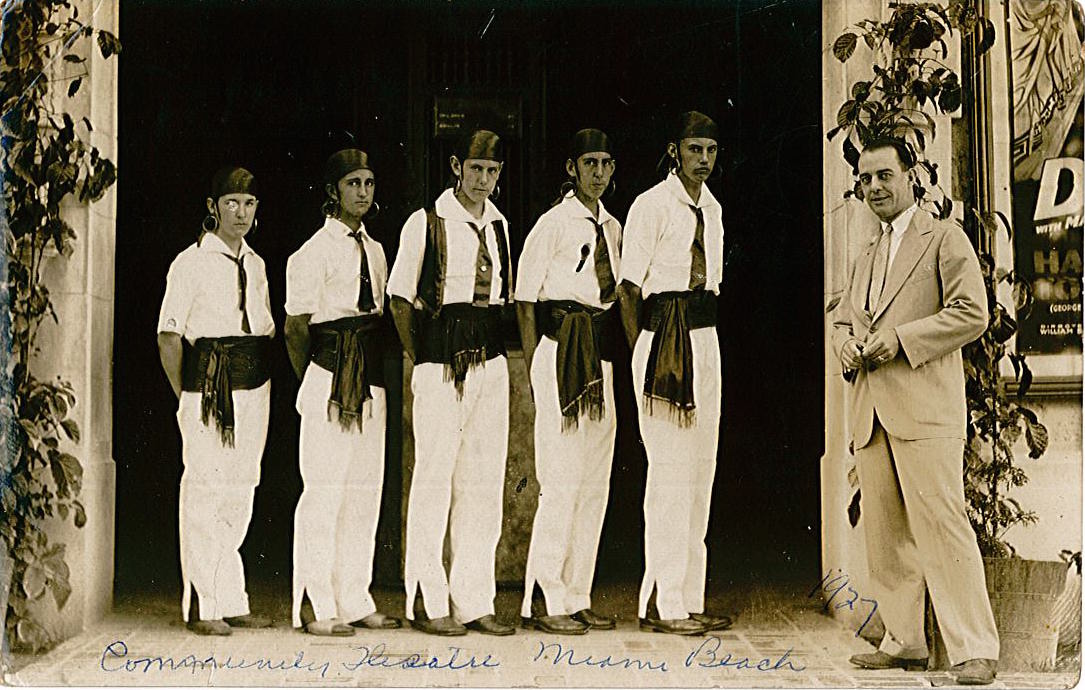
This was the motto chosen by the first graduating class at the new Ida M. Fisher High School in 1927, when the five graduates were honored with their diplomas.

My mother, Helen E. Johnson, was the class president and her friend Veronica was the secretary/treasurer. Later, Mother wrote in her memoir, “When our senior year began in September 1926, there were twenty-three students; eighteen left Miami Beach before graduation. We held classes in the open concrete rooms on Washington Avenue without desks. Moveable screens separated the classes. The coach’s wife ran a sandwich and drink lunch counter in one of the back rooms. We were glad to be in a hot climate [though] no windows [had been installed]. The teachers were wonderful to endure this [during construction].”

The first yearbook, “The Kingfisher,” in 1927, was a paper-printed edition published by the journalism class. The following year the title was changed to “The Hourglass,” and in 1928, it became “The Typhoon.” The small school was filled with activities, athletics and clubs, despite the few students. The building had a central courtyard where all students could mingle.

Just before graduation, Veronica and Mother went to a hair stylist in Miami for their own personal style, “wind-blown.” The junior/senior banquet was held at the Wofford Hotel. Veronica’s parents treated the class to an outdoor luxury dinner at The Biltmore in Coral Gables where the class held their senior dance. My mother drove everyone from the Beach to Coral Gables (more than an hour trip each way) in the family’s Jewett touring car, which accommodated the class and their dates.

My grandparents, Alma and Theo Johnson (known to everyone as Mom and Pop), drove to Miami Beach in September 1924 with four of their six children. Pop came to Miami Beach to partner with his brother, Richard Johnson, who was buying and developing properties on the Beach. Little housing was available for a large family when they first arrived with their four sons. Helen and Dorothy (my mother and her sister) stayed in Ohio while Mom, Pop and the boys stayed in a Quonset hut on Fisher Island until Pop built a place for the family.

In her memoir my mother recalled her trip south: “My sister Dot and I [wore] winter coats, hats and boots, not knowing what to expect. We traveled on the Big 4 train from Columbus to Cincinnati and changed to a Pullman sleeper. During breakfast in Atlanta, switching [train] cars was so jerky we could only get half a cup of hot chocolate.”

By the second night, they were in Jacksonville. They boarded Henry Flagler’s Florida East Coast Railroad, with a stop in Ft. Lauderdale (population about 1,500), where Mother and Dot put on their summer clothes. They arrived in the middle of Miami and were met by Pop in his Model A Ford.

Pop was building a warehouse to cover the hardwood flooring used in construction. It was located on Surprise Lake, the locale near what was to become the future Miami Heart Institute. This warehouse became the living quarters for my mother’s family and for the workmen and was aptly named, “the Barracks.”

“Mom cooked three meals a day for everyone and did all the laundry. No wonder she was not so happy in Miami,” Mother wrote in her memoir. “She’d left her church, her lifelong friends and relatives in Ohio, and was lonely, because she did nothing but work, cook, and do laundry.”

My great-uncle Richard was the wealth seeker in the Johnson family. In Columbus, OH , he owned and operated a hat factory before he became a promoter for Carl Fisher on Miami Beach. His office was located in the Bastian Building on Lincoln Road. His wife Dorothy changed her name to “Dorothea” when they moved to Miami Beach with their only child Gwendolyn. My mother and Gwyn were close in age, so Mother often accompanied her to parties and dances where she met many of Gwyn’s socialite friends.

“When school was out, Pop and two of my brothers stayed on the Beach to work on the apartment Pop was building, the Avocado.” In the fall, Mom, Pop and the rest of the family went to Pennsylvania to visit relatives. During the Pennsylvania visit, the 1926 hurricane hit Miami. Pop left immediately and drove to Miami Beach to assess the damage to the Avocado. In Mother’s memoir, she recalled, “There was little water damage to the hardwood floors and some damage to our solar hot water heater system on the roof.” He returned, picked up Mom and the boys and drove back to Miami Beach. My mother and her sister went by train to join them.

“When we arrived, we were amazed, seeing barges tossed in the interurban track in the middle of the causeway from the storm. The roadway looked like waves. The Australian pines on Pine Tree Drive were practically wiped clean of all foliage, but Pop’s ‘Avocado Apartments’ withstood the storm and the following hurricane that finished off many of the buildings partially damaged by the ’26 storm. He was an excellent builder.

“By November ’26, the Avocado was ready for occupancy. Before renters arrived, I was allowed to have a party in the front [apartment].” Mother described the Avocado: “Eight apartments on two floors off a main hall, each with a sun room, living room, dining area, kitchen, bathroom and one bedroom…all furnished including dishes and linens, love seats and couches that could be converted so each apartment could sleep up to six people.” All came with housekeeping. “However, on Miami Beach, housekeepers of color had to leave the Beach by 5 p.m.” Mother’s family moved into the two-bedroom apartment over the two-car garage at the rear of the building. Mom and Pop occupied one bedroom; my mother and her sister shared the other one. The boys bedded in the sun room and living room.

Life was good on Miami Beach for my mother’s family until two events brought Beach living to an abrupt end. Just as Mother was graduating from Ida M. Fisher, Pop’s business manager in Ohio pilfered the profits from his heating and sheet metal business, and then Pop’s brother, Richard (holder of the property deeds for their lots and buildings), entered a poker game with Carl Fisher. He used the deeds as collateral, lost the game and all the holdings, leaving no home for my mother or her family on Miami Beach. Thus, the return to Ohio began.

After several decades in Ohio, Mom and Pop moved back to South Florida, but not to Miami. They chose that “small town” where my mother and her sister changed into summer clothes on their first train trip. My parents joined them in the Riverland area of Ft. Lauderdale years later. Three of Mom and Pop’s children and their children and great-grandchildren made South Florida their permanent residence, and I chose Miami, my home now for nearly 40 years.

The story begins with two people, Mary and Ed.  Both born normal healthy babies, Mary in January 1913 and Ed in July 1915.

Mary was the fifth child of Cecilia and Sam Silverman.  She had an older brother and three older sisters to love her and help take care of her. Following Mary came three more sisters and one brother.

Ed was the fifth child of Bessie and Max Holowitz. There were two older brothers and two older sisters to welcome Ed into this world.

Growing up with immigrant parents, their lives in Brooklyn were fairly typical in those days.  

The summer of 1916 changed everything.  An epidemic of polio consumed New York.  It affected almost every family, including the Silverman and Holowitz families.  Both Mary and Ed were struck with the virus and were left crippled.  Mary had no use of either of her legs, and Ed had just learned to walk when his right leg became paralyzed.  From the age of 3, Mary wore a brace on her right leg and had to walk with crutches.  Ed also wore a brace on the right leg. There was very little known of the disease at that time and doctors could do nothing to restore the muscles that had died.

Instead of feeling sorry for herself or being pampered by her siblings, Mary was treated as any other child and encouraged to do her share of the chores, have self-confidence and learn to use her head so she wouldn’t have to use her legs.  

Mary was the only one in her family to graduate high school and she did this with honors.  Her hands were golden; she had excellent clerical skills.  She held a prestigious secretarial job in Manhattan and traveled daily by subway from Brooklyn to get to that job.  Going up and down flights of stairs, walking blocks and blocks, was just part of what had to be done.  Snow, ice and all sorts of inclement weather never stopped her.

Ed had a rather different upbringing.  His family was ashamed of his illness and kept him in the background for the most part.  His family did encourage schooling and all the men, four in total, did graduate college and the two sisters graduated from high school. The family was strong, stubborn, loud, opinionated and vocal.   

Mary joined a social group for the handicapped and that’s where she met Ed. It was a wonderful group of people.  They tried to do everything “normal” teenagers and young people did.

Ed and Mary fell in love and married in 1936. Ed continued putting himself through college and holding one or more jobs. Mary also continued working until two years later when Cecile (“Cissy”) was born.

With Mary’s handicap taking care of an infant was not easy.  Ed’s sisters even threatened to take the baby from her because they said she would never be able to raise a child.

She could not walk and carry a baby at the same time since she needed her arms to support her on the crutches, so she kept a carriage in the apartment and wheeled the baby from room to room.  She had no trouble with cooking, cleaning or any other household chore because she was the mother of invention.  She found a way of doing everything.   

When Ed passed the CPA exam on his first try, he went to his older brother, who was an established CPA with his own practice in Manhattan, and asked for a job.  He was turned down flat.  He was told because of his handicap he would not make a good appearance in the office.

Mary cried for days when she found out she was pregnant for the second time.  How was she ever going to take care of two babies just 28 months apart?  She gave birth to another girl, Marcia, and once again, she did what she had to do.

Ed did get a very good job and the family prospered and was very happy. Ed learned to drive and bought his first car, a 1945 Chevy. Mary’s family always lived nearby and could be called on in an emergency, but it always seemed they would ask her to help them rather than the other way around.

The two girls were brought up to be a very independent, learning to do things for themselves and especially helping in the house.

Mary’s eldest sister and her family had moved to Florida after the war.  In the terrible winter of 1947 the family packed and left for Florida to attend Cousin Seymour’s wedding.  They arrived in Miami to find sunshine and 75-degree weather.  “I think we are in heaven!” they cried. Then and there they decided to make moving to Miami a goal.  That goal was achieved just one year later in May of 1948.  With only $1,500 to their name and no job prospects they arrived all full of moxie and hope.

Ed went to work for an accountant while studying for the Florida CPA exam.  He passed easily and opened his own firm.  Mary was the office manager and secretary.

They stayed at the Palmer House Hotel on Miami Beach for three months while their tiny two-bedroom, one-bath house, which cost $8,000, was being built.  They thought it was a palace; it was theirs.  Ed did some gardening and Mary sewed curtains.  The girls attended Fairlawn Elementary and then Kinloch Park Jr. High. It was a good time. The “palace” was on Southwest 67th Avenue and 2nd Street, and a Seminole reservation was just a few blocks away.  At that time, 1948, Miami ended at Southwest 75th Avenue.

They joined and help form West Miami Jewish Center, which later became Temple Zion. They made some wonderful friends, all transplants from other parts of the country trying to make a new start at the end of the war.

One of Mary’s sisters and her family followed them to Florida that fall.  And of course, they stayed with Mary and Ed.  The following summer one of the sisters was getting a divorce and asked if Mary could watch her 5-year-old son for the summer. Again, with six other sisters in the family, it was Mary who said yes.

Mary learned to drive a car.  The end of the war brought new challenges for veterans and handicapped people.  Hand controls were invented so they could drive Hydramatic cars.  It was quite rudimentary, but it worked.  Mary could add one more feat to her accomplishments.

The girls went on to Miami Senior High School and Mary and Ed bought a new “palace” in South Miami.  It was a three-bedroom, two-bath house, with a large Florida room and lots of space to plant fruit trees.  Ed became active in local politics and ran for and was elected to the position of commissioner of South Miami.

Troubled boys in the family were sent to Miami for Ed and Mary to “handle.”  By then, two more sisters and one brother had moved to Miami.  Most of the cousins married, had children and all spent holidays at the Holly’s (My father’s family  all changed their names legally from Holowitz to Holly in the 40’s) home.  It was not unusual for them to have 30 people for Passover or holiday dinner.

Mary died of a massive heart attack at 62 years old, but not before she saw both of her girls graduate from college and she was able to meet all four of her grandchildren.  Ed unfortunately had to bury his dear Marcia, who died of cancer at 49 years old, but he did live to see four of his great-grandchildren.  He died of complications of a stroke at age 78.

Their lives were hard, but good.  They were accepted into the community, thrived and prospered.  They left a good footprint and legacy on this earth. They were truly part of the “Greatest Generation.”

The first time I saw my father cry was on March 14, 1967.

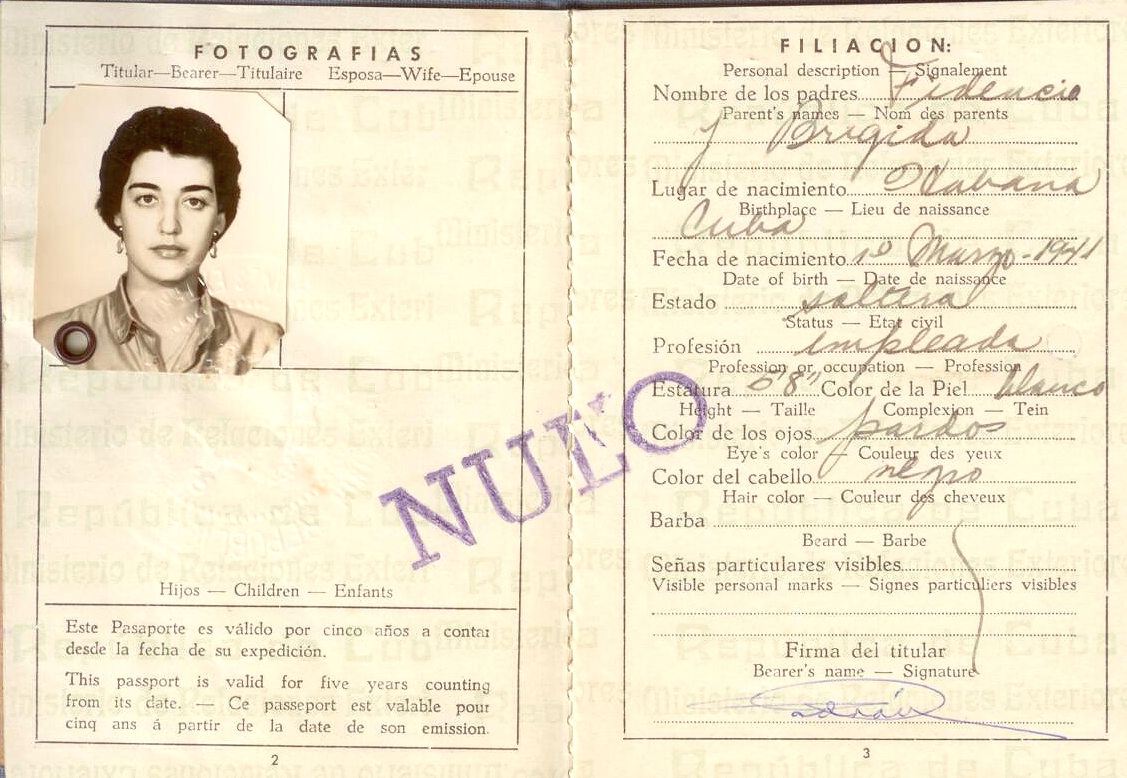
I was 26, he was 57. Dad, Mom and I were saying goodbye to Cuba forever. Hours later, we landed in Miami. After our documentation was received, we reunited with my mother’s sister, Estela. We arrived at my aunt’s house in Carol City. At our first dinner in exile, I noticed that after many years lacking the main staples in my country, I had forgotten all about olives, peas and delicious Del Monte peach halves in syrup that my father devoured. The mattress in my bed was so old and soft that we had to place a wooden door between the box spring and the mattress to make it firm. Still, I slept like a baby. I was in Miami.

The next day, we went to a Christian organization, where I found a beautiful blue dress. My mother got a coat and my dad a jacket. Friends and relatives came to visit bearing gifts. Just a few days later, my father got a job working the graveyard shift. Pilin, my dad’s nephew, gave him $85 to buy a 1956 Chevrolet Bel-Air. In those days, we called those cars “transportations.” Dad was really happy. He was going to get to know the streets of Miami. That weekend, we had our first Cuban sandwich at Badia’s.

Fourteen days after my arrival, I started working at Florida National Bank in downtown in its trust department. Our boss and three other employees comprised the bookkeeping area. Every morning, I took a one-hour bus ride from Carol City to downtown, via Seventh Avenue. Bank employees received a discount lunch card, and during lunch break, we shopped at Burdines, Richards, Jordan Marsh, Three Sisters, McCrory’s and Woolworth.

My father loved to drive and familiarize himself with the streets of Miami. We went to Zayre in Hialeah and visited my mother’s older sister in Little Havana. During this time, the Jersey Boys had one of their great hits and Dad was always singing, “I love you baby…” I got married in October that year. My husband and I moved close to downtown but in November rentals went up and we moved to Southwest Fifth Street.

In 1968, I got pregnant. We bought a house in Carol City so my mom could take care of the baby, but after a few months, my dad got sick and could not work, so my parents moved in with us. My first child, Ingrid, was born in 1969. In 1970, I had my second daughter, Eloise. I found a job close to home. But soon after, my father — who had continued to be ill — took his own life. My mother was devastated, so I stayed home to be with her, and soon after, we moved to Puerto Rico, where we lived for a little over two years. When we returned, I was amazed at how congested the traffic had become and noticed big changes in such little time.

Back in Miami, we bought a house in Westchester. Every Sunday, we attended Coral Way United Methodist Church. There, I reunited with friends, professors and ministers from my school in Cuba, Colegio Buenavista. I went to three consecutive Christmas parades in downtown, walked the first Calle Ocho Festival, and visited the zoo in Crandon Park. I remember buying fresh fish at the area where Bayside and the American Airlines Arena now stand. I can’t forget the go-go girls dancing in Miami Beach.

After our return to Miami, I worked at the offices of a trailer park on Southwest Eighth Street and then at at electronics shotp. Then, in 1978, my life took an unexpected turn — I got divorced. Searching for a better life, I started working at a bank in Hialeah as executive secretary to the senior vice president, and later I went to another bank on Brickell Avenue. There, I made my first Ecuadorean friends. The area was beginning to flourish with lots of international banks. Moving on, I was employed at a mortgage company on Northwest 79th Avenue. I made good friends there that I have to this day.

In the ’90s, it was difficult to find a good job, but after several part-time jobs, I was hired at Banco Cafetero International in the private banking department, working among Colombians, whom I still call my friends.

In 1986, I remarried and moved to Kendall. My husband Alberto and I are retired, but he continues his passion, which is preparing income taxes. He works from home. I joined the Senior LIFT Center where I made new friends from Puerto Rico, Ecuador, Chile and Venezuela. I go to the gym for zumba, yoga and water aerobics. I stay close to my family and friends. They fulfill my life.

I had a very happy life in my native Cuba, but March 14, 1967 changed my life for the better. Thank you, Miami!

In 1934 my family moved from Deland, Florida, to Miami. I was 6 years old, and my siblings were 12 to 20. We were delighted with our new city. Though my siblings sometimes yearned for the town we had left, I was perfectly happy in our new place from the beginning. Growing up in Miami was so much easier than it is today.

By the age of 8 or 9 I was allowed to ride my bike around several blocks in our neighborhood. It’s hard to believe that at the age of 10 I was allowed to ride my bike downtown by myself to buy something on Miami Avenue. Our house was on Northwest 11th Avenue and 7th Street. I rode east on 7th Street, then down to 5th Street, over the bridge, east on Northwest 5th to Miami Avenue, returning to my house via the same route.

My friends told me places they rode with permission from their families. With fewer cars and no expressways, bike riding was much safer than it is today.

We didn’t have a car. There was a trolley that went east and west on Flagler Street to and from downtown Miami. A funny incident was printed on the front page of the Miami Herald one day. A lady got on the trolley with her child, who had a potty stuck on his head. She was taking him to the doctor, hoping he could remove it from the child’s head.

There must have been buses in various parts of Miami at the time we had the trolley. There were many buses in 1943 when I began high school at Miami High. The trolley was long gone and the tracks had been removed.

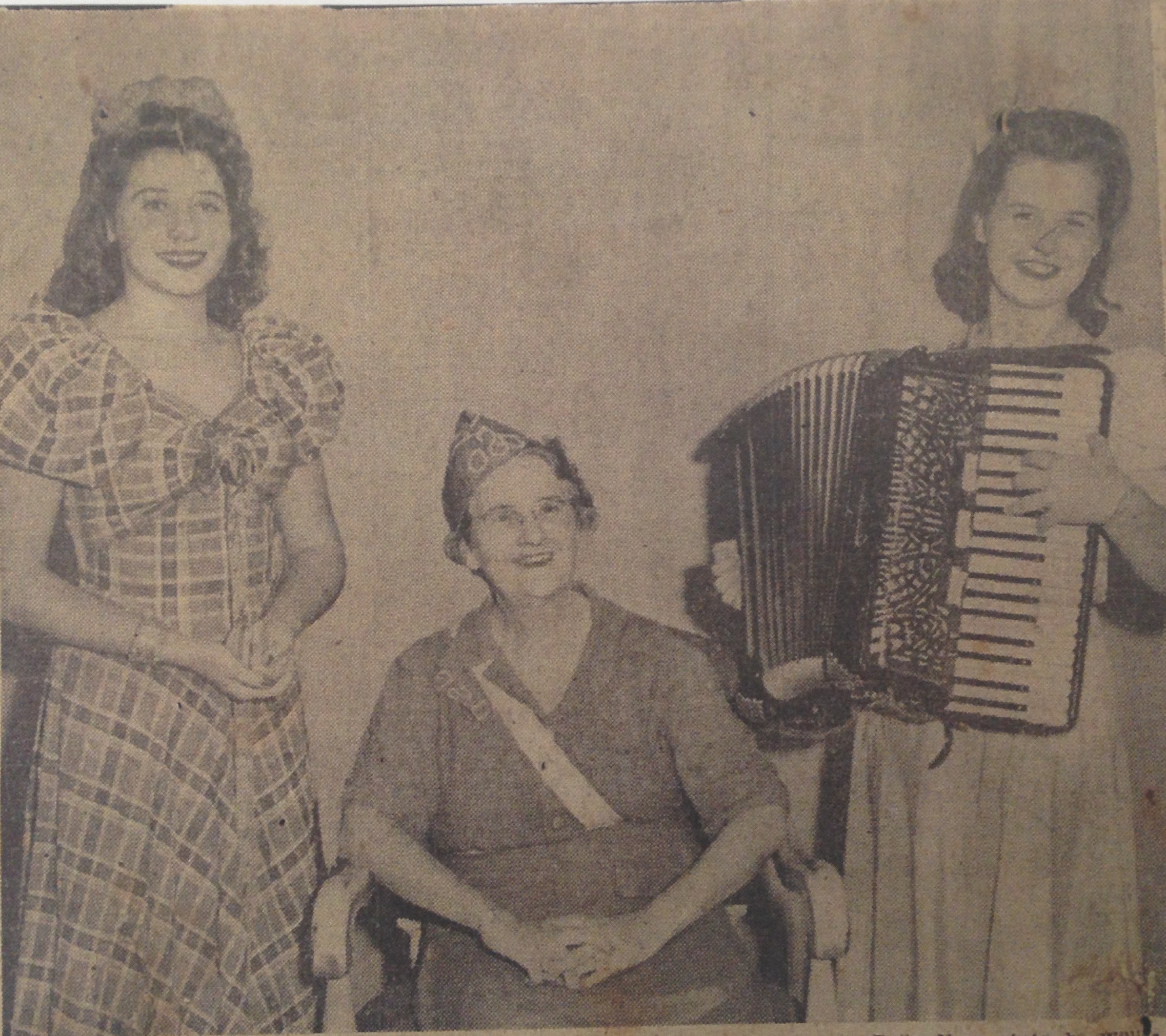
For Christmas, when I was 11, I received an accordion, which in a few years made
my life very interesting. While I was in junior high school I was invited to join a United Service Organization (USO) unit to entertain service men in military bases in and around Miami. The core group of entertainers was from a local dance studio. Other people were included to give us variety. Some of the dancers did solo routines.

One was an excellent singer, and one young man acted as master of ceremonies as well as dancing in the group dances. An older man played the piano and sang some rather suggestive songs. He was quite a hit! I played accordion solos and sometimes led group sing-a- longs. We were well chaperoned by our director as well as some parents of the dancers.

We rode to bases in two-ton army trucks, with long wooden seats from front to back, covered with a canvas on top of the truck. We played one or more shows each week, mainly on weekends, as most of us were in junior or senior high school. What fun we had!

Toward the last of our shows we took two out-of- town trips. The first one was to Key West, where we stayed three days. One of the days we did six shows in the surrounding area. The other days were a little shorter. It was a busy, but very exciting trip for us.

Our other out-of- town trip was to Banana River Naval Base, on the east coast of northern Florida. We took a train from Miami, and did only one show, in which we entertained 600 Navy men and women.

The USO shows soon ended as the war was coming to an end. We had fun, good times with our fellow entertainers, and most of all, satisfaction that we had done something for the war effort.

After high school I went to college in Pennsylvania. After graduation I decided to live in Philadelphia to enjoy the change of seasons and to keep in touch with college friends. I met my husband a few months later on a trip to New York City. After a few trips back and forth we became engaged, and married the following year.

Norm’s first job was teaching Spanish at the University of Rochester. He wrote to me about the beauty of the city of Rochester, and the warmth and friendliness of the people there, but the winters there were just too cold for him.

I moved to Rochester when we got married. We both taught in public schools the next year. For our Christmas break we went to Miami to visit my family. He fell in love with Miami, its beauty, and especially its WARMTH. By the time we left Miami he had applied for a teaching job for the next year. At the end of our school year in Rochester we headed for Miami to stay.

Norm never wanted to live in a cold climate again. He taught elementary school here for 33 years. We raised our children here. We traveled to many parts of the country during the summers, but he was always happy to return to Miami and enjoy the climate that he had learned to love.

Miami is a very different city from the one I knew from 1934 to1946. My second arrival was very different, but it’s beautiful, and more than that, it’s HOME, and it’s wonderful to be here to stay. My parents, as well as all my siblings, except my brother, lived here for the rest of their lives and my plan is to do the same.

“Why Miami, why not New York?” My aunt (then chief nurse of the Nurses Corps of the armed forces of the Philippines) screamed at me.  She voiced concern about the immigration issues Miami was facing in the early ’80s and preferred that I go to the “Big Apple” to experience a major American metropolis.  I responded that in Florida it’s summer all the time like the Philippines and that’s where I got an H-1 visa to legally work in the United States. My only knowledge of Miami then was humming the Miami Dolphins fight song from the perfect 1972 season.

With $100 pocket money from my oldest brother and a paid-for airfare through Pan American Airlines’ “Fly Now, Pay Later” plan, I began my odyssey in 1982 at the young age of 23.

Upon our plane’s stopover in San Francisco, my colleague’s relatives invited us to dinner, but we came back so late that we were not able to board. Oh no!  But confident that we would be rescued by my brother, I asked if he could pick us up. His response was, “Do you know that San Francisco is a five or six hour drive from Los Angeles?” We had no idea of the distance or geography; this was pre-Google time!

Undeterred, my friends and I slept at the airport, and at 4 a.m., I reluctantly paid $4.00 for a hot chocolate, shared with my other three friends. Initially we couldn’t drink the hot chocolate because we thought the straw had no hole in it; then we realized it was just a stirrer, not a straw! Welcome to America!

We were met at the Miami International Airport by complete strangers, with no prior contacts. They were Filipino nurses who worked at Miami International Hospital at the Golden Glades interchange, where we were also assigned. Relying on the Filipino bayanihan spirit of helping each other, the four of us were placed in four different apartments until we could find and afford one of our own.

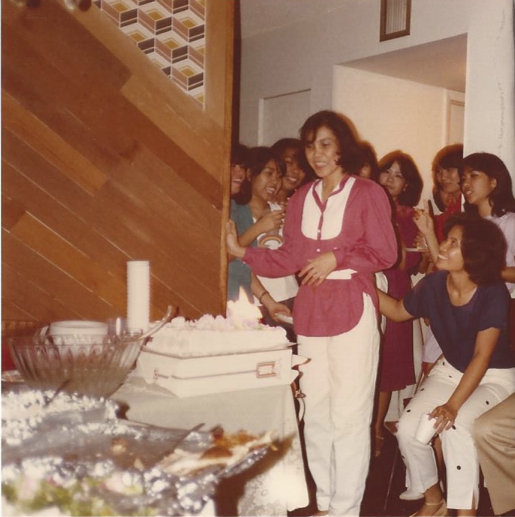
On our third day after arrival, we signed our official work contract with a salary of $8.24 per hour.  Feeling concerned that our welcome was coming to an end where we were staying (guests, like fish, smell after three days, you know!), we embarked on another journey to be independent.  I approached the manager of an apartment complex on 183rd Street in North Miami Beach and showed him our job contract and begged him to allow us to rent with no deposit, no security, and no down payment.  Thankfully we were trustworthy to him and he agreed. At midnight we scavenged the big green trash bins for any recyclable junk we could reuse in our apartment. We got chairs, tables, lamps, a black-and-white television set, and even my first mattress!  Our white bed sheets, slightly torn on the sides, were donated by the hospital.

On our first shopping spree at Loehmann’s Plaza, a friend and I went to purchase a dress for a party, but it took us a half day to find one that suited our budget because we kept calculating how much it would cost in Philippine money. I finally settled on a $40.00 dress, which was more than my monthly salary at Manila Doctors Hospital; I felt so guilty for this conspicuous consumption!  After shopping, we decided to order a pizza and we were asked, “Whole or slice?” We really did not understand what the waiter said and we were too bashful to ask, so we just responded, “whole,” and then he asked, “small or large?” We said large because in the Philippines, pizza whole sizes were small, similar to an individual size here. Lo and behold we each got a large, whole pizza that we couldn’t consume, but we brought back home to our friends! We laughed and confirmed, everything in America is large!

After a year I saved enough to purchase my first car, a sleek, red Honda Prelude. Most of us worked the 3-11 p.m. shift. After work we would pack in my car to go dancing at Biscayne Baby in Coconut Grove and when someone liked one of us, he would be disappointed when he realized we were a pack of five or six in a car.  Sometimes we would come home really late and a few of us were called to work overtime for an early 7 a.m. shift, so we barely had any sleep but somehow we never compromised our work. Overtime work was in abundance then; some of my friends worked double shift almost daily. Nurses were such in demand!

I became one of the first nurse practitioner graduates at Florida International University in 1988 for a mere tuition of $500 a semester, due to a specially discounted certificate program.  Research nursing beckoned to me, so I joined Dr. Eugene Schiff at the University of Miami and later became the first advanced registered nurse practitioner (ARNP)/nurse liaison. I assisted him in opening UM’s Center for Liver Diseases at Cedars Medical Center. My constant thirst for more professional opportunities also landed me other exciting jobs such as research administrator, liver and GI transplant coordinator, and ARNP for solid tumors at Jackson Health System.

I met my husband at a famous watering hole in Brickell, Firehouse Four, now the restaurant Dolores But You Can Call Me Lolita.  In April 2014 we went back to the Philippines for vacation and, upon my return to Miami, I focused on helping restore the livelihood of farmers in Leyte whose farms were destroyed by Typhoon Haiyan. I love Miami’s cultural  diversity and resilience and with my true American spirit I  volunteered to be a fundraiser through the Global Giving Project, with the knowledge that we can defy odds and uplift ourselves if we have the will and  determination to succeed.

This fall, I’m looking forward to joining the cancer research team at the University of Miami medical school.

“I need shoes, Caridad, shoes! Stick some in there, we have to go!” Enrique Moya was hurriedly preparing his wife and children for the ordeal that he knew they were all about to go through. Desperately preparing a bag of essentials while his wife packed some clothes, the look on his usually sure face was that of panic and uncertainty, the look of a man who had everything to lose, and knew he was about to do just that. Amidst the chaos, 9-year-old Henry, Jr.  was sitting on the bed, absorbing flashes of future memories while his older sister yelled for him to get dressed.  He knew that something bad had happened, but he could not have had any idea of the magnitude of it. He knew nothing of the revolution taking place in his native Cuba or what it meant for his family. He had no way of knowing that he would never sit on that bed again.

Six years and 90 miles later, 6-year-old Migdy Vega was stepping off an airplane onto a busy tarmac at Miami International Airport. The flight from Cuba was short and violent, and Migdy was on the verge of being sick the entire way. Looking around she saw the range of emotions on her sisters’ faces: Mercy, who was older, put forth a veneer of confidence, while Tere and Ana Maria, younger, had not stopped crying the whole trip, and were visibly terrified. Taking her older sister’s lead, Migdy tried hard to keep her composure while meaningless words swirled around her in a rushed haze. Her next eight years would be equally chaotic, as Migdy would watch her father, Celestino Vega, struggle to establish himself as a doctor in the United States. She would help raise her sisters while her mother worked two jobs, struggle to adapt to a new language and culture, and at age 14, experience the death of her father. He died suddenly and unexpectedly, of a heart attack while at work. Migdy’s household responsibilities grew as her mother now had to support four daughters on her own, and like many children in similar situations, she was forced to grow up quickly.

Each bump seemed rougher than the last, as water splashed into the faces of six men hanging on for dear life. The captain seemed determined to push the boat to its limits, getting a perverse thrill each time the hull went airborne. Henry’s yellow Formula speedboat was his prized possession, but if you asked his passengers, they’d say he was trying to destroy it. Just 12 years after stepping off a much bigger boat in his new home country, Henry’s Formula and classic red muscle car were indicators of how well he had adapted to his new culture. To him, nothing was given. Those toys were the fruits of scrubbing floors and filling gas tanks, excesses that were only afforded after contributing to keeping the family above water. His was a life of work and play, with little room for schooling in between. Henry traded a formal college education for practical experience, quenching his thirst for knowledge through trial and error, not reading and writing. He began to parlay his problem-solving skills into various jobs in technical support and quality assurance, but he knew that he would never be satisfied until he was the one running the show.

The lights were bright, and much hotter than Migdy expected, as she stood up in front of a crowd of dozens of people. It may as well have been a sold-out Madison Square Garden. Standing under a sign with sparkling letters reading “Miami-Dade County Spelling Bee,” Migdy was about to claim victory and move on to the semifinals for the state championship. The word was “opportunity.” She knew the word, she knew how to spell the word, but she also knew that the lights would be a whole lot brighter at the state championship. The fifth-grade version of Migdy Vega never made it to the state championship spelling bee, nor did any other version. Migdy was a talented student, but her lack of self-confidence was her biggest hurdle to overcome. Migdy still felt the effects of the chaotic transition, still at times felt the familiar feeling of everything swirling around her head. For her, it took a gradual adjustment to feel like she belonged in her new home. As she grew up, she focused on the things she could control, her grades, her chores, and making money by tutoring on weekends. She slowly grew into her own skin, and by the time she had graduated from college, she attacked the workforce head on, using her degree in business administration to apply for every position she could find; the more room for upwards mobility the better, as she was determined not to be afraid of the bright lights ever again.

One day there was a real estate office that had issues with their shiny new computers. There was a third-party tech-support man called in, and a frustrated manager telling the technician what went wrong. There was that same manager telling the technician that he was an arrogant know-it-all and showing him the door. A week later there was a date between the manager and technician, and two years after that there was a wedding. Migdy and Henry saw bright signs in their future: a self-owned business, a house with a painted fence instead of a rusty gate, boats and cars to play with, sons and daughters winning spelling bees. Their days of poverty, loneliness, and displacement were over, and they were about to start creating their own family story.

Recently, everyone in my family came down with a nasty cold/flu that has been going through Miami like a wildfire in the Everglades. We were walking around like sniffling, bleary-eyed zombies addicted to Kleenex and Theraflu. Pitiful.

On a Saturday, after struggling all week with over-the-counter medications, my wife turned to me and said, “You know what you have to do, don’t you?”

I knew.

It wasn’t that I was dreading making the chicken soup, but my new responsibilities at the college were taking their toll, and I thought about the mountain of work that I had brought home. I was determined that not even a cold was going to stop me from finishing the job. I reluctantly told my wife yes, with the secret hope that everyone would have forgotten by the next day.

But by the next morning, my son, Andrew, was downstairs with a list for the supermarket and his stern admonition, “Don’t forget to make the dumplings.” Sometimes I have to remind Andrew and his sister that it’s called “chicken soup,” not “dumpling soup.” So on Sunday evening, after going to the supermarket, I pulled out my stock pot and made the famous chicken soup that my mother taught me how to cook.

My mother, Merty Synidia Philp, née Lumley, was a country girl from a small town named Struie in Westmoreland, Jamaica. According to my aunt, Norma Lumley, my great-grandfather, Andrew Lumley, came over from Scotland to build churches in Bethel Town, which is two miles from Struie. My grandfather, Frederick Andrew Lumley, was a baker/shopkeeper/bartender/farmer/village reader of letters in Struie. He also worked as a cook on a ship that traveled between Jamaica and Cuba, and he taught my mother how to cook chicken soup the way my great-grandfather taught him.

My great-grandfather and my grandfather are a part of a Scottish lineage in Jamaica. As youngsters at Jamaica College, we used to joke that when the teachers were taking roll, you could go outside, smoke a cigarette in the bathroom, come back, and they would only be getting to the McKenzies after going through the MacAdams, McDaniels, McDonalds and MacDougalls.

The meeting of Scotland and West Africa (I will vouch only for those two — who knows what else happened in my grandfather’s bar on a Friday night?) down in Westmoreland, tempered by the rigors of farm life and the daily chores of feeding the chickens, produced a set of habits such as dependability, tenacity and a certain fearlessness toward work and sacrifice that kept my mother’s family together.

For my mother’s family to survive in Struie, they had to be ready for any opportunity that presented itself. My aunts and uncles had careers in fields where opportunities were open: nursing, law enforcement and teaching. They did well in these professions because in Struie they had learned firsthand about dependability and sacrifice. Everyone on the farm was expected to contribute something. There weren’t any exclusive boys’ jobs (except with the bulls and hogs) or girls’ jobs. You had to help any way you could.

This tenacity and attitude toward work helped my mother throughout her life. She began as a teacher, and then she became a legal secretary to one of the top lawyers in Jamaica. When she left Jamaica, she started all over again and eventually became a nurse — the career she had always wanted. But she always stressed that, if a job had to be done, someone had to step up and do it. If you couldn’t do the job, you could help.

This is why she taught me how to cook and to iron my clothes, because the last thing she wanted was a wutless (good-for-nothing) man in her house. Everyone had to do something.

So, back in Miami on Sunday evening, it was my turn to do something that no one else could do as well.

Whatever work I brought home from the college had to be put aside for my family’s sake. I made the chicken soup from a Jamaican-Miami recipe with a whole chicken (skinned and quartered by yours truly), thyme (of course), onions, butternut squash (they only had somefenke-fenke pumpkins, and the kids prefer squash), dumplings (the kids used to help me make them when they were younger, but they’re teenagers now and way too cool for that), carrots, celery, parsnips (added since we’ve come to Florida — for a little sweetness), chayote (don’t make the mistake of going into the Cuban supermarkets and asking for cho-cho; you will get hurt), turnips, and scallions added just before serving.

The soup may not have cured our colds, but it gave us a chance to sit down together and have a hearty meal with equally wholesome company. Well, not so wholesome. There was a revival of “The Dumpling War,” a family habit, which I hope our children will never share with their children.

It was always exciting when a buela would tell me that she needed to go downtown for the day. This meant she had business to attend to at “ El Refugio,” the Cuban Assistance Center. This also meant that we would do a little shopping. As a reward for helping her translate and get around, she would treat me to lunch at McCrory’s.

We lived in East Hialeah. Our world was limited to our house, school, the grocery store and, very rarely, a trip outside to visit family and friends. We did not play with the neighborhood kids. She would not let us play outside of the yard. She was responsible for us so we were always within earshot.

My mom did most of the major grocery shopping, but a buela liked to shop with her money — the money she got from “ El Refugio.” I’m not sure that’s where it came from, but that is what I thought. Sometimes that meant that we would walk five blocks west to the big bodegawhere she felt most comfortable. She could pick up a few things and speak to anyone she needed to, in Spanish.

We would walk down 54th Street to East Fourth Avenue. It was a busy street with lots of cars, so crossing it felt like a major event. a buela’s personality was hard. She was a very strict disciplinarian and there was no crossing her. You needed to stay by her side while crossing the big avenue.

She always took me or my brother Henry with her. She did not like to take both of us together because it was harder for her to keep track of us if we wandered off. My brother was quiet and curious. He never made trouble but it occasionally found him. She preferred to take me along. I was chatty and wasn’t afraid to speak to anybody. Most of all, I didn’t wander.

On those rare days when she had to present herself at “ El Refugio,” we took public transportation to get where she needed to go. My parents worked. They either couldn’t get the time off to take her or she didn’t want to ask them.

On the day of the trip, a buela would never eat anything. She said she was afraid that she might be sick. I think she was just nervous. She would stress about the trip for days. She put her hair in a redecilla (a hairnet). It seemed weird. Today, you would call her a control freak.

We would take a public bus and ride from East Hialeah all the way to downtown Miami. We would cross neighborhoods I did not know existed and see people I had never seen. I looked at other people on the bus and knew that they came from different worlds than the one I knew. It felt almost magical.

She was responsible for getting us around and she was also responsible for me in a strange place. At age 10 or 11, I went along to translate and ask questions for her. She needed me although she never let on how much. It seems strange that an adult could count on a kid, but that’s how it was.

I remember walking into “ El Refugio,” today the Freedom Tower. There were lots of desks and people talking. There were high ceilings so the voices seemed to grow louder. I remember that they would give her jars of peanut butter and probably other stuff I don’t remember. That was something she would NEVER have bought, but my brothers and I loved having it because it was so different from what we were used to.

My favorite part of the trip was lunch at the McCrory’s lunch counter. I got to eat American food in an American restaurant. I mostly remember asking for fried chicken and French fries, like I had seen on TV. It tasted so good. She did not like hamburgers or hot dogs. She said it wasn’t “real food” so I didn’t push it. We sat on the swivel chairs and I would order for both of us.

Next, we would go to “ el discount.” The store was big and she could get stuff there she did not find in Hialeah. The shelves were really high and there was so much to buy there. Sometimes, she went into La Epoca, the fancy department store that had come from Havana. It looked classy, or classier than what we were used to, anyway. I know for a fact that she got my dad a guayabera there. They also had dress shoes and other special things there she seemed to really like.

Lastly, we went into Gesu Catholic Church just for a few minutes if there was time. Then, back on the bus.

Every time I see that bumper sticker—“Florida Native”—a ripple of envy and irritation flutters in my chest. It’s a rare and exotic club to which I will never belong because I’m one of those folks who have been flooding into Florida at the rate of 1,000 a week for the last few decades. Although they tell us that the tide has slackened to 591 new residents a day, Florida natives are still as scarce and outlandish as manatees. How unfair it seems that even though I’ve lived in the state for well over 30 years (surely longer than plenty of the younger natives), I should still feel like an interloper.

In 1965, on a south Florida winter day, I stepped off the train at the Hollywood station to attend Riverside Military Academy. It had been an incredibly romantic journey, a long rumbling train ride through the brown scraggly fields of Tennessee and Georgia, then into the expanse of green nothingness that was north and central Florida, until finally the palm trees began to thicken, the greens grew lush, and the windows in the train slowly lowered. Suddenly I was standing beside the tracks looking at a sky dense with extravagant birds, white and huge, with lazy wings and long, orange legs trailing.

I remember taking my first breath of rich sub-tropical air. There was something sweet and spicy in the breeze—that warm macaroon aroma with an intoxicating undertone of cinnamon that seems to waft directly from some secret Caribbean island. That afternoon I breathed in a lungful of air I have yet to release.

Though I didn’t have the words for it then, I knew the light was different, too. Softer than the harsh and unglamorous Kentucky daylight I was used to. It had an almost romantic, twilight rosiness, a quiet light, yet at the same time far more vivid and precise than any I’d known before. A painterly January light. And while I had been on the platform of the Hollywood train station for less than a minute, I knew with utter certainty that I had taken a mortal wound.

Sometime later that winter, I dropped the bombshell on my parents. I informed them that I had decided to turn down the Air Force Academy appointment my father and I had labored so hard to secure. I wanted to attend college in this newly discovered Shangri-La, Florida. While the shock of my passing up a free four years of college must have been incredibly difficult for them to absorb, to their everlasting credit my parents let me win that argument.

I never told them that the institution of higher learning I had chosen, Florida Presbyterian College, had caught my eye because the catalog I’d devoured in my boys-school guidance office had numerous photographs of coeds wearing Bermuda shorts in classrooms. Ah, sweet Florida, what a sensuous and libertine land.

I did four glorious years of college in the charming and soporific St. Petersburg of the ‘60s. On holidays I explored the west coast, the Keys, camping at starkly primitive Bahia Honda, building bonfires on midnight beaches, discovering out-of-the-way taverns that served cheap pitchers of beer and spectacular cheeseburgers, bays where fish jumped happily into frying pans, and unair-conditioned piano bars in Key West where writers huddled in the corners and talked the secret talk. I had never felt so at home.

Then I graduated, and after serving a bleak exile in snowy latitudes to collect two more degrees, it was finally time to find a job. I was so determined to return to Florida that I didn’t even bother applying for teaching jobs in any other state. It was a cavalier decision bordering on lunacy, for that was a time in the early 1970s when teaching jobs were scarce and terminal degrees plentiful. Every taxi driver had one. When no job offer was forthcoming, I moved back to Florida anyway and put my new doctorate to use digging holes and planting azaleas, palm trees and a host of other landscape plants around the bases of high-rise condominiums. Better to do manual labor in the relentless sun of Florida than to find myself in some university office staring out the window at the desolate tundra of Anyplace Else.

The phone call finally came. It was a dream job at a new state university in Miami.  And then little by little, all these years happened. But even after all this time, the light is still new and surreal and the air still drenched with spices they haven’t yet named and the sky is chocked full of the most impossible birds. Parrots squawk across my backyard sky every morning at 7:00.  
I kidnapped a boy from Kentucky and transplanted him in paradise and he grew up to write books that sing the praises and mock the dizzy and perilous follies of this gaudy corner of the nation. I love this place. I have loved it from the start and have learned to love it more with every passing year—all its quirkiness, its stresses, this simmering melting pot where no one wants to blend.

I have decided we need a bumper sticker of our own—those of us who had the misfortune of being born somewhere else, but who made the difficult choices, overcame the fears and complications and the psychic traumas of abandoning the safety of one home for the uncertainty of another. There are 591 stories a day about how we arrived here, and sure, not all of us were as swept away by the sensory treasures of this place as that 18-year-old kid on the train platform. Some of us came simply for jobs or to play golf in February or to soothe our arthritic joints, and there are many who find nothing to rhapsodize about in the sumptuous air or rosy light. There are many of those 591 who simply ignore or endure what the rest of us cherish. Well, let them get their own license plate. But as for the rest of us, ours should say, “Home at Last.”

Translate »