Skip to content
Named Best Museum 2022
by Miami New Times

My mother was born in Tampa in 1895. Shortly after her birth, the family moved to Punta Gorda. In 1898, there was an offer of free land for homesteading in Dade County.

My grandfather and grandmother gathered their brood of six and started out in a horse and wagon. Their route took them north of Lake Okeechobee, then to West Palm Beach and then south along the coast to Miami.

This arduous journey across unpaved prairie and forest took three weeks. The 20 acres they homesteaded were between Northwest Third and Fourth avenues and 11th and 13th streets in what is today’s Overtown.

My mother only went to school through the third grade. In 1904, one of her classmates was a little girl named Bessie Burdine, whose father owned the general store. My mother’s teacher at the time was a young woman fresh out of teachers college, Lillian McGahey.

Forty-two years later, Miss Lillian taught me math at Miami Edison High. Her brother, Ben McGahey, went on to own the largest Chrysler-Plymouth agency in the county.

My mother married in 1911 at age 16. My grandparents and their children lived on the little farm for 18 years. My grandmother sold it in 1917 for $1,800, or $90 per acre.

My father came to Miami in 1923. In 1926, the great hurricane struck with massive loss of life. The Prinz Valdemar, an iron-hulled schooner, was picked up by the storm surge and deposited on the east side of Biscayne Boulevard around Fifth Street. It was retrofitted with large tanks and served as the county’s aquarium for the next 25 or so years.

In 1927, my mother was widowed. Her husband was lost at sea bringing back a load of Scotch from Bimini. She was left with two young daughters and no marketable skills. My father was her husband’s best friend, and they were married in 1929. I was born in Victoria Hospital in 1930.

My father and mother’s first husband worked for the biggest bootlegger in the Southeast. He went on to become the mayor of Miami Beach. My father continued to work for him after the repeal of Prohibition. We lived in a succession of houses. The one on Michigan Avenue was quite elegant as well as a house on Meridian Avenue that had a tennis court.

Although my father speculated at times in buying and selling real estate, we never owned a home. As the Depression deepened, our family lived in houses that were more modest. That’s a nice way of saying we lived in one dump after another. (My mother used to joke that we moved every time the rent came due.)

In 1941, when I was 11, our family moved to the Edison Center area. I enrolled in the sixth grade at Edison Elementary and graduated from Edison High in 1948. When I was 12, I had a Miami Daily News route.

One of the boys who worked out of the same station was Ralph Renick. Ralph had a special bicycle. As I recall, it was made by Rollfast and had a small front tire that allowed it to accommodate a built-in basket where Ralph could put his papers for delivery. The rest of us had to make do with a wooden basket placed on the handlebars of our regular bikes that made them highly unstable when loaded with papers.

His brother Dick and I were good friends. Ralph and Dick attended St. Mary’s High School, about 10 blocks north of Edison High. During high school, I used to deliver 250 Miami Heralds every day before school.

One Sunday in November 1944, I was riding my bike on 79th Street on my way to do some fishing on the causeway. I stopped at the railroad tracks for a very long troop train to pass.

A 1942 Lincoln Continental pulled up alongside of me. I looked in the back seat and there was a little man who seemed to be swallowed up in a camel’s hair overcoat. He leaned out the back window and, in a rasping voice, said, “How ya doin’ kid?”

I saw the scar on one cheek and knew immediately who it was.

I replied, “Doing fine, sir.”

It was Al Capone.

In 1948, I went to work for the telephone company, and in 1950, I spent a year as an installer on Miami Beach.

Most of the mansions had fairly elaborate multi-line systems that needed constant maintenance due to the saltwater. The Firestone Estate was located where the Fontainebleau is today, just north was the Dodge Estate, where the Eden Roc now stands.

During the summer months, the hotels closed due to lack of business and the fact that many did not have air conditioning. The American Legion scheduled its convention in October 1948, which necessitated the early opening of the hotels housing delegates.

I was a helper with a PBX installer-repairman when a call came in to proceed immediately to the Roney Plaza Hotel. When we arrived, we were ushered into the Presidential Suite. After being frisked by Secret Service, we were instructed to hook up the “hot line” for Mr. Truman, who was the featured speaker for the convention.

Before wireless technology, the president required a direct land line to Washington wherever he went. As I sat on the floor installing the telephone set, I glanced up and saw a pair of sturdy legs attached to a pair of sensible shoes standing next to me. It was Mrs. Bess Truman. She was a lovely and gracious lady without a trace of pretension who introduced herself to all those present, both great and small.

In 1951, I joined the Army. In reality, I joined one day before I was due to be drafted. In November 1952 at Camp Stewart, Ga., our unit was out in the swamp conducting its Army Training Test before deployment overseas.

During mail call, the company clerk said, “Telegram for Lt. McCormick.”

Back then, telegrams were usually the bringers of bad news. The wire was from my father. It read, “After 27 years, we finally did it.”

He went on to give the score for the Edison-Miami High annual Thanksgiving Day game. It was the first time Edison had won in more than a quarter century.

Telegrams went out all over the world that night.

Richard H. McCormick, DVM, was born in Miami’s Victoria Hospital in 1930. He graduated from Edison High School in 1948 and Auburn University in 1965, and practiced veterinary medicine in Miami for more than 45 years.

My grandparents, Adolf and Anna Hofman, were among the early settlers of Delray Beach, arriving there from Germany in 1895. The little town was named Linton.

My grandfather was a pineapple farmer. My mother, Clara, was one of their three children. She moved to Miami in 1918 and lived in the downtown YWCA while she attended business school.

My father, Wead Summerson, was the grandson of English immigrants who settled in Pennsylvania in 1802.

The family moved to South Dakota in 1905.

As a young man working in the oil fields of Wyoming, he heard that in Miami, the streets were “paved with gold.”

In 1924, he drove his Model T to Miami to investigate this “great wealth.”

He looked for a job in a plumbing shop and the owner asked him where he was from. When he replied, “South Dakota,” the elderly owner scowled and said, “We don’t hire no damn Yankees!”

Disappointed, my father turned to leave when a young man raced after him calling, “Wait, wait! We really need plumbers. Let me talk to my grandfather.”

Soon the old man returned with his grandson. “Son,” he said, “since you are from South Dakota, we are gonna hire you.”

My mother and father met and married in Miami in 1928. Dad was accepted into the U.S. Border Patrol and they moved to Jacksonville, where I was born in 1933.

They returned to Miami in 1941 and lived here until their deaths.

I attended Allapattah Elementary School, which then was located on Northwest 36th Street and 17th Avenue.

I can recall seeing Seminole Indian women dressed in customary Seminole garb as I walked home from school. I later attended Shenadoah Elementary School.

It used to cost 9 cents to get in the Tower Theatre on Saturday afternoons, but often I would join other kids on Saturday mornings to scrape chewing gum off the bottom of the seats to earn a free pass for the afternoon movie.

In 1942 while swimming off Miami Beach, I saw that the sand and water had tar and debris from torpedoed ships.

I also remember seeing German POWs on the back of trucks being transported to work at projects around town.

They had P.W. printed on the backs of their jackets.

They must have come from the camp in Kendall, which was located across the street from what is now Dadeland.

When the war was finally over, I rode on the bus downtown with my father to participate in the celebration.

People were shoulder to shoulder laughing and shaking hands up and down Flagler Street.

I was mesmerized by the joy, shouting, “No more war! It’s over, it’s over!”

While attending Shenandoah Junior High, I rode my bike to deliver newspapers for the Miami Daily News.

At the end of each week I collected 35 cents from each of my customers.

Later, while attending Miami Senior High, I rode my Cushman Motor Scooter to deliver the Miami Herald.

The entire school was assembled outside facing Flagler Street to pay homage to President Harry Truman as he rode past us waving from a long black convertible.?

?In 1951, during the second year of the Korean War, I joined the U.S. Coast Guard and spent most of the three years in the Pacific Theatre.

Upon discharge I returned home and became a plumbing apprentice.

As a union plumber I worked for 42 years on buildings throughout Miami, Homestead and Fort Lauderdale.

The last seven years I worked as the plumbing inspector for the city of Coral Gables.

I married Jocelyne Grief in 1959 and became the proud father of a son and a daughter. We were divorced in 1976.

Eighteen years later I married Joyce Jolly Tyra, a native Miamian.

Her parents, Tom and Ethel Jolly, were old-time Miamians as her father arrived from Mississippi in the latter 1920s with his brother to help carve the Tamiami Trail from the Everglades.

Joyce’s uncle was killed in a dynamite explosion during construction of the trail.

Joyce’s father met and married her mother in Miami as she was visiting here from Massachusetts with her sister.

Joyce and her younger sister, Linda, grew up in Allapattah and both graduated from Jackson Senior High School.

Joyce married Ed Tyra, a classmate, and is the mother of their three children.

Ed died suddenly after 26 years of marriage and Joyce became an English teacher in the Miami-Dade County public school system.

Joyce and I are thoroughly enjoying our retirement while living in Kendall.

We always look forward to visits from our combined family of children and grandchildren.

I was born during a knee-high snowstorm on Feb. 20, 1921 in Pittsburgh. The Bureau of Vital Statistics misread the doctor’s crossed t as two t’s, so I became Ritta instead of Rita. I was second oldest of six children – Eva, Ritta, Josephine, Mary, Frank and Dolores.

I started grade school at age 5, skipped the third grade and graduated at age 12. I was a voracious reader, especially on the weekends. The travel advertisements in the Sun-Telegraph and Pittsburgh Press about Florida were so enticing to look at on zero degree days. Every step along my route to school reinforced my thoughts about Florida.

After graduating from high school at age 16, I attended business school and then was employed by Carnegie-Illinois Corp. as secretary to the expeditor for a shipbuilding company, which built destroyers, etc. for the war effort.

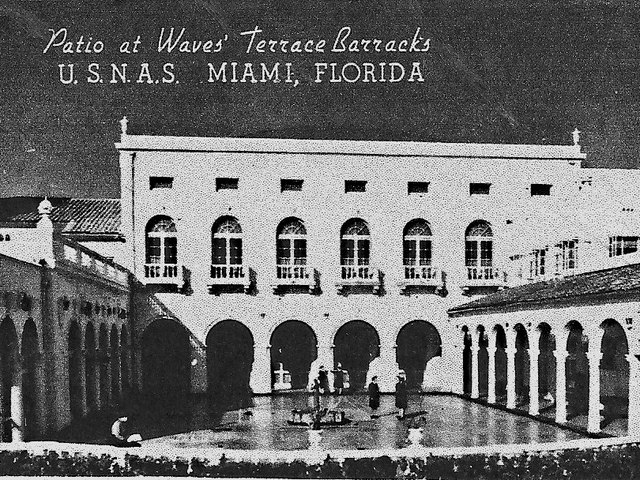
We were a very patriotic family, and since the only male was 12 years old (he later served in the Korean War), I enlisted in the Navy in the organization “Women Accepted for Voluntary Emergency Service” (WAVES). I was sent to combined boot/yeoman training in January 1943 at Oklahoma State University in Stillwater.

As our training was coming to a close, we were asked to indicate if we had a preference of Miami, Washington or California for a place of deployment. Naturally, I chose the place of my dreams – MIAMI, and was fortunate to be deployed to the U.S. Naval Air Station at Opa-locka.

I was assigned to the Flight Training Division in Hangar No. 1. At that time, only pre-operations training was given, since the runways were too short for the larger, heavier planes required for operational training. Later, when the runways were completed, the base became Operational Unit –VSB-5 OTU-5. The plane used was the famous SBD-5 dive-bomber known for its “Swiss cheese” wings. Newly commissioned Navy and Marine officers were trained there, in addition to a few British, New Zealand and Australian pilots.

Opa-locka had its own bus line to Miami, which was heavily used by both civilianworkers and military when on “liberty.” Miami and Miami Beach warmly embracedall servicemen. I still have my “Serviceman’s Guide,” which listed the places that welcomed us:

The MacFadden-Deauville Hotel for a very small fee provided use of their Olympic-sized pool and lockers, etc. Richards department store had a lending library for two cents a day – no deposit required.

At Shangri La Restaurant, lunches started at 40 cents. At Club Bali, deluxe dinners cost $1.50. The daily rate at Hotel Patricia was $3 and weekly rates were $18 for one person and $25 for two people.

I was discharged in late November 1945, returned to Pittsburgh and took a few months off.

My military service was a most gratifying experience – doing what I felt was my duty and enjoying the camaraderie with my WAVE friends and the officers and enlisted men stationed in Miami. Some have remained friends for life.

In 1946, I was re-employed by Carnegie-Illinois in Pittsburgh and attended Duquesne University at night. After a couple of unendurable winters, I came to my senses and applied for admission to the University of Miami. I enrolled in 1948.

The main campus consisted of the administration building, a wooden science building, apartment housing, and an unfinished Merrick building (the “Skeleton”). The bottom floor was the bookstore and the second was a library. The top floor, when added, became home to the law school, many wooden portables, and the student union building, which was called the “Slop Shop.”

I was awarded a Bachelor of Arts degree in 1951 and enrolled in the law school. I graduated in 1953 and became a member of the Florida Bar, which I maintained for 50 years, retiring in 2003.

In November 1953, I married a fellow law-school graduate, Clifford S. Hogan. He served in the Army Air Force in the European theater as a fighter pilot, flying the classic P-51 Mustang.

In the early 1960s, during the Cuban Missile Crisis, he was recalled to serve at the Homestead Air Force Base and we temporarily moved to the base.

The army had set up a tent city for the troops. The year before his assassination, President John F. Kennedy visited the base. All of the residents lined up to greet him. He rode in an open-air car. Everyone was quiet and I shouted “Hi” and he looked directly at our camera and we were able to get him on film waving at us.

After the end of the Cold War, we returned to our home in South Miami. My husband remained in the reserves for many years and later retired as a colonel.

We were blessed with three children: Clifford, Robert, and Valerie. They received their primary educations at Epiphany, Lourdes, and South Miami High School. Two obtained degrees at the University of Florida and one at Florida State…so, we had all three schools covered football wise. We have been parishioners at Epiphany Catholic Church all of our time in South Florida.

Miami has more than exceeded my hopes and dreams…which began at age 12 in frigid Pittsburgh.

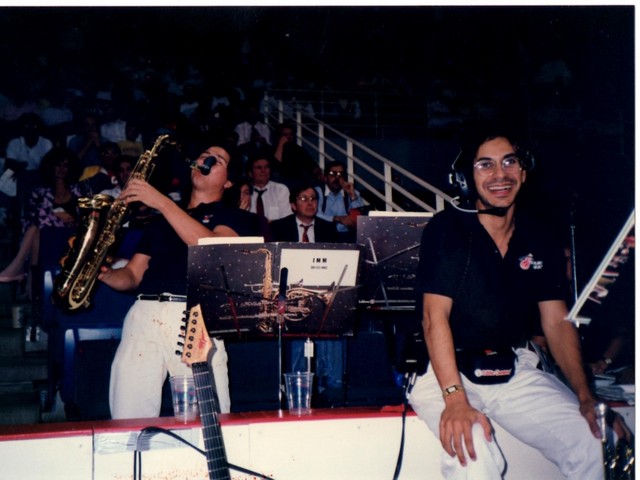
I played for the Miami Heat for their first three seasons. Yet not one Heat fan knows my name, although they may recognize my face.

It was spring of 1988, and I was the music director on Norwegian Cruise Line’s MS Southward.

I have been a newspaper junkie since my days as a paperboy in my hometown of Knoxville, Tenn., and Sundays were our “Miami Day” – time to load up with a new crop of passengers, and my chance to grab a Sunday Miami Herald. I read with great interest the article outlining the NBA’s approval of a new team for the Miami market.

I was on my fourth year of working on ships, and starting to crave a “real” life. This was my chance to make a move. And as luck would have it, my ship contract was coming to an end. I contacted the Heat front office . For weeks, I kept calling – and I finally convinced them the team would probably not be very competitive the first season, and they needed a band to keep the fans entertained.

They finally relented and set up an audition, as they said several other bands had contacted them. The window of opportunity was open, but the rest of my band was on board the Southward, in the midst of a four-month contract. I had to act fast – the audition was four days away. Luckily, I ran into several great musicians playing at Bayside Marketplace. I told them about the opportunity, ran back to my new apartment on Collins and 29th Street, and spent the next two days furiously writing arrangements.

I rented a rehearsal studio, we got four songs under our belt (“25 or 6 to 4,” “The Heat is On,” “Wipeout,” and “I Feel Good”). We arrived at the mostly-finished pink Miami Arena, and won the audition! That first Heat Band consisted of Gary Mayone (keyboards), Rey Sanchez (guitar), Jim Kessler (bass), Ed Smart (saxes), Kelly Milan (trombone), and me on trumpet. Most of those guys are still around, enjoying successful freelance careers.

It was a great introduction to Miami, and I relished every moment of the first three seasons.

If you don’t remember, those were heady times for basketball: Michael Jordan was in his prime, Larry Bird and Magic Johnson were winding down, and Charles Barkley was as entertaining then as he still is. The band had a dressing room right near the players that we shared with Burnie, the Heat’s mascot, so interaction was easy.

Twenty-three years later, my band is still active, I am back in the cruise industry, and my wife Juliet and I have raised three children – Celia, Emma, and Given in this wonderful city now called home.

The Sumans currently reside in Miami Shores, and still root for the Heat, even though I am sure I am the only trumpet player released by a major sports team!

In 1894 or 1895, my great-grandparents, Arthur and Alice Sturgis, along with their six children, boarded a train in Muskegon, Mich., and headed for Miami.

The train was delayed near Delray Beach because of an outbreak of diphtheria. Once they were allowed to continue on their trip, they boarded a ship to Miami. The railroad had not yet reached Miami. They purchased a house in Miami, which Alice opened as the Sturgis Boarding House.

Arthur, a blacksmith, died Nov. 1, 1897. Alice purchased a burial plot for six for $50 in the Miami Cemetery. I still have the deed. Alice continued accepting boarders and raised their six children.

In 1897, my grandfather, Joseph Montgomery English, came to Miami from Tennessee. He had only 12 cents in his pocket and asked whether there was any place he could stay until he found work. Someone pointed him to the boarding house, where he met my grandmother, Mildred Mable Sturgis.

They married and had six children. He was a butcher and owned a grocery store between Northwest Fifth and Sixth streets on Third Avenue. In 1912, he built a five-bedroom house for his mother-in-law, Alice, for a new boarding house. This house is on the corner of Southwest Sixth Street and 11th Avenue.

After Alice died, my grandparents moved into that house. They lived there until 1925, when my grandfather built a house at 2733 SW Fifth St. In the back he had a three-car garage converted to an apartment. He died Jan. 5, 1926, just before the house was finished.

They also owned an apartment building on Southwest 13th Avenue, which enabled my grandmother to finish the house before the 1926 hurricane. I still remember the living room of my grandmother’s house. It was beautiful, with bookcases on both sides of the fireplace. The walls were so textured that they had to be painted with sponges.

I loved that house with its sun porch and huge kitchen.

When my parents, Mitchell M. Wynne and Mable Alice English, were married in 1928, they purchased a one-bedroom house. In 1940, they moved to a house on Northwest 23rd Place. This was the house I grew up in. It was made with Dade County pine and wood shingles.

It survived hurricanes without a broken window or missing shingle.We lived in a wonderful neighborhood. We would take the bus downtown to shop at Burdines and eat at the Woolworth’s lunch counter or see a movie at the Olympia Theater. We spent our summers riding our bikes to Curtis Pool and the PBA Park. We also spent many days at Crandon Park and Matheson Hammock.

All four of us attended Citrus Grove Elementary and Junior High School and graduated from Miami Senior High.

I was born in Brooklyn, New York, in 1947. My parents were also born in Brooklyn, and their parents emigrated from Russia to the United States between 1910 and 1912, arrived at Ellis Island, and settled in New York.

I have great memories of growing up in Brooklyn and remaining in Brooklyn as an adult. I taught English at Meyer Levin Junior High School from 1970 until I retired in June 2001. After retirement I moved to Rio de Janeiro, Brazil, and lived there for five years. It was a wonderful experience!

Upon returning to New York in 2006 I found dealing with the cold winters more and more difficult. Finally, in August of 2010 I made the move to Miami, and I am happy to say that I am now a permanent resident of “The Magic City.”

Actually, my connection to Miami goes back to 1955 when my father’s parents became “snowbirds” and began wintering in Miami.

They bought a home at 1325 SW 40th Avenue in Coral Gables, and my parents, sister, and I drove down every year during Christmas vacation as a family until 1964. I continued to come down during my college breaks until 1970. Between 1955 and 1962 we stayed with my grandparents in Coral Gables. My grandfather then sold his house and leased a hotel on Miami Beach – The Premier Hotel on Collins Avenue and 8th Street.

Of course, then it was called Miami Beach; now it’s called South Beach, and the hotel has become a Victoria’s Secret store. For our visits during 1963 and 1964, my parents opted for more comfortable accommodations.

In 1963, we stayed at The Cadillac Hotel on Collins Avenue and 40th Street, and in 1964, my last trip with my parents, we stayed at the Chateau Resort Motel in Sunny Isles. I continued coming down until my grandfather retired from the hotel business in 1970, and that was the end of my Miami connection for twenty years.

I do have some very fond memories of my childhood and adolescent visits to Miami and Miami Beach, and here they are:

– Going to the beach and zoo at Crandon Park. I remember the peacocks walking around freely and the miniature train ride around the zoo.
– Swimming in the Venetian Pool.
– Stopping at Burger King, the first Burger King I had ever been to (there were no Burger Kings in New York at the time), for a Whopper and a chocolate shake.
– Going to Tyler’s Restaurant on Ponce De Leon Boulevard. I especially remember the chocolate and banana cream pies.
– Going to the movies at the Coral Theater on Ponce De Leon Boulevard and the Miracle Theater on Miracle Mile. I remember seeing “Auntie Mame” at the Miracle.
– Going to Pizza Palace and Krispy Creme on SW 8th Street. It wasn’t called Calle Ocho then.
– Buying fruit at the fruit market on the corner of Le Jeune Road and SW 8th Street I can still smell the wonderful aroma of the oranges.
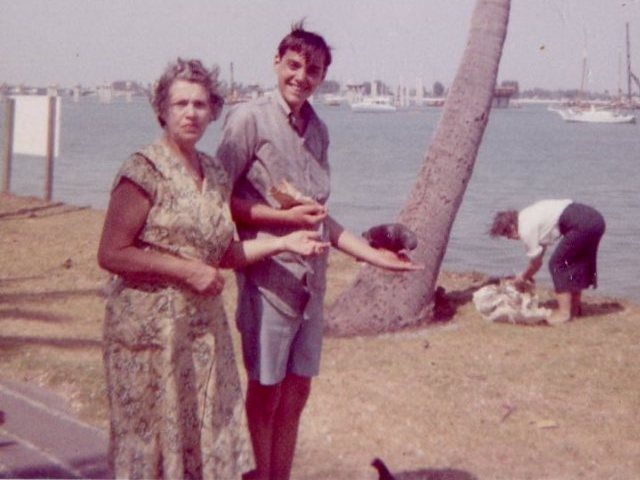
– Feeding the pigeons in Bayfront Park and going to Pier Five in downtown Miami.
– Passing Burdines and seeing the amusement park on the roof and the big neon Santa between the buildings.
– Going to the original Parrot Jungle and Monkey Jungle and taking an airboat ride in the Everglades.
– Going to FunLand Amusement Park on NW 27th Avenue and 79th Street.
– On Miami Beach, eating at Pickin’ Chicken, Picciolo’s Italian Restaurant, Wolfie’s, on 21st Street and on Lincoln Road, The Noshery at the Saxony Hotel, Famous Restaurant on Washington Avenue, and Hoffman’s Cafeteria on Collins.
– Going to the movies at The Caribe Theater on Lincoln Road. I saw “The Planet of the Apes” there in 1968.

My parents retired in 1977 and moved to Florida. They bought a condo at Kings Point in Delray Beach. I would come down to visit them during my Easter breaks, but this place was not my cup of tea. Then in 1990, I took a ride down from Delray to Miami Beach with my parents, and the magic hit me again.

At that time, South Beach, as it is now called, was going through a renaissance, and I was hooked. It was at that point that I started to think that this is the place where I would like to retire.

Now, here I am back in Miami, sadly, many of the places I remember from my childhood and adolescent visits no longer exist. But Miami has moved forward and is now a world-class city, and I am happy to be a permanent resident of this “Magic City.”

On Christmas Eve in 1964, in the midst of revolutionary activity in Cuba, my family and I were expelled from our rural Cuban town without any warning or money.?

Suddenly, we all were on a new trajectory of unforeseen challenges, opportunities and lessons. ?

I arrived in South Florida in the summer of 1975, after being discharged from the U.S. Army. Miami was a transient city back then. Cubans were outsiders, and many local Miamians wanted us to go back to where we came from. It was a cold and ruthless environment here, and, at the time, many of us did not have successful role models to look up to. But we had values and we would do whatever we needed to do to get ahead — from delivering milk to cleaning bedrooms and bathrooms at Miami Beach hotels.

I worked as a door-to-door salesman. It was an honorable life, one that rewarded those who embraced it and who earned as much as they could. The sky was the limit, as long as you didn’t let others define you. I was not about to give anyone that much power over me. I was not the smartest, but I would be the hardest worker, the most organized salesman, and the most productive employee in that sales group. I had no idea how difficult it was about to become.

I was 23 years old in a strange new city, with no one to network with, and no referrals from people who could help me find a prospect. The first week was a brain-crushing, ego-deflating experience. After one week, I walked up and down every apartment building in Fontainebleau Park, off Southwest 87th Avenue. I walked through every clothing manufacturing factory I could find in Hialeah.

I had nothing to show for it. I had not made one penny, and unless I generated a sale, by the end of the month I would be fired. I was ready to quit, but I did not. I came from a humbled economic background, from a family of rich personal values. I knew it was going to be a rough road, but I was determined to make it work: America was now my country, and Miami would soon enough be my home.

I poured through the Yellow Pages and made countless calls. One day, I contacted a business, and asked for the man whose name I had from an article in the Miami Herald. He was a real “somebody” who had just sold a company and was on his way to building another. I was getting used to the rejections from the gatekeepers, the assistants, and I still had not succeeded in getting an appointment to sell insurance. But by now, I was somehow immune to the rejections. I was shocked when the assistant transferred the call to “Mr. Big.”

He asked me, “How did you get my name?” I told him, “from the D&B; index cards that have the name of employers in Miami and I had read about you in the newspaper.”

Then he went on to give me a few encouraging words: “To succeed, you have to fail. When you fail, you learn. When you fall, you get up.” These were the first encouraging words I had heard from someone whose name was in the paper. Mr. Big was bigger to me than he would ever know.?

Those words of wisdom gave me the fuel to make more calls, to survive the week, and by the end of the second week, I had 12 appointments to make my pitch. Later that week, I met another Mr. Big. He, too, declined to buy my services but just like the one before, he gave me words of encouragement that filled my heart with the energy I needed to push ahead.

Those two individuals — without knowing it — helped me create a new world for myself and my family. These are the kinds of individuals who have made our city a magical place where dreams come true: I currently serve as chairman of MBF Healthcare Partners, L.P., a private equity firm located in Coral Gables, and recently published my memoir, Humbled by the Journey: Lessons for My Family and Yours.

Like me, who knows how many others have been guided, encouraged and driven to live their dreams by individuals like the two who touched my life?

They have not known until now how much they have meant to me. Mr. Armando Codina was the first Mr. Big. Thank you for what you did, for who you are. The second Mr. Big, came into my life at a time when I needed a word of support. To the family of Mr. Leonard Miller, I owe much of who I am to your dad, your husband, your grandfather, your Lenny.?

This is who Miami is. This is what we need for Miami to continue to be!

World War II was over, but not for my father, U.S. Navy Commander Charlie Houghton. There was one more job for him.

He was placed in charge of decommissioning and restoring the hotels on Miami Beach that the Navy had used. During that time, my father worked with two of the hotel owners. They liked the job he had done and hired him to work for them. They owned Westview Country Club in North Miami. They thought it was too soon after the war to reopen the Westview. Their idea was to open a trailer park on their golf course. They wanted my father to start it up and manage it.

It was exciting to live in a country club. Our living room was large enough to set up a volleyball net and play a game. The country club itself was built on a hill surrounded by beautiful green grass.

We were there for just a week when a hurricane hit. We Houghtons knew nothing about hurricanes. My father and mother gathered all eight of us kids into the main living room and we stayed there until the storm was over. The surrounding land and roads were flooded. It wasn’t unusual to see someone rowing a boat up Northwest 119th Street. When the water finally subsided, one of our neighbors drove up in his truck to show my dad the rattlesnake he killed in his yard. My six brothers gathered around the truck to see the rattler. My sister and I hung back and saw it from afar. IT WAS BIG.

My dad and older brothers, Tony and Jimmy, worked together to get the trailer park up and running. The boys learned a lot that summer about electrical, water and sewer hook ups. They built it and “the people came.”

My new friend, Bessie Crocker, lived across Northwest 119th Street. Her mom and dad owned and ran a restaurant named The Blue Yonder. The restaurant was only open for dinner. One day, Bessie’s mother made us a lunch of delicious German noodles and let us eat in the dining room. She was a wonderful cook and nice lady.

Behind the restaurant was a huge cow pasture. Bessie and I explored the pasture and jumped over a lot of cow bones. We didn’t want to touch dead stuff. One day a big brown bull chased us. It was scary. Cow pastures can be scary. We actually outran the bull. That’s how scared we were.

My brother Richard and I would walk down our street to a neighbor’s farm. I liked to go there when they dipped the cows. The cows swam in a deep narrow cement pool filled with something to kill fleas, bugs and tics. The cows swam across the killing pool and got out on the other side and walked away as if none of that trauma really happened. Oh, to be a cow!

The era of having a trailer park on the gorgeous rolling lawn of a country club was over. The owners wanted their country club back with golf players and parties and dancing. The Houghton family was on the road again. We were headed for our new house in the southwest section of Miami.

My older brothers were ardent explorers.

They set out on foot to explore our new neighborhood. Like Lewis and Clark they left with confidence. When they got home, I was told about a huge swimming pool called Venetian Pool in a place called Coral Gables. The next day, the boys and I walked to the pool. It had four cement platforms to jump or dive off. My mother gave us nine cents each to get into the pool.

I soon found out that I could earn money at Venetian. Tourist buses stopped at the pool. The tourists enjoyed throwing coins into the water and watching us dive for the money. They threw mostly pennies but sometimes a dime or nickel got tossed in. It was an underwater battle trying to be the one who got to the money first. I did well and almost always picked up enough money to buy a hot dog. Venetian Pool’s hot dogs were the best.

In the summer, we would walk to Venetian and swim all day. The pool had a natural cave with water in it. It also had an underwater hole in the wall that kids could swim through. We kids would wait in line to have a turn at diving underwater and swimming through the hole. I was always afraid that someone would grab my foot and stop me from going through the hole and then I would drown. Glad to say it never happened.

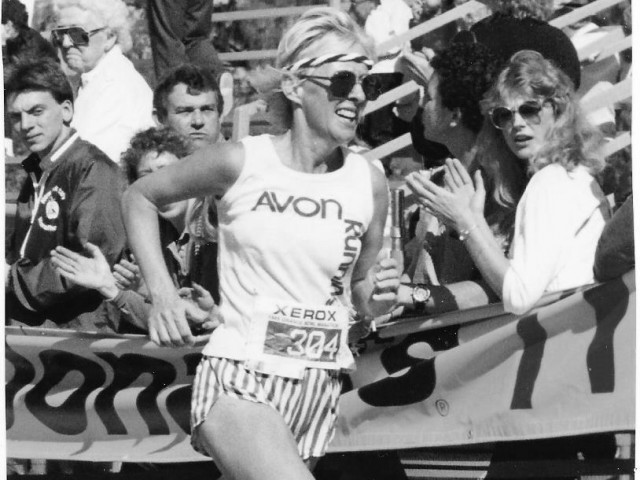
But the best-ever Miami story for me was on January 5, 1985, when I ran 26.2 miles from Baker’s Haulover in North Miami Beach to Miami, and then to Coconut Grove. I’ve never felt so proud of my hometown and the people than when I ran in the Orange Bowl Marathon. All the people along the race route helped and encouraged me to keep on running. There was the enthusiasm of two ladies on Miami Beach who clapped in time to their cheer, “Go runner, go!”

It put a smile on my face and gave me new energy to keep going. I passed an elderly couple who had set up an “aid station” and obviously spent their own money to buy paper cups and water for the runners. There was also a young girl sitting on a sidewalk who was cutting orange slices for her friend to hand out to the runners. These people and many more caused me to be so proud of Miami, my city. When I think of all their kindnesses, I get tears in my eyes.

A vacation from my very first job in New York brought me to Miami Beach in 1952 where I stayed with a family friend, just blocks from the ocean.

“Aunt” Gertrude Reid, aka “Madame Zaza,” was a crystal-ball gazer who worked at the Kenilworth Hotel, where Arthur Godfrey did his broadcast. The apartment where I stayed was on 41st Street, down the street from the first Lum’s Restaurant.

The jitney ride from the railroad station to Miami Beach was exciting for a girl just off the train from New York. Miami is where I have stayed and raised a family, and they raised theirs here, too.

My decision not to return to New York caused my parents and grandfather to move here. I worked as a medical assistant for Dr. Koenigsberg in North Miami, and then for the Miami Fashion Council in the Chamber of Commerce building downtown.

I met and married my husband here that year, and we lived on a block off Miami Avenue on Northwest 55th Street in a furnished apartment with caring landlords, the Hollandys. The area was beautiful – a white duplex with palm trees painted on the front wall. There was a concrete table with umbrella on the grass next to the building and it was surrounded by beautiful hibiscus. My grandfather loved to sit there when he visited. He continually marveled at being in Miami.

My parents had a place near the bay on 26th Street. Mom and I wore hats and gloves when we went to Flagler Street, to Burdines Tea Room, or when we shopped at Oelkers for material to make hats and ate at the Town Restaurant.

Mal Marshall had a clothing factory on Miami Avenue (and occasionally allowed the public to make purchases) and we were introduced to the “Cubavera” style, fashion with a Latin flavor. Rome Mattress Company provided bedding for the area and Sterling Equipment outfitted restaurants.

Smitty’s Barbeque on 36th Street served pretty good food, and Edith and Fritz on Miami Avenue offered all-you-can-eat items for $2. Seven Seas couldn’t be beat for seafood. B-Thrifty was the grocery store of choice close by. In Hialeah, where my husband worked, there was another favorite place to eat, Steven’s (aka Whoppie’s).

Miami Beach offered treats like seeing Sammy Davis, Jr. as a very young man, dancing with the Will Mastin Trio at the Rockin’ MB Lounge right next to the beach, across the street from the Roney Plaza Hotel, and the Noshery, also on Miami Beach.

A move out west to Schenley Park brought us closer to Variety Children’s Hospital, ice cream at Milam’s Dairy and pony rides at Suniland Park. Hardware items were purchased at Salem Supplies on Douglas Road, and Mainly Art was the place for framing and supplies. The South Dade Jewish Center was born in the living room of Elsie and Joe Segal in 1955, later to become Temple Beth Am when the building went up in 1957.

A move farther west saw three children at Blue Lakes Elementary, Glades Middle School and Killian High School. We roamed horse farms, strawberry and tomato fields, the roads west to Krome Avenue, and south to Knaus Berry Farm. There was no charge to enter Matheson Hammock. There was easy, free access to the sea wall down at the Deering Estate off Old Cutler where snapper could be caught with little difficulty.

Shrimp cocktails on Key Biscayne at the Hurricane Harbor Lounge were $1.50, and Leonard’s La Pena on Bird Road served ONLY shrimp cocktail and steak. Whitey graciously showed you to your table at The Pub on Coral Way, where the lettuce wedge was huge. Sam & Carl’s Deli on Red Road was a favorite, too, serving a “Messy Bessy Sandwich.”

A trip into Coral Gables netted you delicious pastry at Andalusia Bakery, and there was Woolworths, and Jan’s for outrageous ice cream concoctions. Jimmy’s Hurricane on Bird Road, Chesapeake Oyster House in the Gables, and Perrine were popular restaurants.

My father worked at Steven’s Market on Red Road, and played cards with Abe Katzen, who owned the 5 & 10 Cent store on Red Road in South Miami. My mom worked at Stanleighs and at Claire Whyte, both on Miracle Mile. At one time, my parents owned Toni Lords, a gift shop on Southwest Eighth Street across from the Garden Restaurant.

My mother was a veteran volunteer. She and friends started the Park West Cancer Support group with help from David Blumberg. My mother was a “listener” at school, and on the phone with children who returned to empty homes after school, as their parents were still at work. My daughter worked at J Byron’s on Miracle Mile and then for Bernie Janis, who was a pioneer in West Kendall.

My sons worked at Nathan’s, KFC, and Kmart while in high school. They continued their education, married, and raised four children in Miami, with one set defecting to Coral Springs.

My husband was a successful businessman who loved music and art, fishing, and handball at Flamingo Park on Miami Beach. He and his partner in handball and business, Eugene Fleischer, built the José Martí building on Southwest Eighth Street, still there, with a ceramic map of Cuba on the west wall created by Fran William, a local artist of the day. They also built Westchester General Hospital for Dr. Maury Fox, and a division of the first Century Village in West Palm Beach.

My husband was active in Toastmasters, and together we were active in the Miami Power Squadron, and as docents at Metro Zoo for many years. We enjoyed opera at the Dade County Auditorium, and pizza at Santacroce near the University of Miami.

The third generation is on the rise in a wonderfully burgeoning Miami with its downtown/midtown revival and unique multi-cultural flavors.

As I stroll through Biscayne Boulevard I glance up to see La Torre de la Libertad, a former political asylum center for Cubans. Although the Freedom Tower no longer carries out its administrative function, it continues to serve as a beacon of welcome for all Cuban refugees, those of the past and future.

The tower elicits few emotions inside of me, since I arrived from Cuba at the age of 3; however, it does remind me of both the triumphs and struggles my parents endured when settling in Miami in hopes of creating a brighter future for me, their only daughter.

My parents were among the influx of immigrants who arrived in the late 1990s. My father, Roberto Perez, arrived on a Friday in 1999. The following Monday, he began working as an electrician by day and cleaned restaurants as a busboy by night.

Six months later, my father found himself waiting in the airport with a bouquet of roses and a balloon that said, “It’s a Girl” (he still had not enrolled in English classes). Before he knew it, he was reunited with his young daughter, wife and mother-in-law. With a family under his wing, it was time to move forward at full speed; fortunately, my mother and grandmother were by his side.

Only a month after my mother Ani arrived, she eagerly began learning English at the Adult Education Center at Coral Gables Senior High School. She later enrolled in the REVEST program, an English class tailored to immigrants, at Miami Dade College Wolfson Campus.

While taking classes, she worked in the jewelry department of Service Merchandise. It was her first job in America, one she remembers clearly from soaking her feet in a bucket of hot water each time she came home from work.

The following year, she enrolled in MDC to take computing and accounting classes as well as ENC 1101. At the age of 30, she sat alongside recent high school graduates. While taking ENC 1101 in the day, she took on a night job as chief of data input in the Miami Jackson Adult Education Center.

My father also completed the REVEST program at night, while continuing to work as an electrician in the day. He continuously hopped from company to company in search of a higher wage.

Fortunately, my grandmother offered to stay home and take care of me so that my parents could work and further their education at the same time. My household valued what it meant to be a family. Even as a child, I realized the continuous interplay of teamwork among us. They figured that if they overcame the hardships of Cuba together, then they would surely overcome these times as well.

Once I was old enough to go to school, my grandmother Miriam Alderete was hired as a Spanish teacher at a private K-8 school, where she worked for 14 years. She was recognized by the Institute of Hispanic Culture with the Academic Order of Don Quijote de la Mancha award for her excellence in teaching Cuban literature.

The pivotal point in my father’s career occurred when he matriculated in vocational classes in electricity at Miami Senior High to obtain his journeyman license, which soon proved advantageous when he was hired four years later as an electrician for Miami-Dade Housing, and later as a plant electrician for Miami-Dade Water and Sewer.

No longer being able to bear going to work when I came home from school, my mother took her Florida teacher certification examination and was hired as a full-time teacher at Booker T. Washington Senior High. She woke up at 5:00 each morning for five years to avoid the expressway traffic heading to downtown; still, she thought it was worth it.

In 2004, my brother was born and so my mother transferred to Miami Sunset to be closer to home. She earned her master’s in mathematics education from Nova Southeastern University five years later. Soon after, it was my father’s turn as he earned his master’s in electrical, burglar alarm and fire alarm specialty.

While growing up, I saw my parents build a new home, a new life and even extend the family, whether it was by having another child or lending a hand to others so they too could build their new lives.

As refugees we cannot measure how grateful we all are to have been able to step foot in Miami and watch our lives unfold in ways we could have never imagined. However I am even luckier than my parents because I have been able to “stand on the shoulders of giants,” as Isaac Newton said.

My parents, along with other refugees, have played their own role in the building of the city, but most importantly they have laid the foundation for the next generation. They held our hands and carried us on their backs through the storms of adversity the new country brought forth only to steer us into calm waters, hand over the wheel and say, “now it is your turn.”

Translate »