Skip to content
Named Best Museum 2022
by Miami New Times

I grew up on the North Shore of Boston in the ‘50s and ‘60s in a small blue-collar town with its four seasons. It took me years to figure out why every year I would get “blue” in August. I loved summer, beaches, the sun, and walking around in flip flops. In August, I knew the winter, the cold and snow were coming and I did not like that fact.

Once, in my early 20s, I begged my girlfriends to take a trip somewhere in warmer climate where there were beaches, sun, and I could walk around in flip flops. The three of us traveled to Bermuda and, on my second day there, while I was sunning on famous Horse Shoe beach, along came my future husband with two of his friends, all from Italy.

Marcello and I hit it off right away, even though I thought he was German and told him that. (He had blond hair and green eyes.) With his hands flying around, he told me he was Italian and from Tuscany. Six months later, we were married and were trying to decide whether to live in Boston, Bermuda, or somewhere else.

Marcello told me that when he was a little boy he always dreamed of Miami Beach. He also is a beach bum, likes the sun, heat, and walking around in flip flops. So, the bold decision was made that we would move to South Florida.

Marcello flew down in late 1972 and stayed with my second cousin until he found a job and an apartment for what was now a family of three (our daughter Diana was born in Boston in October 1972). He found a job at famous Valenti’s Restaurant on U.S. 1 in Kendall, and worked there for several years.

Marcello’s goal was to own and operate an Italian restaurant within five years of our settling in Miami in early 1973. He made that dream come true in 1977 when he opened Il Pappagallo Italian Cuisine in Perrine on U.S. 1. It was a small restaurant that could seat approximately 55 people, and it was very successful for almost 30 years. Marcello and several of his original staff – Karin from Germany, Anna from Italy, and Ugo from Argentina – were with us for many years. People came from all over Miami-Dade, and even from the Keys and Broward County, to dine in our quaint little restaurant.

Our first residence was in King’s Creek apartments across from the huge Dadeland Mall. I would walk there with my newborn daughter and shop at Jordan Marsh and Burdines. A couple of years later, we moved to the Briar Bay/Falls area and have owned our home for 34 years. I now walk to The Falls and shop at Macy’s.

Our second daughter Cristina was born at Baptist Hospital in Kendall on Christmas Day, 1974. On Cristina’s 10th birthday we hired a white limo and had the limo driver dress up as Santa and we ate at the beautiful Reflections restaurant in Bayside. For fun, we would take day trips and a picnic lunch to the Keys, Matheson Hammock, Cape Florida and Miami Beach. Life was good.

Our daughters went to Killian and Palmetto schools and received their degrees from Florida International University. They now live in Central Florida but still love Miami and would like to move back.

While Marcello was at his beloved restaurant, I worked for the federal government in Miami for 36 years as an international trade specialist for the U.S. Department of Commerce. In this position, I was very lucky to have met many members of the international community, exporters, and local, state and federal government officials. It has been a joy to see how Miami International Airport and PortMiami have grown into world class operations. In 2009, I received the International Women’s Day Award from the World Trade Center Miami and in 2011, the International Business Woman of the Year Award from the Organization for Women in International Trade.

The Santucci family will always remember how Miami was a small city and how it has changed since we arrived in 1973. Back then, the tallest building in downtown Miami was a bank and, of course, the Dade County Courthouse on Flagler. Miami Beach was full of rental apartments for the elderly and you would see them sitting out on the front porches in rocking chairs, enjoying the salt air and sunshine.

We did survive Hurricane Andrew even though we lost the restaurant business for four months, and our home was half destroyed. We never thought of leaving, but only thought of rebuilding. On the first day of reopening our restaurant we gave all proceeds to Zoo Miami (then Metro Zoo) and to a homeless shelter.

Miami is and will always be our home town. We love that it has evolved into an international city with people from many cultures and countries. On our small cul de sac we have families from China, El Salvador, Brazil, Cuba, and other U.S. states.

Over the years, we took at least 15 cruises, and have made many trips to Italy to visit Marcello’s family and to New England to visit my family. But, we are always pleased to return to our home, Miami.

I was always amazed at one coincidence Marcello and I shared. He and I were both born near the 42nd parallel north – he in Tuscany, Italy, and I near Boston, Massachusetts. And from our early childhood years, we both knew we wanted to live south in a warmer climate.

Marcello and I are now retired near the 26th parallel north in Briar Bay/The Falls, and are enjoying the sun, beaches, and walking around in our flip flops! Dreams do come true…..

I was born 70 years ago at Jackson Memorial Hospital. My father had done his surgical training there in the late 1930s, following his mother’s move to Miami from Tennessee.

My great-grandparents came to Coral Gables in 1928, and my mother’s family wintered here and later took the grandparents’ home. My parents’ wedding reception on Nov. 18, 1941, was the last major event at the Biltmore Hotel before it became an Army hospital.

Dad was happy to find a house after WW II, since properties were scarce. It was located near Bird and Red roads, which had Allen’s Drug Store, Woolworths, and B Thrifty. Our street was next to the rock pit where we played with the dreaded BB guns. It is now the site of the YMCA. In 1950, we moved a few blocks east to Coral Gables.

Starting in 1947, I went to JMH with my father, and after ninth grade, Dad got me summer jobs at the hospital to see if I really wanted to be a doctor. The hospital was segregated, but I worked with and under African Americans, which was very enlightening for me.

In 1958, my first summer at JMH, my monthly salary as a pharmacy tech was $212. I worked eight summers with no salary increase. In 1970, I treated Cuban refugees from the Freedom Flights in the rooms of the old ER.

Dad was willing to pay 10 cents for the Venetian Causeway instead of using MacArthur Causeway to get to my aunt’s flower shop on 36th Street. While riding the flower shop truck in the 1950s, I marveled at the wonderful new hotels in Miami Beach. I remember Dixie Highway (U.S. 1), with its two lanes, and along the two lanes of Kendall Drive, there was only tall saw grass.

In 1950, my father’s commute improved when he moved to the 550 Building on Brickell. It was the first office building on “mansion road.”

Because of a shortage of schools, 50 children were in my Coral Gables Elementary first grade classroom and we had to share desks. I became very proficient at air-raid drills. I wasn’t allowed to go to the Venetian Pool because of the fear of polio, and I was among the first to get the Salk vaccine.

Every Saturday, for 25 cents, I spent most of the day at the Miracle Theater. When I was older, I never used the double seats at the Coral Theater, but was jealous of those who did. We took buses everywhere, including to downtown Miami.

Our family ate dinners at Red Coach Grill, Edith & Fritz, and Batista’s, later called Delmonico’s, at Ponce de Leon Blvd. and Douglas Road. For seafood, we usually ate at Loffler Brothers, and on big occasions at Chesapeake’s. I would eat four or five mini cheeseburgers at Royal Castle, and never worried about it. Shorty’s BBQ seemed a long trip from the Gables but worth the drive.

At Christmas time, we drove to see the house lights, especially on South Alhambra Circle. We also went to Burdines to see the train exhibit and to ride the Ferris wheel. Of course, one had to visit the outdoor display at Holsum Bakery.

The heat at school and home wasn’t much fun during the warm months. The large attic fan helped a little, but nothing like our first wall AC unit when I was 10. During summer school, I drenched my starched shirts at the UM “cardboard campus,” which had no air conditioning. That site became part of the “new” War Memorial Youth Center. Because Tahiti Beach cost 10 cents, we went to Matheson or Crandon parks, which had the zoo. In high school, we water skied by the mangroves near Key Biscayne Yacht Club and would leave our stuff on the beaches behind private homes.

Other thoughts about growing up here: At the Coliseum, I enjoyed seeing Golden Glove boxing matches and the Harlem Globetrotters, and later enjoyed bowling when it was converted. Initially, in the Gables, we could drive through the Douglas Entrance and along University Drive through UM to Ponce de Leon Junior High. The air raid siren sounded every Saturday at noon and the UM carillon played at 5 p.m. on Sundays.

As to the demographic changes in South Florida, a few years ago I started studying Spanish, which tells it all. Coral Gables and the rest of South Florida is certainly different from my youth, but I still love it and am thankful to be home.

After a family road trip in 1969 from New York City to California to Miami and back to New York City, my husband, Guillermo, and I were very impressed with Miami. We saw a burgeoning metropolis holding much promise for the future of our children.

Guillermo was Cuban, having left Cuba in 1947, and I am an American whom he met in New York City and taught to speak fluent Spanish.

In 1970, we took a vacation to Miami and purchased five acres in the Redland, for a very paltry sum. In 1972, we decided to move to Miami. Everyone told us Guillermo should go ahead and get a job and a place to live first, which was the logical thing to do. However, we had never been apart and decided to come down together and let fate take over.

Luckily, we sold our house quickly so that we could move to Miami by the end of August and the new school year. My husband didn’t trust moving companies, so he rented the largest U-Haul van he could find, packed all of our belongings and then we headed south with a huge sign on the side saying, “Miami or bust.”

Guillermo and our 12-year-old son, Ron, rode in the van towing our car, and I followed with our 10-year-old daughter, Arlene, in our station wagon. We used Walkie-Talkies to communicate with each other. After each stop, we’d find notes on our huge banner from people all over the country wishing us well.

Upon reaching Miami, we immediately found a lovely house to rent and set about looking for jobs. Even though Guillermo had his own business in New York, he took a job as a carpenter building houses. This turned out to be a fortuitous move. After looking at several houses and seeing how they were constructed, my husband determined he wanted to build our house himself. Although the land we had purchased was in a pretty desolate area at the time, after studying the county’s future development plans we decided to build on our property.

After consulting with architects and learning what their fees were, I decided to design our house myself, and we had building plans prepared by a draftsman for one-tenth the cost.

My husband knew something about construction, but certainly had never built a house before and knew nothing of Miami’s building codes. However, he learned fast, made useful contacts on his job, and consequently never failed an inspection in the building of our house. Proof of his capabilities came when Hurricane Andrew didn’t even cause a leak in our roof.

Guillermo eventually became a contractor here, and the buildings and structures he subsequently built at Miami’s Metrozoo were among the few that withstood that storm. Since Guillermo literally built our house himself with a little help from our children, friends and an occasional expert — working nights and weekends — it took two years before we could move in.

My children learned to become expert equestrians, since we bought them each their own horse. It was the only way they could visit their friends.

Their father built them jumps and barrels for the horses, and our front yard became a mini steeplechase.

We knew all of our immediate neighbors, who lived several acres away, and the area had a small-town, country feeling. On Christmas, one of our neighbors came by with a wagon full of hay carrying a group of carolers.

We had frequent visits from bald eagles, and I even saw a pair of bobcats crossing the road one day.

Ron, with his innate interest in animals, invariably found all kinds of snakes and animals, which he brought home both dead and alive. He had a hobby of taxidermy at the time and would preserve birds and small animals. He once brought home an injured owl he hoped to nurse back to health, which he put in his room. When I came home and found his door shut, I opened it only to be scared out of my wits by the screech let out by the owl.

Krome Avenue back then was a narrow two-lane road. Coral Reef Drive was a dirt road going east to 137th Avenue, and only a two-lane road from there on. Kendall Drive was mostly farmland a little after Dadeland until Kendale Lakes, which was billed as “The Town Beyond the Crowd.”

Both of my children have Miami to thank for their careers, also. During his summer vacations from the University of Florida, Ron worked with snake expert Bill Haast at the old Serpentarium on U.S. 1. When they started building the new zoo in South Dade, Mr. Haast recommended Ron for a position there. He started when the zoo was still at Crandon Park, subsequently moving to the new zoo, where he is Zoological Ambassador/Director of Communications.

Ron also credits his job for having met his wife, Rita. She was the physical therapy intern who treated him when he was bitten by a crocodile while filming a TV commercial.

Arlene became a candystriper at South Miami Hospital during her high school years. She found her calling there, went on to become a registered nurse and worked in the trauma unit of Jackson Memorial Hospital. There, she met her future husband, Dr. Pedro Carvajal, when he was an orthopedic surgeon just out of the University of Miami’s Medical School.

Miami was good to us from the moment we moved here. My husband built our dream home, and he was able to plant a grove that would give him all the tropical fruits he missed from Cuba. Sadly, he died suddenly, and much too young, of a pulmonary embolism in 1991. I’m thankful to Miami for all it’s provided for me and my family, and am fascinated by all of the positive changes I’ve seen since we moved here. Miami is truly becoming a world-class city. The best thing we ever did was move to Miami, and I know that its future, as well as that of my children and grandchildren, will be brilliant!

I’ve visited Miami often over the past 20 years, sleeping on friends’ couches, perusing thrift stores, gorging on ceviche, watching the ever-changing crowd along Ocean Drive.

But it wasn’t until 2009, when I stepped outside all comfort zones to research my book, Fringe Florida, that I got an inside glimpse into the diverse and quirky glory that defines Miami.

My research trip was a whirlwind of interactions with everyone from python owners to nightclub promoters. I kicked it off with a day at a swinger’s convention at a hotel downtown, where waiters in guayaberas served drinks to randy nude couples. Fringe Florida is a book about the state’s unusual and sometimes illicit subcultures. In Miami you didn’t have to dig too deep to find Middle Earth.

But as with any major project, many valuable experiences fall to the floor in shaping the final piece. At the time, I was still exploring the notion of juxtaposing Miami’s 1980s cocaine glory days against its modern party drug scene. My impressions of the earlier period were colored by documentaries such “Cocaine Cowboys” and of course, the Hollywood fictions of “Miami Vice” and “Scarface.” All cast the era as violent, but glamorized by easy money and the hedonistic excesses that go along with it.

In search of remnants, I checked into the Mutiny in Coconut Grove. The Mutiny once served as a party palace for drug lords and home to many who sniffed a daily diet of the white powder that fueled the local economy. Nearly 30 years later the Mutiny had transformed into a sleepy sleek condo-hotel. All that remained of the wilder days were second-hand stories. Tips in blow, coked-up residents lighting $5 bills and then climbing balcony to balcony to escape the smoldering fire.

On a walking tour of pastel Deco South Beach, a fellow tour-goer confided he lived at the Mutiny in the day. A tan fit man in his 60s wearing designer jeans, he spoke of all-night parties and nude women running down his hallway. “It was like living in an upscale brothel,” he said. More important, his former Coconut Grove home was a set for – what else, a handful of “Miami Vice” episodes.

I later cruised by the modern three-story house shrouded by lush palms and live oaks. No Don Johnson loafing around in white linen suits and sockless loafers, just a flock of bright blue peacocks wandering the streets, interlopers from a distant land not unlike me.

I tarried through a long list of drug lore sites, real and Hollywood.
In Bal Harbour I strolled the jetty beside the Harbour House condo tower where cocaine smugglers Jon Roberts and Mickey Munday once put up women who acted as lookouts for law enforcement patrols.

On this bright October day, the white sandy beach was nearly empty and the refurbished condo tower appeared lifeless. A vintage runabout cut through the teal waters of Haulover Cut. I imagined someone behind the condo’s glass eyes watching it through binoculars. The illusion faded when a New York condo owner fishing for snook said he knew nothing of the tower’s infamous history.

Too many of the sites were drive-bys with no opportunity for interaction. The banks of Biscayne Boulevard which once laundered millions; gritty Jones Boat Yard where corrupt police raided a boat loaded with 400 kilos of coke as the crewmen jumped overboard and drowned; luxurious mansions of former kingpins in gated communities beyond reach.

By definition, the site of the “Dadeland Mall Massacre” would be available. Many consider what happened on a sunny afternoon in 1979 the start of Miami’s cocaine turf wars. Two men armed with machine guns jumped out of a panel van and sprayed Crown Liquors with bullets, killing a rival drug kingpin and his bodyguard and injuring the store clerk. After a white-knuckle drive in rush hour traffic, I arrived at Dadeland Mall to discover the liquor store had been swallowed by Saks 5th Avenue during a mall renovation.

Miami’s bad-boy glamour was an illusion cast by Hollywood and revisionist history. The world of Miami’s cocaine titans may have been an oyster, but there was no pearl, only a prickly shell that in short order began to smell foul.
As for the modern club drug scene, in the time I spent inside the velvet-roped hot spots, I found trending drugs that spanned the letters of the alphabet: Special K, X, and G. Not so different than you’d find in a nightclub in any major city. At the time, the most distinctive drug culture revolved around pill mills. I visited one. They sent me to a walk-in MRI clinic down the street.
In hindsight, I’m not sure what I expected to find. The cocaine era was a dark time and one that continues to haunt. My Miami friends say tourists still ask where to score an 8-ball.

It wasn’t until I joined the lunchtime crowd at Mac’s Club Deuce that my disillusionment gave way to an appreciation of what Miami had become. Except for the neon gracing its wall, courtesy of the “Miami Vice” crew, it looks like a set from a Damon Runyan novel. Dark and smoky with the original red laminate serpentine bar, Club Deuce has had few alterations since it opened in 1926. The bar’s real treasure is the spell of friendship it casts. Before I finished a screwdriver, I met everyone.

The longhaired fashion photographer wearing more silver bangles than I thought humanly possible who worked on his laptop to be able to write off his drinks. The young businessman in a starched shirt unbuttoned enough to show a white undershirt. A blustery former cop who ranted about Obama. An Ecuadorian pottery wholesaler who for years in the 1980s wouldn’t leave his home at night much less venture to South Beach — three men with a gun and a machete had mugged him outside a club. “It was extremely dangerous on South Beach,” he said. Now he lived there and wouldn’t dream of moving.

Mac Klein, Club Deuce owner, was 95 when I met him and looked as if he could take a man 20 years younger. He was wearing an unbuttoned Hawaiian shirt; his glasses were thick and black. He didn’t talk much, but kept reemerging from the back with memorabilia. The bar’s original menu. A flier for the “Miami Vice” wrap party. A thank-you note from the cast. A dog magazine featuring his champion Doberman pinschers. Sensing my love of dogs, he insisted that I keep the magazine, which I now treasure.

My drug scene exploration may not have turned up the type of fringe I sought for my book, but I have no regrets aside for the credit card debt I racked up. And on any trip, I make a point to duck into Club Deuce and say hello to my friends, whoever they may be that day.

I moved to Miami after returning from my Fulbright Scholar Program in 2002. The same muggy air, car horns, heat that I left in the Philippines greeted me as I walked out the doors of Miami International Airport.

The cab driver spoke to me in Spanish and I understood everything he said, but I was slow to respond. I had spent the last year speaking Tagalog, a language full of Spanish words after 300 years of colonization. When I instinctively replied to him in Tagalog, he just kept on, unfazed, in Spanish.

My job at the University of Miami started right away. For the first year, I lived in Kendall, or “Kendalia” as I liked to refer to it. It took more than an hour in rush-hour traffic to get to and from the Coral Gables campus. In Manila, traveling five miles from Quezon City to Makati had taken an average of two hours each way. Now, instead of getting anxious, I could let go of the frustration and instead spend time listening to the Latin stations, dancing in my car and practicing Spanish.

In 2009, I moved to a neighborhood along Coral Way, a historic urban boulevard that runs through Miami from Brickell Avenue to 37th Avenue. My house had been built in 1939 along with other bungalows and mission revival-style homes. Everyone on my street spoke Spanish almost exclusively.

My casita stood between two houses of the sadme style, and within these houses lived viejas. On the right, there were three widowed sisters — Marta, Olga and Paula. On the left was Elsa, also a soltera. The women were best friends, and I’d see them on the sidewalk in front of my house, sometimes laughing together, sometimes shouting in anger. Right away, they befriended me, a single woman much younger than they were and never married. They called me China even though I told them, “Yo soy Evelina, la Filipina. No soy China.” They laughed at me, calling me China anyway.

Elsa was a small and quiet widow. From afar, I never knew how she was feeling, but face to face, I could see it in her eyes and in the path of her delicate wrinkles. Every day I would notice her standing by the chain-linked fence in her front yard, watching the street, waiting for the mail, and talking to passersby.

One afternoon I brought her a mango from my tree.

I can hold a polite conversation in Spanish, but when it gets malalim — deep — I mix my languages. Sometimes Tagalog comes out when I mean to speak Spanish, or vice versa.

Elsa recounted the story of her life to me at her kitchen table. She had suffered bouts of depression since she came to this country. Never in Cuba, only in this country. She wouldn’t even say it — the United States of America. Solomente en este pais, pero nunca en Cuba. These days she felt nervous constantly. Everyone she loved had died — su mama y papa, su esposo y hermana. Seven years ago, her husband and sister had died months apart. Though she had the abuela sisters, who took her everywhere, and a daughter in Boston, she couldn’t calm her nerves. The noise of her memories crowded her head, kept her up at night.

We sat for a long time. She picked up the mango, smelled it, and handed it to me. “Que rico,” she said.

I told her she needed a novio. She laughed.

When I married last year, Elsa quickly took to my husband, who spoke absolutely no Spanish. They exchanged words each day. She sneaked up behind me one day to tell me my husband was a good man. “Y guapo tambien,” I told her jokingly. Yes, yes, he’s handsome, so be careful, she said, women will try to take him away from you. She gave me a look. I told her I’d be careful. No mujer would come between us. We laughed and then she told me she liked my dress. A moment passed, and she said, “Tu esposo es una buena persona.”

Last month, when my husband and I came home from a trip, nobody was standing at Elsa’s gate. On the fence and the trees nearby, someone had posted “No Parking” signs.

“Something’s wrong,” I told my husband.

“It could be anything,” he said.

For days, the neighborhood was quiet. The abuela sisters were nowhere to be seen.

One day soon after, my husband came home and told me he had found out what happened to Elsa.

“Who told you?” I asked him.

“Olga.”

“What did she say?”

“I don’t know. It was in Spanish. But she was talking, talking, talking and she went like this.” He put his hands together and leaned his head on them with his eyes closed. “And then I said, ‘She died?’ And she said, ‘Sí, sí, sí.’”

Elsa was not the first to pass away since I moved into this casita. There was an old man across the street during my first year. And last year, Marta, one of the abuela sisters, died of a brain tumor. Now Elsa. I like to think the spirit of these viejas are circling the bamboo, the mango and the avocado trees, whistling love songs, blessing us from afar. I like to think they are a part of a Miami that will never die.

They have taught me that you don’t need the right words, or even the same language, as long as you are willing to sit with one another and listen.

My mother hanging on to the top of a telephone pole is one of my earliest memories of South Florida. It lingers in my mind some sixty years later. Soon after we moved here from up north, a hurricane blew through. My father was away on business, so it was just my mother, my two younger sisters and me.

We were lucky to have long-time Florida residents as neighbors, so we did whatever they told us to do to prepare. We made it through the storm with little damage, but, as usual, we lost power, and telephone. The power came back on in a day or two, but the telephone didn’t.

Over the next week, everyone else on our street got their telephone service back, but ours was still out. Using a neighbor’s phone, we’d call every day, only to be told to be patient. Finally, after about ten days, I watched with amazement as my short, slim mother (I was only eleven, but already taller) shinnied up the telephone pole. Wrapping one arm around the pole in a kind of “death hug,” she used her free hand to reconnect the wires into the main line.

From her perch she sent me back into the house to make sure the telephone worked before she came back to earth. One try and she managed to get it connected. No one from the telephone company ever came.

That definitely “low-tech” repair job was accomplished many years before women would be seen wearing hard hats and working on telephone lines. My mother’s climb provided a telephone that still worked when she moved out of the house thirty years and many hurricanes later.

I was born at St. Francis Hospital in March 1947.

My parents both came to Miami Beach for work, my mother in 1936 and my father in 1939. They met while working together at a deli, owned by my great aunt and uncle (Mary and Dave Alper).

We lived on 15th Street, near Washington Avenue and the old Miss Ehrman’s dance studio. We were one of the first families to move to the very new Morton Towers. A lot of my family moved to Miami Beach soon afterward.

My grandmother Fannie Malschick, already retired, lived in one of those apartment/hotels on South Beach that now host the rich and famous. She played cards with her cronies, did group exercises on 15th Street and safely walked everywhere.

My uncle, Gilbert Malschick, worked at the Eden Roc as a bartender from the 1950s to the 1970s. My cousin, Allen Malschick, was a well-known Miami Beach photographer who took pictures of many celebrities who entertained at the hotels on Collins Avenue.

My father eventually opened his own deli with partner Phil Seldin (Raphil’s Deli on 41st Street). His customers included the famous and infamous. Before that, my dad owned The Little Inn restaurant in Miami, a popular hangout for soldiers and friends during World War II.

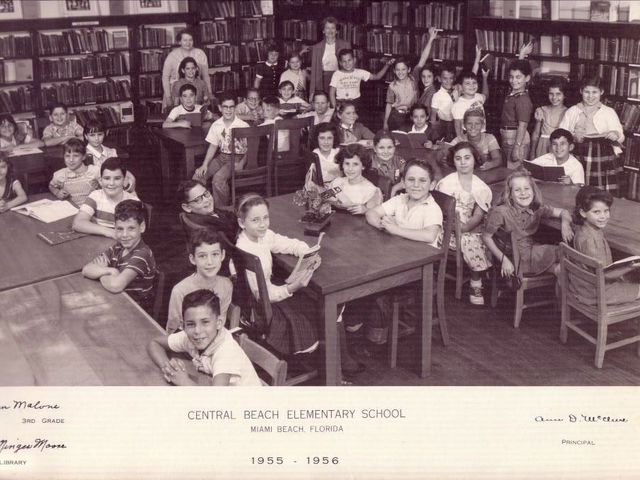
I attended Flamingo Park preschool, Central Beach Elementary, Fisher Jr. High and Miami Beach High School. Many of my friendships, born during those years, have stood the test of time and I am in touch and close to many of those “kids” today.

In 1960, the first wave of Cubans came to Miami Beach. All of a sudden a new culture was introduced, and we had tons of new friends. We spent the sweet years, as I now refer to my childhood, at Saturday afternoon matinees, shopping on Lincoln Road, and eating at Liggett’s or Wolfie’s. Friday night was dedicated to dancing at the 10th Street auditorium, and on Sunday, many beach parties were held at 14th Street and Ocean.

As we began to drive farther from the Beach, we hung at Fun Fair and the bowling alley across the street, Corky’s and Marcella’s Italian Restaurant, known for the amazing garlic rolls. We ventured even farther to the Coconut Grove coffee houses and playhouse.

I left Miami Beach after high school graduation in 1965, but my heart remains in the memories of those wonderful years. Our lives are richer for the experience and we have grown both up and together these many years later.

The year was 1942. My father, Don Terry, was in the Navy stationed at the Everglades Hotel in downtown Miami. During World War II, the hotel was used as a Navy barracks. He swept every floor of that building.

One Sunday evening, he went to Central Baptist Church where he met my mother, Margaret. Instead of marrying right away, he left and served in the South Pacific theater for the remainder of the war.

My parents wrote letters back and forth and each letter was numbered. Not ONE letter was lost over a period of three years. Today I enjoy reading parts of those letters. One day, I hope to write a book about their experience.

In March 1945, they were married and they honeymooned at the Leslie Hotel on South Beach. I was born a year later.

After his honorable discharge from the Navy, Dad returned to Miami and worked awhile at Eastcoast Fisheries along the Miami River. Having taught school in Texas, he applied to teach here in Miami. He taught speech, drama and band at Hialeah Jr. High., Robert E. Lee Junior and West Miami Junior until his retirement in 1975. Sen. Bob Graham is one of his former students. He passed away right after Hurricane Andrew in 1992.

Mother, a native Miamian, was a graduate of Miami Senior High, class of 1935. She worked at the downtown Burdines store and then at Florida Glass & Mirror. She also worked several years as registrar at Kinloch Park Junior High and retired from the payroll department of transportation to enjoy watching her only grandchild.

Also a native Miamian, I attended Miami Senior High, (class of 1964), then went on to Miami-Dade Junior College, Barry College and University of Miami. I taught in Dade County Public Schools for 32 years — at Kinloch Park Elementary, Gloria Floyd and South Miami Heights Elementary, from which I retired from in 2001.

I now co-own and manage Bijoux Dance Center, 4150 SW 70th Ct., where I teach ballroom dancing. I have so many memories of Miami over the past 60-plus years and how it has changed. The skyline, demographics and spoken languages now reflect the cosmopolitan nature of my hometown.

The Orange Bowl is gone, the parade, the old zoo on Key Biscayne, the amusement rides on the roof of Burdines at Christmas, pony rides on Northwest 36th Street, the Coliseum in Coral Gables, drive-in movies, IHOP on U.S. 1, the amusement rides on Northwest 79th Street and 27th Avenue.

But the Venetian Pool and Biltmore Hotel are still are part of the scenery.

“My kind of town, Miami is.”

My grandfather and other family members were Miami pioneers, having arrived in 1895 from Crescent City, Florida.

My grandfather, T. N. Gautier, was one of 500 signatures needed for Miami to incorporate as a city. He was also the first school superintendent for Miami. His grocery store, Miami Groceries, was listed in the one page 1902 telephone directory as “T.N. Gautier Groceries, dial 9.”

My father, T.N. Gautier, Jr., was part of the Miami “Dirty Dozen.” I have no clue what those guys did. I do know that they were a young group of successful businessmen in Miami back in the day.

I was first introduced to Miami at my birth in Victoria Hospital many years ago. Victoria was a small 30 to 40 bed hospital on Northwest Third Street and Ninth Avenue.

My first real memory of Miami was the Labor Day hurricane of 1935. It hit without warning, as there were no TV hurricane advisories back then. I was 3 years old, but not afraid of hurricanes because I was 3 years old. My dad came home from his job at Burdines during the eye of the storm. During the lull, my family walked through a vacant lot behind our house to Flagler Street where we weathered the hurricane at fire Chief Henry Chase’s two-story concrete block house. It was a fortress against the storm. The Chase’s house was next to Fire Station #3. For me, the highlight of that day was seeing the roof of the Dempsey’s house fly off and sail away. Of course, that was not the highlight for the Dempsey family.

I attended Riverside Elementary School from first to sixth grade. Shoes were optional and many of the kids didn’t wear shoes, and I, “Shoeless Joe,” was among the many. However, I did wear shoes to church and weddings.

We lived five blocks away from Ada Merritt Junior High. It was an easy bike ride for me. Our Ada Merritt boys’ teams won the Dade County Soft Ball Championship every year for our three junior-high years.

The old Miami Orange Bowl was half a mile away from our house. My dad and I would walk there to watch the Miami Seahawks. The Seahawks were a professional franchise in the All-American League. They had an All-American running back named “Bullet” Bill Daley and a lineman named Gene Ellenson who graduated from Miami High and ended up a coach at the University of Florida. Those two men were the only redeeming players on the Seahawks team. Sadly the team eventually folded due to lack of paying fans.

My mother Claire Gautier was a soprano soloist at Trinity Methodist Church in downtown Miami. I was used to her practicing on our piano at home and took her talent for granted. But because I loved football my mother became my hero when she sang at the wedding of Army’s All-American quarterback Arnold Tucker in the mid ‘40s.

The Mackle Company, later to be known as the General Development Corporation, changed the dynamics of home building in Miami as they provided affordable housing for hundreds of families. They developed Key Biscayne and built the Key Biscayne Hotel. They also built other developments, including Ascot Park and Westwood Lakes.

My job for The Mackle Company was titled “Industrial Expeditor and General Coordinator,” which technically translated into…GOFER! When I left Mackle to answer the call of the U.S. Army, the Mackle Brothers gave me a watch that they had engraved, “Joe Good Luck Mackles.” The watch is still ticking to this day. It’s like the houses that they built — still being used.

Fast-pitch softball was another thriving sport. It was an outdoor sport and Miami being hot did not stop fans from going to various city parks to watch the games. This, of course, was before TV and air conditioners. The softball games were an evening of entertainment for people of all ages.

I pitched in all of the city parks, but the one I remember most is Moore Park. There was a man there who went to every game. His name was Scotty. He was a one-man cheering section and encourager to all the players. He knew every player’s name and called it out when they were up to bat. I could always hear him with his Scottish accent yelling out when I got to home plate, “Hit a homer, Joe!” Eventually many thousands of people in Miami welcomed air-conditioning and TVs, and didn’t go out at night to watch fast-pitch softball in the heat and hard benches. It was a gain for them and a death knell for fast-pitch softball.

In 1956, I had the privilege of being one of the coaches for Miami’s Little Major League. The team represented Miami for the Florida state championship held in St. Petersburg. We won the state title. Several on that winning team went on to be baseball stars, including Steve Hertz, who went on to play for the Houston Astros and Eric Wanderon who played baseball for Miami High and received a scholarship for both football and baseball at the University of Miami. Tommy Shannon, a pitcher for our team, got a scholarship to the University of Florida as a baseball pitcher and quarterback for the Gators.

Miami is my hometown, where I grew up and met my wife Miriam. It is where my daughter and son were born and went to school. Living in Miami taught me about living through hurricanes, traffic, hot weather and mosquitoes. Miami, to me, was a great city to grow up in.

In the 1940s, my father Joseph Lanteigne Sr., worked at the Grain Federation League grain elevators on the docks in Albany, N.Y. My mother, Elizabeth Lanteigne, was a nurse at Albany Hospital.

Each morning, after returning home from working the night shift, Mom would turn on our black-and-white television set to watch the Arthur Godfrey show, which was broadcast from the Kenilworth Hotel on Miami Beach. Watching the sunny skies and the palm trees swaying in the ocean breezes fill the television screen, my mother would say, “This is where we are going to live.” After several bitter winters, our family packed up and moved to Miami in 1957.

My dad was employed with Dade County Parks Department at Matheson Hammock Park, and my mother worked for Dade County Juvenile Court and Domestic Relations in Miami. In the late 1980s, my mother was honored by the Juvenile Court, the only nonjudicial staff member to be so recognized. After more than 30 years of service, my parents retired from Dade County.

It was at our first residence, an apartment on Southwest 27th Avenue and Fourth Street, that my sister Andrea and I first experienced living in the South. It began when we took our first bus ride into downtown Miami on bus route No. 14.

My sister and I got on the bus and began to walk to the back of the bus. The bus driver instantly stopped the bus and in an aggressive tone told us to sit in front of the white line. That was just the beginning. Later that day we saw separate seating at the dime-store lunch counter, and separate drinking fountains and restrooms.

After my parents purchased a two-bedroom home on Southwest Fifth Street and 28th Avenue, we would go to Toby’s Cafeteria at Eighth Street and Beacom Boulevard for dinner on Friday nights. Afterward, we would go grocery shopping at the Kwik Chek Food Store on Eighth Street and sometimes visit Velvet Kreme Donut Shop for an evening treat.

I was an acolyte at the 8 and 11 a.m. services at Holy Comforter Episcopal Church, located on Southwest First Street and 13th Avenue. Between services, Father Garret would take me to Tyler’s Family Restaurant on Flagler Street for a hot Danish pastry.

I attended Miami Senior High School and graduated in June 1960. I believe that the graduating class was more than 1,300 students, which was the largest high school graduating class in the state of Florida at that time. My sister attended Citrus Grove Junior High School and then Miami Senior High School, graduating in June 1962.

Miami High was a wonderful experience back then. The school’s architecture allowed for the Miami breezes and the noise from the planes passing overhead to flow into the classroom.

The auditorium was the home of high-energy pep rallies for games against rivals Jackson, Coral Gables and Edison high schools. The Orange Bowl football stadium hosted more than 40,000 students and family members for the annual Thanksgiving evening football game between Miami High and Edison.

In the summer of 1957, I applied for my first job, at the Dade County School textbook distribution center and warehouse on Southwest 22nd Avenue and Fourth Street. This is where I spent my summer days during my high school years. I also worked in the evenings at the Coral Gables Country Club.

Living and growing up in Miami during the late 1950s and early 1960s was full of wonder. In the winter, we’d wait for the big black vultures’ annual arrival to roost at the Dade County Courthouse from their summer home in Ohio. That was a sign that the Burdines department store Christmas carnival was going to be set up on the roof of the downtown store soon.

On Saturday evenings, we’d often eat dinner at the Shrimp Place on Northwest Seventh Avenue. We’d stand outside hoping to be able to see the Russian Sputnik in the evening sky. I remember the excitement felt when our first space shot was successful. Even more exciting was when our first astronaut in space, Alan Shepard, lifted off from Cape Canaveral. That was an era of great American pride.

The later 1960s and 1970s had their share of history in Miami. There were political conventions held in Miami Beach that sparked civil-rights and anti-war demonstrations. Miami faced many civil-rights demonstrations during that time period, which greatly changed our community, as did the later arrival of the refugees from the Mariel boat lift.

Shortly after the assassination of President John F. Kennedy, I enlisted in the United Sates Army. While in the First Infantry Division at Fort Riley, Kansas, I volunteered as part of the division’s advance to Vietnam.

When I returned home, I became an internal auditor at the First National Bank of Miami. Later, Southeast Banking Corporation was incorporated and I was asked to transfer and become one of the first employees of Southeast.

My passion for banking began. In 1969, I attended Miami-Dade Junior College, and then transferred to Florida Atlantic University, graduating with a degree in accounting in March 1972. I returned to work at Southeast Banking Corporation in 1974, and it was there I spent the last 20-plus years. I retired in 2013 as president of Mercy Credit Union, located in Mercy Hospital.

My wife Linda Blondet Fondas Lanteigne graduated from Immaculata-La Salle High School in the 1960s. She knew as a child that she wanted to be a teacher. Linda graduated from the University of Miami with her degree in education. Her first marriage took her to the Bahamas where she taught for 15 years.

When she returned to Miami, Linda began teaching first grade at St. Brendan’s, then Blue Lakes, Coral Reef and Kenwood elementary schools. For the last seven years, Linda has been a first-grade teacher at Pinecrest Elementary School.

For the past 18 years, we have lived in our High Pines 1952-vintage home. The first several years, we spent long hours remodeling to ensure we could retire in our home. We were always careful to maintain the integrity of the original house. We now spend most weekends taking care of our tropical garden. Lots of time is spent with Pee-Wee and Chi-Chi, our special Quaker parrots, and Buddy, our faithful Maltese dog.

Miami has gone through major growth and dramatic changes. There is still no place better to see the blue sky and feel the warm, gentle winds. When asked where we are from, with pride we say Miami. Miami is an unbelievable place to call home.

Translate »