Skip to content
Named Best Museum 2022
by Miami New Times

The road trip began in northeastern Pennsylvania and ended in Miami, Florida, in August of 1985.

The plan was two years of grad school at UM for my spouse and then back home.

Seemed like a doable plan. We took an apartment at Red and Bird Road. We walked to Allen’s Drugstore for breakfast. Walgreens and Piggly Wiggly were there to make life easy.

The semester began at UM. Kenton was a teaching assistant as well a doctoral candidate. He was engaged in scholarly activities. I explored.

Kenton came from a dance and musical family; his brother had moved to Miami years earlier and operated a dance studio at 114th and Bird Road.

Teaching at the dance studio provided additional income and involvement in the arts. I did a stint at their reception desk for a short time, passed out samples in a supermarket and did telemarketing at the Coconut Grove Playhouse, transitioning to special events. Great fun and interesting people.

When Thanksgiving rolled around we found ourselves having dinner outdoors in a garden. We marveled at the streets lined with palm trees. (Still do!) Shortly thereafter, wearing shorts, I sang “Here comes Santa Claus” with other parade goers on Sunset Drive in South Miami. I enthusiastically drove out-of-town visitors around — the beaches, Coconut Grove, Calle Ocho, Dadeland Mall and the Everglades.

In anticipation of the move to Miami I had subscribed to the Miami Herald, voraciously reading about this temporary home. The thing that I found to be particularly intriguing was an article about a new project which would provide studio space for artists to work. It was called the South Florida Art Center and it was located on Lincoln Road in Miami Beach.

I had a degree in art education but had worked in retail management in Pennsylvania for ten years. There were no art classes in my small mining town high school. No art lessons; my first visit to an art museum was as a sophomore in college. I yearned to be an “artist.”

So off I went to find this “Lincoln Road” which surely, I thought, would be made of yellow bricks!

The street was sluggish, devoid of any references to our idea of the energy depicted in Miami Vice. Empty cavernous storefronts, small haggard businesses. Disquieting.

I remember sitting in a temporary office. Across the desk was a woman named Ellie Schneiderman, an incredible visionary willing to do the deed no matter what it took. And the deed was to give artists a place to work in commune with each other and the community. It was a dingy and dark loft space and I was scared to death. By the time the interview had ended I was officially an artist at the South Florida Art Center!

Over ten years I changed studio spaces three times. I exhibited at the Art Center and many venues in South Florida, the Northeast, as well as Costa Rica and California. The South Florida Art Center had become my art school. The other artists were integral to my growth as an artist. We shared, critiqued, tossed ideas around and socialized with like-minded new friends who offered many different perspectives and cultural histories. In those early days we literally owned “The Road.” It was magical.

I was also blessed to have several mentors during this time. One, an accomplished printmaker, taught me many techniques, offered advice and shaped my view of the importance of process in the making of art as integral to the completed piece.

Another introduced me to the tradition of hand papermaking. I had no clue that paper could be made in one’s back yard or indoors in a studio, your laundry room or your kitchen counter (on a smaller scale), using fabrics and plants to produce the pulp necessary to make sheets of paper. After learning and creating my own paper pieces I actually traveled to Costa Rica to exhibit and participate in a workshop where we made paper from local plants.

Kenton enjoyed his UM days as well as teaching and performing dance. He participated in the dance segment presented by Disney for a Super Bowl game. Definitely a fun time.

These were but a few of our wonderful experiences. It has been a glorious time for us.

Kenton did complete his studies at UM and began to teach as an adjunct at Barry University, St. Thomas University, UM, Miami-Dade and Florida International University.

After almost 30 years I guess we’re staying.

Coincidentally, this year is the 30th anniversary of the South Florida Art Center, now known as ArtCenter/South Florida.

I continue to make art in a studio in the Bird Road Art District and Kenton is a professor of philosophy at FIU.

My thanks to those who have written of their beginnings in South Florida. Their memories have kindled long dormant, almost forgotten, ones in me. And that is a good thing.

Although I was born in the 1940s at Jackson Memorial Hospital, my paternal grandmother, Clara Belle Thomas, and her husband came here from Louisville, Kentucky, in 1925. Great fear, following the destruction caused by the 1926 hurricane, caused her and my grandfather to return to Louisville that same year. But, with Miami “sand in their shoes,” they returned in 1927, this time buying three rental houses, one of which was where the Omni now stands.

Because of the stock market crash in 1929, their renters lost their jobs, couldn’t pay their rent, and the bank repossessed all three houses. While the whole nation went into depression, my grandmother fed her family Campbell’s tomato soup for quite a while.

When she could, she worked as a seamstress at the downtown Burdines and my grandfather drove a street car from Flagler Street north on Miami Avenue to NW 36 Street, which then was on the outer fringes of the city. They saved their money and, in time, bought a property on NE 52 Terrace. Their children, one of them my father, went to school at Lemon City High School, now Edison High.

I was told that in the mid-1940s, visible maybe ten miles off Miami Beach, were explosions from allied ships being sunk by German submarines (U-Boats). My father, John G. Thomas, taught law to troops training on Miami Beach and later, for several years, was an assistant city attorney for the City of Miami.

On Saturday mornings in the 1940s and 1950s, we saw cartoons and serial shorts, like Flash Gordon, Hopalong Cassidy, and The Lone Ranger in theaters. For twenty-five cents we sure got our money’s worth. My parents purchased a black-and-white TV set in the early 50s and we couldn’t wait until 9 p.m. on Monday nights to watch “I Love Lucy.” Color TV first came in the form of a multi-colored sheet of acetate which we placed over the black-and-white screen. How neat was that?

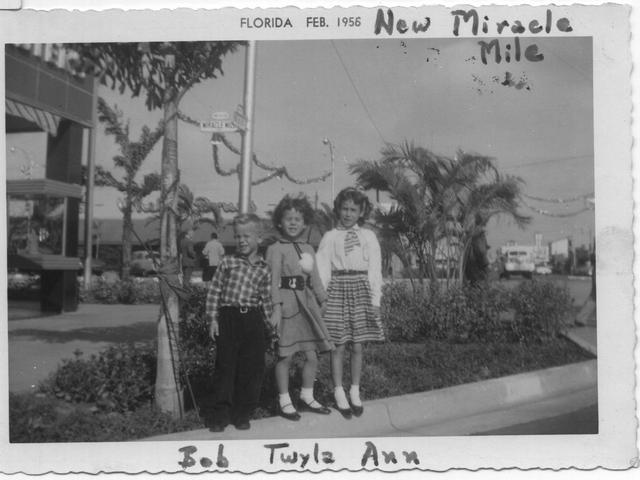
Taking a blue and silver bus from the Gables Bus Terminal, then located on the corner of Ponce de Leon Boulevard and Miracle Mile, and traveling to downtown Miami was great fun and safe as can be. I can still taste the fifteen-cent burgers at Royal Castle which were made with real meat and real chopped onions.

My school years were spent at Coral Gables Elementary, Ponce de Leon Junior High, and Coral Gables Senior High School. Cotillion, during sixth grade, was held in a room next to the Coral Gables Library, which then was on the north side of the city. It prepared youngsters in dance and etiquette and was taught by Mr. and Mrs. Rodney Novakowski.

The etiquette was really just common manners. Part of the “dress of the day” was the dreaded crinoline, a starched half-slip worn to help our skirt stand out. Marbles, anyone ever hear about playing marbles? They were the rage in the early fifties. These were simpler times.

In the early 1950s in elementary school, in addition to fire drills, we learned how to react to an air raid warning: go under our desks and place one arm behind our neck and the other across our forehead. The Korean War had made everyone more alert.

In junior and senior high school, I learned how to play a clarinet and marched in many Orange Bowl and Junior Orange Bowl parades. The community of other band members became a family away from home.

An unexpected plus came in 1959, when a rather pedestrian clarinetist – me – was given a scholarship to the University of Miami Band on the Hour, with Fred McCall directing. “Hail to the Spirit of Miami U.…”

It was then, in the band, that I met my future husband, John C. Adams, Jr. Tuition was $395 a semester. One day, between classes at the “U” in 1962, I looked south and I saw army troops and big guns in a caravan of vehicles heading south on Dixie Highway.

This was the beginning of the Cuban Missile Crisis. The United States, led by President John F. Kennedy, demanded that Russia remove their missiles from Cuba, only 90 miles from the US mainland. Thankfully, this face-off was successful.

In 1963, armed with a bachelor’s degree and a few Spanish phrases, I got a job with Pan American Airways, Latin American Division, based in New York, and flew to South America and the Caribbean. In the winter, leaving New York, I’d be dressed in a calf-length coat over my uniform. Three and a half hours later, when I’d deplane in Caracas, Venezuela, it was summer.

In 1965, John and I were married, and in time had two children, Nancy Adams, a speech pathologist and Andrew Adams, a civil engineer.

It is said, “adversity brings maturity.” If that is true, then South Florida came of age after Hurricane Andrew. People of all ages volunteered to help in any way they could. When I volunteered to help, I was given an orange vest and a whistle and told to report with another lady to the intersection of Miracle Mile and Douglas Road in Coral Gables. There we would direct traffic for several hours.

We were not alone, though. As people drove by they would say, “Thanks,” and hand us an ice-cold drink. The next day I was sent south on Dixie Highway to a Salvation Army make-shift tent headquarters. There we opened and distributed contents of aid boxes sent by tractor-trailers from all over the country. I opened one box from Ohio which had a hand-written note placed on the top that said, “we are praying for you.” Then I knew we were part of a bigger community than I ever imagined, the United States of America.

For the past 20 years, John and I have been private investigators, licensed by the State of Florida.

All these years have been such a hoot! When I read this it sounds like I’ve been a part of history. Ours is a “fairly young” community and before you know it, you’ll be a part of history, too. I am blessed to live in a great city and a great nation.

In the 1920s, the film industry was beginning to invest in “sound” for movies. Impressive theaters were built and audiences came rushing to escape the reality of life. Movies and vaudeville drew thousands of people to these spacious, elegant buildings known as movie palaces, and Miami was no exception.

The Olympia Theater was one of them and she was the heartbeat of downtown Miami. Her lights were brilliant and kept their sparkle through the economic and natural crises of the times from the energy left by the many performers and stars who graced her stage.

Then the glamour and excitement vanished. The dazzle of the movies and the up-tempo of the vaudeville acts no longer thrilled the crowd. The stock market crashed in 1929; the ‘30s saw a hurricane disrupt the lives of Miami audiences. The Olympia’s seats were empty; the audience was gone. The halls were dark except for the ever-present traditional, single bulb, caged in steel standing near center stage and left to burn eternally. This light–the soul of the theater– never goes dark.
It is called the “ghost light.” There is a superstition connected with it that says a spirit floats through and haunts every theater, even Miami’s Olympia Theater. I know it exists.

With all its problems, the Olympia was destined to become a parking garage until millionaire businessman Maurice Gusman bought the theater, saved it from the demolition ball, and it became Maurice Gusman Theater, Center for the Performing Arts.

The theater’s rebirth began and the lights returned brighter and stronger than ever before. I came to Gusman as a Florida International University intern in the 1980s. Upon graduation, I was hired as an assistant to the managing director. I began my dream job on December 26, 1984. Downtown was quiet but I was intoxicated with excitement. This same feeling led me through the next 20 years of my life in a job I loved. Yes, it was filled with long hours but I gained priceless experiences, as well. I also discovered the value for details and contractual requirements unique to major stars. I reveled in the personal moments with these major stars, which I was privileged to see.

I like to call this “my Renaissance period” for it was that for both my beloved theater and me. It formed a lifetime of love for me and a rebirth for the theater as Miami audiences begged for a stage for world performers.

Edward Villella gave birth to the Miami City Ballet, forming a ballet company with local talent and New York dancers with a full week of performances; Michael Tilson Thomas auditioned musicians from all over the world to come to Miami to be a member of a teaching orchestra, the New World Symphony; and my boss created programs for the season of traditional jazz performers, such as Marian McPartland, Dave Brubeck, Ramsey Lewis and Carmen McRae to note a few. These programs brought music lovers to downtown to the corner of Flagler Street and 2nd Avenue.

I loved going to downtown Miami even though everyone told me how frightening it was. Strangely, I never felt threatened by the street people. I felt sadness for them but never fear. The dark streets and empty store-fronts did not intimidate me, nor did the dark of the theater. The “ghost light” was always on so I could stand at the top of the mezzanine balcony and look all over the theater as the light created unique shadows throughout this exquisite atmospheric theater designed by John Eberson in l925. The single stage light cast dramatic shadows on the proscenium arch making the sculptured faces and the carved stone gargoyles grotesque and macabre.

Remember I mentioned the “spirit that floats through and haunts” every theater. The reason I know it exists is because I did see it. Laugh if you will but I did. Here is what happened:

My boss loved to drop last minute projects with immediate deadlines on my desk to see if I could manage it. It was Friday at 4 P.M. He picked up his briefcase and as he left the office rushing down the back staircase of the theater foyer, he said “don’t forget, you have to feed the dance company on Saturday night two hours before show time. See ya.”

What was that? I yelled as I came out of my concentration over a contract and ran to the top of the stairway only to see his 6-foot tall body slip out into the backstage alley. As the door slammed shut, and I started back into my office I thought I heard something or someone but I knew I was alone in the theater. I stopped at the doorway, listening for a familiar sound but there was only the silence of the theater. Then a swath of light floated through the chandeliered balcony foyer making its way up the stairs to the mezzanine. I was not frightened. I was inquisitive. I believe buildings and houses have “energy.” I looked for reflections from 2nd Avenue traffic but there were none. I believe this kind of energy manifests itself in some way, especially if you are sensitive to its existence. I saw the spirit that floats through our theater. I never saw it again but what a beginning.

I love the theater, I love the ghost, I love the audiences and I loved my life at Gusman Center for the Performing Arts, now The Olympia Theater again.

The homeless man knocked on my window while I was stopped at a red light on North Federal Highway, just east of the Miami Design District. He made the motion of hand-to-mouth, the one that says, “Feed me. I’m hungry.”

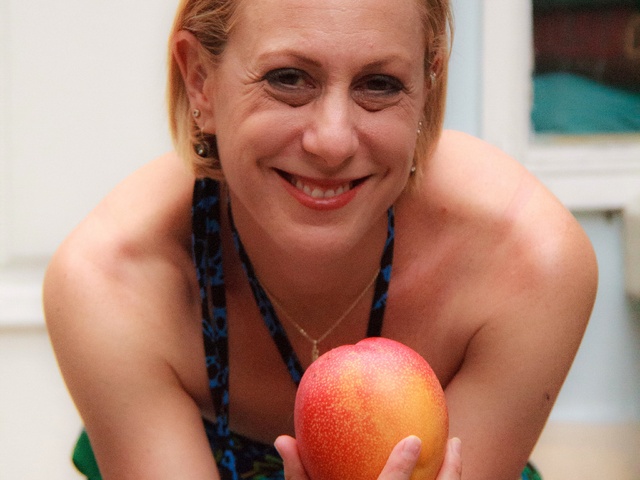
It just so happened that it was June, and in the middle of a heavy mango season, when eight of our 14 trees were throwing fruit at me as if we were playing a long, continuous and particularly juicy game of dodge ball. Because I never go anywhere without them, I had several Publix bags filled with fruit on the seat beside me. I rolled down the window and handed him one, bulging with the aromatic globes.

He was about to thank me when his expression turned suspicious. The overwhelming perfume of dozens of mangoes shot out of my car window along with the air conditioning. “Wait,” he said, “what are these?” He looked inside and his nose wrinkled. Then he handed the bag back to me. “No thanks. I don’t like mangoes.”

The light turned green at that moment and, with Miami’s notoriously impatient drivers honking at me, I didn’t have the opportunity — or, at this point, the charity — to explain that while he might be one of the few people in South Florida to disdain the world’s favorite fruit, perhaps he could trade them on the street for something else. I just shook my head and drove off.

This anecdote popped into my head when I woke up one recent morning and discovered a criminal act had occurred on my property the night before. Someone had stolen all the guavas from my tree, fruit that were still hard knobs of verdant acidity, but would any day begin transforming themselves into softer, sweeter and kinder versions. My dog walker, Jorge, and I were keeping a close watch — there were about 75, maybe more — waiting for that first tinge of yellow and hint of distinct aroma, caught somewhere between cat pee and tropical mold (but closer to cat pee).

Our vigil was for naught, because my tree has apparently been marked for a while now, and every harvest I’ve almost had for the past two years has magically disappeared. Worse, this time, the thieves didn’t just pick the fruit. They ripped off entire branches, the main arteries where the guavas had proliferated most, rather than take the time to tug them from what would have been, surely, their unforgiving stems.

Several weeks later, I came home from a weekend away to find that all of my low-hanging, early-ripening avocados had been taken as well.

Posting my losses on social media, I learned in response about the rumored “mamey wars” in the Redland region, where mamey sapote is so treasured that it has to be grown under guard. I heard about a fellow Miami Shores resident’s jackfruit tree, which was robbed of its Dali-esque fruit at 2 a.m. one night (a neighbor on a night shift caught the perpetrator in the act). I was given lots of recommendations about planting away from front yards and fences, and suggestions on how to espalier young trees so that they’re less of a target for the drive-by, rip-off artists who sell ill-gotten nighttime gains to fruit cart purveyors. It’s all good reasoning and sound advice, except that it comes far too late.

On the other hand, mango season is so prolific I wouldn’t notice if 500 pieces of fruit took a walk one day. I’d actually probably be grateful. But that rarely happens. Even the mango trees on the nearby properties that have gone into foreclosure remain untouched, the fruit decaying into the ground.

Indeed, as much as mangoes can foster love and lust during the first of the season, by the middle or end no chef, neighbor or homeless person within miles wants to catch a glimpse of me. I was even denied entrance to the Sunday poolside brunch at Hyde Beach in July this past year, where I was bringing mangoes for the kitchen, because the security staff considered them on par with groceries. As in, per the Terminator dude at the velvet rope (yes, for brunch, an element I’m still trying to figure out): “You can’t come in here with a bag of food.”

“No, you don’t understand,” I said. “I have a reservation for brunch, and I brought these mangoes for the kitchen.”

“No entrance with a bag of food.”

“This isn’t ‘a bag of food.’ These are beautiful, tree-ripe mangoes. From my trees. Picked by me. For the chef.”

No one asked for my reservation name, called for a manager or even bothered to turn around to talk to me directly, although it was obvious that they did consider me a middle-aged idiot. Very slowly, the same man said, “Ma’am, we don’t allow outside food to be brought in.”

I was, by now, angry and exasperated, not to mention hot, holding twenty pounds of mangoes in July and arguing at a velvet rope to a venue where I had been invited by the public relations firm for brunch. “Really, it’s not like these are potato chips. I hand-picked these for the chef. It’s mango season. Backyard growers like me do this. Trust me, it’s a Miami thing.”

“We don’t have a chef.”

Check and mate. I left the premises because, well, who would want to eat brunch there anyway?

But along with the lesson of not accepting brunch invitations at what is essentially a club, in Miami, I have learned, some kinds of fruit are valuable currency. (I wonder, had I been holding guava, would Hyde Beach security have parted the Red Sea for me?) Yet those fruit that are plentiful and common, no matter how well-loved, are like the old Italian lira: inflated, worthless. And at the height of season, you can’t even give them away, not even to those who have nothing at all. Including, it seems, a chef.

As a youngster, I was excited to be driving out 36th Street to see my uncle, Dave Click, arrive in an airplane. He was secretary to Florida state Sen. Trammell.

The airstrip was just a small landing area in a big grassy field with a chain-link fence around it. (In later years, I spent much time at the fine new terminal at Miami International Airport, because my husband, the father of my three children, flew for Eastern Air Lines.

We sang Moon Over Miami and loved it. “Stay Through May” was a Chamber of Commerce plea. Flamingoes at Hialeah Race Track were fun to watch. Kids were allowed on one special night to watch dog races at the Kennel Club, and Daddy took us there.

Watching the Orange Bowl parade was an annual event never to be missed. My husband and I had two good stepladders and stretched a board between them for us and our three children.

There was a huge rivalry then between Miami High and Edison. In the 1940s, a friend and I from Miami High attended Edison classes one day and were never noticed. That proved to us that Edison just did not have the disciplined organization of Miami High. Strangers there would have been sent to the office for identification right away. Once, Edison students splashed red paint across the front of our building when they finally beat us in football after 28 years. It made the news.

I received a scholarship to the University of Miami in 1943, but I did not own a car. I waited on Coral Way for a bus on class mornings. When I gladly accepted a ride from a gentleman who had stopped, the man was quite brusque in stating that a young lady should not accept rides from strange men.

I quickly settled in the front seat and said, “But everyone in Miami knows you, Police Chief Quigg.” He seemed pleased with my response and took me all the way to the university.

Coral Gables established its Miracle Mile of shops on Coral Way. The city put plants and flowers in beds in the sidewalks in the business district. Lincoln Mall in Miami Beach had also done this years before. Since I grew up to have a profession in landscape architecture, these places had a lasting influence on me.

My life was very much affected by strikes at the airlines, and they were so bad for our family and the city. I believe it was said that Eastern Air Lines employed 7,000 people in Miami at that time.

The airline closed for good in 1991.

I was born in Cincinnati, Ohio in 1932. I had a wonderful time growing up in Cincinnati, playing outside, flying model airplanes and kites, playing baseball, and most everything kids did in that day and age.

My father, an Italian immigrant, came to the United States and settled in Cincinnati. He worked as a machinist and became ill, diagnosed with silicosis, known as dust on the lungs, and was advised by his doctors to leave Ohio to find a warmer climate. My father had a cousin in Miami who invited him down for two weeks. After he arrived in Miami, he called my mother to tell her he had “found paradise” and for us to come to Miami to see if we liked it here.

I was 10 years old when we left Ohio in 1942, arriving in Miami after three days by Greyhound bus. When the bus pulled into the terminal, we could not find my father. Much to our surprise, he approached us in a Hawaiian shirt, hat and sunglasses. We saw the sun, the skyline and water and could not believe the beauty that was upon us.

My father took us to a drugstore with a diner and we had dinner. As we ate, Mom and Dad discussed selling the house in Ohio and moving to Miami. Dad rented a two-bedroom apartment in what is now Little Havana, where we lived while Dad sold the house in Ohio.

Dad purchased two lots in Hialeah, at Ninth Avenue and 12th Street, on the west side. This is where he built our new home. The other lot was plowed and my father kept livestock there and grew fruits and vegetables. In Italy, he had been a farmer, so he used his skills to farm the land. We sold vegetables, fruits, milk, and eggs in order to make a living. We also had chickens and goats.

Mom enrolled me in school and we had a great life while I was growing up in Hialeah. We had land all around us and lots of fields to play in and have fun. We had only one station on television and that was Channel 4. The station went off the air every night at 9 p.m. We had no telephone service, no air conditioning, and did not even have garbage pickup. Dad would bury the garbage in the back yard.

Later, my father bought five and a half acres of land in West Hialeah and began farming that land, too. He sold the crops from the back of his truck in Hialeah every day, and I would help. The silicosis had disappeared and Dad worked hard every day to support me and Mom.

The years passed and I began high school. I played football for Edison High, ran track and field and played basketball. There was a little soda shop across the street from Edison and all the guys and girls would gather there after classes for sodas and just hanging around with all our friends, listening to music and talking. Saturday was date night with our girls, and there were dances and parties all the time. I worked in a laundry that I helped build so I could get enough money to buy a car.

I built model airplanes and flew them at the Hialeah Recreation Park at night on the ball diamond. My friends and I would fly our free-flight models on the weekends in the cow pastures on Hialeah Drive.

We fished in the canals and would hunt in the woods around Hialeah and down in Kendall, where it was no man’s land. We hunted rabbits on Okeechobee Road, and in the Everglades for ducks and pigs. We would bring our game home for my mom to cook, and boy, could my mom cook. Mom was also Italian and she would put on a spread for an army.

My teen life came to an end and I joined the United States Air Force and was a sheet-metal mechanic. I was stationed in Texas, California, Japan, Georgia and the Korean war zone. After four years in the service, I returned to Miami.

My family and friends gathered for a party and I met my wife Vilma, a beautiful Italian woman I fell in love with from across the room. We dated for a year and married in 1955 at Blessed Trinity in Miami Springs. I built a house in Hialeah and we had two children. I worked at National Airlines as a sheet-metal mechanic for a few years while studying at the New York Institute of Photography to become a professional photographer, beginning at the Home News newspaper in Hialeah.

I spent many years as a professional photographer in Miami and worked for many major corporations – Grand Union, Winn-Dixie, many developers, and companies of the food-trade industries. I had the pleasure of photographing and meeting the mayor of Hialeah, Henry Milander, Senator Bob Graham, President John F. Kennedy, Moshe Dayan, and many other dignitaries. I flew aerial assignments all over Miami, and photographed the wonderful skylines of Brickell Avenue and downtown Miami.

My years have caught up with me now and I no longer can do what I did. But what memories I have of this beautiful Miami that my father called paradise. I love the paradise he found and what I helped shape in such a little way.

As a 16-year-old boy, traveling alone, I first met Miami in 1942 as I stepped off the train at the railroad station just north of the Dade County Courthouse, on the way to visit my girlfriend in Santa Clara, Cuba.

Flying to Cuba during World War II required me to check in the day before at the Pan American ticket office at the corner of Flagler and Biscayne Boulevard. Passengers had to deposit their luggage there for the next day’s flight so it could be searched by the Army.

The next morning, we 19 passengers assembled in a Pan Am jitney bus, which drove us to Northwest 36th Street, then to the runway behind the small airport terminal to board the two-propeller plane, with one passenger on each side of the aisle that slanted down to the small tail wheel.

The night before boarding, I rented a room at the Royalton Hotel, on Southeast First Street, for $3 for the night. I began to explore fascinating Miami. I watched a professor giving free lectures on astrology and selling his horoscopes on Biscayne Boulevard and Southeast First Street. I smelled fresh doughnuts at the Mayfair doughnut shop and the hot dogs at Howard Johnson’s.

I heard a band playing at the Bayfront Park bandshell. Two blocks north on Biscayne Boulevard, I watched people dancing to the sounds of an orchestra playing on the roof of the Columbus Hotel. Hungrily, I continued north on the Boulevard to Eighth Street where Pan Am had told me Manning’s Seafood Grill had the best seafood dinner in Miami for $1.50. After dinner, the salty, sweet smell of fresh fish lured me across the Boulevard to watch the fishing vessels arrive at the municipal docks (now Bayside) and sell their day’s catch to the waiting public.

The next day, I was off to Cuba to visit my girlfriend, Emily Iznaga. Her father, a doctor in Santa Clara, Cuba, wanted his family to learn English by attending a typical American school in a town where no one spoke Spanish.

He chose Daytona Beach where my family had just moved. I met Emily in the registration line the first day in the ninth grade. I was smitten and the rest is history. When World War II started, fearing future difficulties in traveling, her father called the family back to Cuba. Thus, my trip to Cuba in 1942! Visits continued, but soon I was off to the Air Force.

In 1948, after the war, Emily and I were married in Santa Clara, Cuba, and moved to Miami. We moved into a brand-new apartment on Red Road at Southwest 77th Street, where four city blocks of apartments were being finished for returning war veterans.

I graduated from the University of Miami under the GI Bill in 1950.After graduating, I became deeply involved in Miami as a realtor-developer and federal trustee for major real-estate bankruptcies. In 1950, home prices were $25 per square foot.

To be closer to my office downtown, Emily and I moved to a 2/1 in the Roads section of Miami, and later to Natoma Street in Coconut Grove. When, in the 1970s, the first house in Miami was sold for $1 million, we toasted the event, but also thought who in their right mind would pay $1 million for a house!

Emily and I, with our three small children, Eric, Vicki and Ronald, would go to ride ponies downtown, where the Omni Hotel was later built. We went to childrens’ Saturday matinees, and in the evenings, to the Tropicare Drive-in Theater on Bird Road where the three children, brought in their pajamas, soon fell asleep and we parents had the short time alone we seldom had.

In the summer, we swam in the lagoon at Matheson Hammock, the Shenandoah public pool, Crandon Park with its zoo, Ferris wheel and roller skating rink, or in the freezing waters of the Venetian Pool, which had originally been built from a rock pit.

Emily died young and Geraldine Griffin, whom I later married, became the second mother of our three children, plus a new sister, Nadia. Gerry, a native Miamian, remembers, as a child, sleeping during hurricanes in the ice plant at the corner of Southwest 37th Avenue and U.S. 1- what a cool shelter!

In 1971 Gerry and I, the four children and “Mama,” their grandmother, moved to Rock Reef on South Bayshore Drive, opposite a mangrove thicket that was the shoreline of Biscayne Bay. Our family loves living in and being a part of Miami – a multilingual dynamo poised for the future.

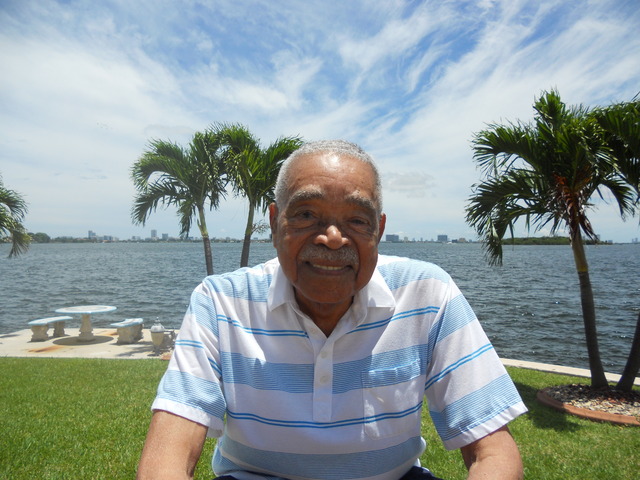
I was born in Nassau, Bahamas. I came to Miami when I was four months old in 1919. My dad came first on his way to visit a brother in New York City.
He was going to buy some printing equipment in order to go into business for himself in Nassau. He met some of his compatriots who had come over from Nassau and were living here. They said that this was a great town. They saw a lot of progress and opportunity in this young city. He must’ve seen it, too, because he decided to stay. He sent for my mother, my three sisters and me.

He had a sister living in Miami at the time and she rented a place for him on Northwest 15th Street between Second and Third Avenues. We lived there for a few months and then my dad bought a home in the 1900 block of Northwest Fifth Place. That’s where we all grew up.

Living in segregation, I wonder how I managed to get through without being hurt too badly. Back in my day, lynchings were every week. My mother sheltered me to keep me from getting involved with white people. When I returned from my duty in World War II, I gave my mom a list of cities that I would rather live in than Miami. She said that a lot of these places weren’t that different from Miami. They’re segregated just like it is here.

She said, “Anywhere you go, you’re gonna find the same kind of people and you’ll always be black.” She said that I’m not a person to run from something. If something isn’t right, then I ought to fix it.

When Martin Luther King came down, I attended some of his meetings. My friend was a good friend of King’s and I used to attend meetings where he would preach to us about nonviolence. I remember talking to Martin a few times and I said, “Martin, you really believe that if I was somewhere and a white guy spat on my face, you think I would walk away from that?”

I said I’d try and kill that son of a b—-. He said, “That’s why you’ve got to try to learn to control yourself.” I liked him.

Working for my father at The Miami Times is the only job I’ve ever had. I was working in the printing department, where the money was. The former state president of the NAACP (National Association for the Advancement of Colored People) used to come by my office all the time and talk to me about becoming more active in the NAACP. I said that my dad handles all that at the newspaper with the coverage. He thought my dad was too hesitant about taking a stronger stance and he knew I was tougher. His name was Father Theodore Gibson. He had Christ Episcopal Church in Coconut Grove. He said he needed my help, so I started helping out the NAACP a little more.

The first project I got involved with was integrating the golf courses in 1949. Back then, we could only play one day a week and that was Monday. That was the day that they maintained the golf course. They watered the lawns and cut the grass and we’re out there trying to play golf. I went and I talked to Gibson about it and started thinking about how we can attack it.

We decided to file a suit. We went out to the golf course in Miami Springs on a Wednesday instead of a Monday and presented ourselves to play golf. They wouldn’t let us in. I think it was two days later that we filed a suit. It took us seven years before the Supreme Court wrote a decision and said that you cannot take a person’s tax dollars for a municipal golf course and tell that person that they can only play once a week because he’s black.

After that, we had the beach. Twenty-eight municipal beaches everywhere but one beach for blacks, Virginia Key Beach. We decided we’d go after them in 1957. We called and arranged a meeting with the County Commission.

We got a good solid group together. We made sure that all of us were registered voters and all of us were freeholders. We had read the rules and believe it or not there was nothing in the county charter that said black people were restricted to one beach. But we had been told so many times and refused entrance to a white beach.

We had a meeting at 10 o’clock at Crandon Park. We went in and all the county commissioners were there. We made our appeal. They sat there and didn’t say a word. Nobody. We went on saying that it was wrong and that we wanna know what they’re planning on doing about it. They didn’t say anything. I guess they thought we’d just go away.

We then said, “It’s 10:20 now but what we plan on doing is coming back over here at 2 o’clock, and we’re going in the water. It’s up to you to do whatever you please. You can beat us up like most of you police always do when we go to the white beaches.”

Two o’clock came and our 12 had dwindled down to maybe about six of us. Oscar Range, whose wife went on to become our county commissioner, and myself, put on our trunks under our shirts and pants and just had on some sneakers. There were police out there just standing around us as a preliminary thing. We walked straight down to the beach, we kicked off our shoes, took off our shirts and we jumped in the water; just two of us. We were waiting for 20 minutes on something to happen, and nothing did.

We came back, put on our shoes, shirts and left. The next day, I called the NAACP and told them, “We’d like you to go to the beach tomorrow, any beach other than Virginia Beach.” We showed up and nobody said anything. The County Commission got the word out what we were doing and they knew they couldn’t defend it. From that day on, black people have been using all 28 beaches in Dade County.

Those are two things I’m most proud of. It taught me a lesson that you just gotta push and do your homework. First, you gotta be right. You’ve gotta have the right cause and you’ve gotta involve the right people. You just need some warm bodies to take a stand and get to the course and you’ve got a good chance.

(This story was compiled by Museum of Miami intern Lisann Ramos as recounted by Garth Reeves).

Garth Reeves was the publisher of The Miami Times newspaper and passed away on November 25, 2019 at 100 years old.

When I was just 6 months old my parents moved to Miami and rented a house across from a beach on Collins Avenue. They could actually open the front door of their house and see the Atlantic Ocean, but this beautiful view almost cost us our lives. Three months later a powerful Category 4 unnamed hurricane made landfall on September 17, 1947 at Port Everglades.

My parents were raised in New York City and were unwise to the dangers of tropical cyclones, so they elected to remain in the rented house; that is, until the Atlantic Ocean came “a-knocking.” My mother told me that when the ocean came through the front door my father decided it was time to leave. My parents grabbed me and my 4-year-old brother and tried to make it to the safety of the mainland in the family car.

When the sedan finally succumbed to the rising tidal surge halfway across the Venetian Causeway all they could do was huddle and hope for the best. An uncle on the mainland must have been more hurricane-smart and realized that one of his six brothers was probably in trouble, so he jumped into a 2 ½-ton truck they used for the family tile business and came looking for us. He possible saved our lives as my dad’s car was being battered by waves coming over the low bridge’s railings, according to my mother.

This experience had such a profound effect on my father that when he decided to build a house for his family a few years later, he used topographical maps and searched for a lot with a very high elevation. His final choice was near Southwest 23 Street and 14th Avenue and has an elevation of 36 feet above sea level. This ridge is part of the Miami Rock Ridge and is called Silver Bluff.

The fine house my father built rested slightly more than a half mile from Biscayne Bay and one mile from the first bridge of Rickenbacker Causeway, which were both in easy bike range for a young boy. This close proximity to Biscayne Bay would have a profound effect on me for the rest of my life.

At that time one could fish behind Mercy Hospital on the seawall for trout and jacks, or head over to the Rickenbacker bridges in winter for snook, loads of mackerel, bluefish, bonefish, tarpon, and big jacks. We even caught snook in the canals in the Grove and assorted fish on the bridge to “Fair Island,” before it was developed and renamed “Grove Isle.”

When I was just 3 years old my father died of natural causes and my mother had to struggle to survive. Before I was even 10 years old I took advantage of being a child of a single parent and became a free-ranging youth that ventured as far as his bike and legs would take him.

I took up fishing in earnest, and by the time I was 14 I fished in the summers all through the night, mostly solo since none of my friends shared this kind of freedom. (I leaned early on how to defend myself from pedophiles and bullies.) I was a late bloomer and did not learn how to swim until I was in 9th grade. One year later I bought a used Scuba outfit with my paper route money and started diving under all of the Rickenbacker bridges.

By age 15, I had complete usage of my mother’s ‘55 Chevy, and was ranging all the way down to the middle Keys to fish and dive. I lived a very adventurous life and often slept in her car next to bridges in the Keys, since my mother had a friend who drove her anywhere she wanted to go.

I lived to fish and dive and this pastime stayed with me for the rest of my life. In the 1950s, one really didn’t need a boat in South Florida to locate quality game fish. I caught tarpon, snook, trout, bonefish, snapper, bluefish and even grouper all from land or bridges. Some of these fish even earned me weight citations in the Miami Metropolitan Fishing Tournament before I graduated from high school, and still hang in my den.

Miami was truly a paradise for me over a half century ago. I now look how young kids are practically sequestered inside their houses out of parental fear. I always thank my lucky stars that I was fortunate to have those early experiences instead of being cooped up in front of a TV or computer as today’s children often are.

It was the end of the first week of June, 1963. I had just finished third grade at Shenandoah Elementary School and I was looking forward to summer vacation. Papi was a third-year resident in neurosurgery at Jackson Memorial Hospital; he was on call 36 out of every 48 hours.

Neither my mother nor my father was particularly young: Papi had been 45 when I’d been born; and Mami, almost 42. I was their only child: their hija consentida (pampered daughter).

In 1963, Mami had just turned 50. As for Papi, both his salary, at $219 per month, and his age, at 53, were “record-setting,” according to Mami. “He was the oldest resident in JMH’s history.”

My sweet natured, shy – yet gregarious – father had befriended many of the staff at the Jackson. A tall, lanky, bow-tie clad, pipe-smoking Tennessean became his special friend. He called my father, “Fred.”

Basil Yates, who figured in our lives for many years to come, came to our financial rescue. Estábamos muy apretados: we didn’t have much money. One day Yates asked his friend Fred if he had enough money to take care of his family. Papi very honestly responded, no. Yates reached into his pocket and pulled out $200.

With Yates’ generosity, we were able to move from the kindly, shabby tenement, “El Vanta Koor” (Vanta Court) to a better apartment building several blocks away. Not only were we to move, but – thanks again to Dr. Yates – we were able to spend a month on Miami Beach that July. We rented an apartment in the Amsterdam Palace Hotel.

There was no air-conditioning, but that’s the way Mami wanted it. Las brisas del mar – the ocean breezes – provided plenty of cross-ventilation. When Papi could join us, he was able to enjoy the alcove that fronted the balcony, right smack in the middle of the second floor of the Amsterdam Palace.

For my part, I played among the statues and fountains on the first floor, ceaselessly rode up and down the elevator, and spent as much time in the ocean as I could. Sometimes I went swimming twice a day. Mami liked to take me in the early mornings, when the sandbanks were built up, and we were able to walk out into the ocean as far as we dared. I became vey tanned that summer.

There’s a picture of me at a party, sitting next to Papi, where I’m muy bronceada y rosada, very bronzed and rosy, indeed. I’m wearing a white shift with big roses on it. I’m shyly looking down at my hands and Papi is glancing over at me. This is the way I remember myself from the summer of 1963.

Late summer found us in the new apartment. For three years, I had all but stumbled out of bed to get to school, as “El Vanta Koor” was located next to Shenandoah Elementary. Now I had to walk a few blocks.

As my English had improved tremendously, I fully expected to find myself in an English-only fourth grade classroom. To my horror, I found myself being directed back to my third grade bilingual classroom! It turned out a number of us Cubanitos were in the same predicament. We soon found out we were not being held back – we just needed a little extra “tweaking.” I remember not finding it so strange after a while.

In the old days, walking from Calle Ocho on Southwest Tenth Street Road, one was able to run smack into Shenandoah Elementary. All three floors of it, with its Mediterranean tiled roof and graceful arches.

Passing underneath these arches on Nov. 29, 1960, I embarked upon my first grade experience in the United States. I didn’t speak one word of English. I remember my first grade teacher, Mrs. Morvil, speaking to me in English. Looking up at her, quizzically, I responded en español. And that’s pretty much how it stayed, all year.

At the beginning, I wrote a few letters to my teacher in Cuba, asking her to send me my textbooks. And then I didn’t open my mouth, to the point that I almost failed first grade. I had learned enough to know that an F was a bad grade, and I had received six of them. Somehow, I was passed on to second grade.

The first six weeks of second grade were pretty bad. Then something happened: a small group of us were handed over to Mrs. Bustillo, a Cuban teacher who spoke enough English that she was able to teach us in both languages. I did much better with her, ending up the year with my lowest grade being a C in Physical Education. And, oh, how I hated P.E.

On the other hand, I didn’t fight learning English, any more. I did really well: I became the spelling champion in our class, and runner-up in the entire grade. I actually remember breathing out, “hand-ker-chief,” in spurts: that did the job.

Third grade was my year of glory at Shenandoah: the Spelling Bee, and the Hungarian Gypsy Dance.

Two Hungarians were the obvious choices to lead this gypsy dance out from underneath the central arch, under the lights one May evening in 1963. Nicky Perusina and I were all dolled up in our red velvet and gold-trimmed jackets. He wore black pants, and a long black bow fringed with gold tassels. I wore a white skirt with red and green stitching, a flower-trimmed headdress, and carried a little bouquet of flowers in my hands. I even got to wear makeup – I felt so grown up.

I DO remember being nervous, and trying to remember on what foot I was supposed to skip out, first. Most importantly, I remember telling myself, “Don’t trip. Don’t trip.”

Well, I didn’t trip. We all had a good time. And I became known as The Hungarian Dancer.

Translate »