Skip to content
Named Best Museum 2022
by Miami New Times

I first met Mary Merlo Lugo at a party at a friend’s house in South Miami. Circulating, as one is prone to do at any party, I found myself seated next to this wonderful woman who, at age 93, regaled me for the next four hours with the most entertaining anecdotes about her life, both in her native Puerto Rico and in Miami.

She moved to Miami in 1945, never to go back, except for a few short visits.

I was fascinated with this woman’s zest for life, but mostly impressed by her clarity of mind. I asked her adopted daughter to take me to Mary’s house to meet her husband, Vince, and got to know him, as well, thus starting a trip down memory lane, which I just had to sit down to chronicle.

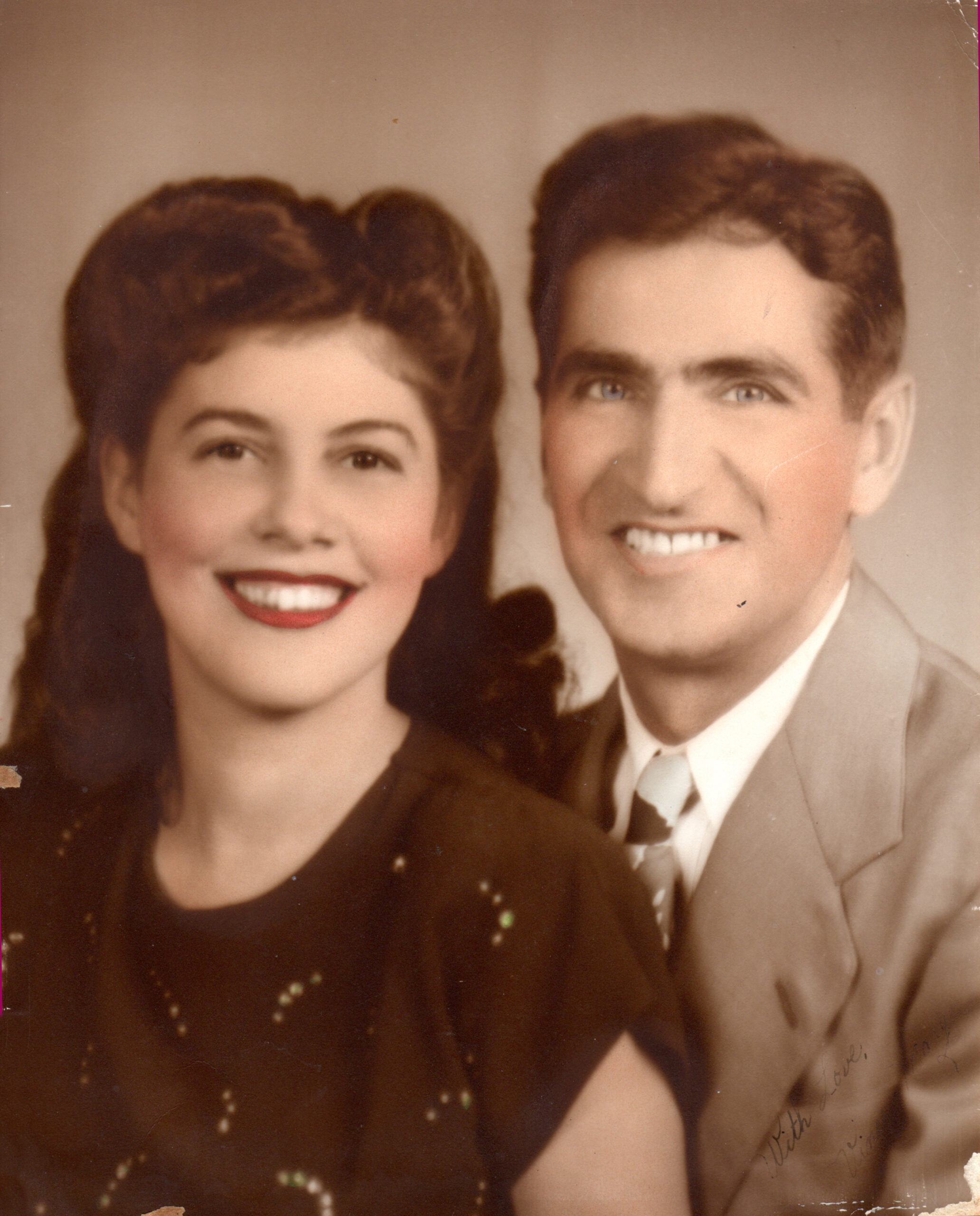
Vincent Biondi was born in the Bronx, New York, on Aug. 19, 1917, one year before Mary, who was born in Guayanilla, Puerto Rico, on Oct. 18, 1918.

When Vince was 9, his Italian mother, Josefina, moved him and his brothers to Washington, D.C., where he lived until he was drafted into the army in October 1941, just two months before Pearl Harbor. After basic training in the Corps of Engineers, he was shipped to Ireland with the 1st Armored Division, and from there he was sent to Oran, Algeria, and later Anzio, Italy. Once the war was over, and after spending a number of weeks in a hospital in Naples, Italy, he was flown back to the United States in 1945.

After a series of odd jobs, Mary ended up working at Woolworth’s, and while she became immersed in the energy of a blossoming city, Vince was convinced by a friend in Washington to come down to Miami to look for new opportunities. He worked as a painter in Miami Beach and Coral Gables. One day, a year later, he happened to go with a friend to Woolworth’s. They were talking about a hurricane that was threatening Puerto Rico as they passed the counter where Mary was stationed. When she heard Puerto Rico mentioned, she interrupted their conversation.

Vince was immediately smitten, and as it happens with all the affections destined to last, their relationship was initially tentative, with Vince stopping in at Woolworth’s every day to visit her, giving themselves time for their growing love for each other to mature.

They were married on Aug. 16, 1947, and the city embraced them as Mr. and Mrs. Biondi with a gulp of fresh air as soon as the doors of the church flung open.

The city in those days was flat, irregular, unkempt. Nonetheless, some changes were sprouting here and there. South Beach had its Art Deco buildings, which Vince kept beautified with his painter’s brush. However, with a family in mind, Vince decided to get a regular job and ended up working at Burdines, making $1.65 an hour. He joined the union and, with pension and medical plans secured, they were able to buy their home at 931 NW 39th Ct. with the help of the G.I. Bill of Rights.

Vince and Mary took the plain but structurally sound house and slowly transformed it into a comfortable Miami house that became the home of their two daughters, Cheryl, who now lives in Orlando, born in 1950, and Aileen, born in 1953, who now lives in Gainesville. Then, one day in 1961, when Cuban families were making the supreme sacrifice of parting with their children and sending them alone to Miami to escape the Castro regime, Mary and Vince took in a 14-year-old Cuban girl as their own until she could be reunited with her natural parents. To this day, Migdalia calls them Mom and Dad, and Cheryl and Aileen are like sisters to her.

Migdalia eventually went to Puerto Rico, but Vince, Mary and their two daughters remained in Miami, sharing good and bad times, dodging dangerous hurricanes and taking in the luxurious pleasure of the perfume of native flowers in the winter.

Certain deep loves mature slowly, but they are meant to be forever, so the song says. However, nothing as we know it is forever. I called Mary to ask her the dates when her daughters were born. Mary passed away too prematurely, on Thursday, March 15, 2012. I was preparing to fly down to Puerto Rico, her birthplace. She never got to read this chronicle.

As I now sit on the beach in Puerto Rico, rewriting the end of this “Miami Story,” I really think that I was truly blessed to share some very special moments with this very wonderful woman and her husband. They, in turn, shared 65 glorious years together and many happy experiences in Miami raising their daughters, Migdalia included. Mary’s great sense of humor, her kindness and love for them and all of us who were lucky enough to get to know her, is a great part of her exceptional legacy.

I agree with Maya Angelou when she says that most people do not grow old. We find parking spaces and honor our credit cards. We marry and dare to have children and call that growing up. We carry an accumulation of years in our bodies and our faces, but generally, our real selves, the children inside us, are still innocent. Mary and Vince made me realize that.

My Miami story began before I was born.

My paternal grandfather, Thomas Tilden, arrived in the 1880s in Syracuse, Mo., and built a magnificent barn. It was “the largest in Missouri, the third-largest in the United States, and the sixth-largest in the world,” crowed the newspapers at the time. Like a fine home, it had mahogany woodwork throughout and cost well over $10,000 – a goodly sum in those days.

But tragedy struck.

In 1896, the barn and all its contents went up in flames. Grandfather, subsequently depressed, decided to sell his farm and move his family to a milder clime. To scout the territory, he boarded Mr. Flagler’s train and rode all the way to its just-completed terminus at Biscayne Bay. There, according to my grandmother, he found a settlement, recently incorporated, of fewer than 50 inhabitants.

Evidently this did not suit his needs, so he reboarded the train and went north; about halfway up the state, to what is now Florahome. There, he bought land and built an architect-designed home. Back in Missouri, he loaded his furniture, some livestock, tools and other belongings into a freight car, and on Oct. 16, 1901, he and his family took up residence in Florahome. When my grandfather died in 1906, my grandmother, with her four youngest children (my father included) moved back to Missouri.

But two of the children stayed on at the farm in Florahome and, even today, there are Tildens at Winter Park.

Fast-forward to 1946: World War II had ended. I was a sophomore at Lindenwood College in St. Charles, Mo., and my parents’ wartime employment in Oak Ridge, Tenn., was no longer needed.

They planned to start a new life “out West,” but wanted to see some of the USA. They bought a trailer and, with my three brothers in tow, headed south to Miami.

Oops, their timing was off – September was upon them, and school started. They parked the trailer and enrolled Billy and Tommy and Bobby in nearby Edison School.

Trailer-park living did not appeal to them, however, but they found that no homeowner would rent to them with three boys. They ended up buying a house on nine acres at the edge of the Everglades – East Glade Drive and Coral Way (Rural Route 4, Box 222). No other manmade structure was within sight except the tip of the Biltmore Hotel nearly five miles to the east in Coral Gables.

I came home from college and we still didn’t have a telephone (wouldn’t for another year). We did have electricity, solar water heating and a tennis court. We had an acre in lawn and only a push lawnmower. One of us was always out pushing the mower.

Meanwhile, my father, William Tilden, an architectural draftsman, found a job. He took our lone car to work every day and deposited me for a summer course at Alex Gibson’s Modeling School. Billy was enrolled at Miami High, Tommy and Bobby at Olympia Heights. Mother, at home with the laundry, sprayed the screen door for mosquitoes each time before she darted out to hang clothes on the line.

So much for the dream of moving “out West.”

Truly a model of tropical living, our Florida home had hurricane shutters; it had coconut palms in the front yard and Australian pines in back. We had mango, avocado, orange, grapefruit, sour orange, guava and kumquat trees. And Daddy put in a patch of sugar cane. He taught us how to slice off a piece of the stalk and suck the sweet juice, sharing with us a pleasure of his Florida boyhood in Florahome.

On weekends, we took long drives around the county, the city, to various parks, the Everglades, and the ocean with its glorious beaches. There was the thrilling trek on the long, narrow, rickety bridges of the Overseas Highway to Key West. Seeing a huge tractor-trailer truck barreling toward you on the Seven Mile Bridge, you couldn’t help but hold your breath and brace for the shudder as it thundered by.

I learned to drive on the Overseas Highway, turning back before the toll booth at Lower Matecumbe Key.

As we became involved with the community, my mother, Josephine Tilden, became president of two school PTAs and started the South Florida Weavers guild, becoming the state president. After my father died, she designed and built her own house among Redland pines. My father eventually retired from the planning department of Dade County Schools and proceeded to tend his “farm” surrounded by grandchildren and, at various times, cats, dogs, chickens, turkeys, rabbits, a horse (Tommy’s), a cow and a bull (Bobby’s), a pigeon named Henry, and Charlie, a vocal bantam rooster that followed him everywhere.

We children grew, married, settled or scattered, and multiplied.

I spent almost 26 years editing Sea Frontiers for the International Oceanographic Foundation on Virginia Key. Billy died in an auto accident during Orientation Week as he entered the University of Florida . Tommy, a retired Marine, is a veteran of the Korean and Vietnam wars. Bobby retired from the school system and moved with his family to the mountains of northern Georgia.

In 2012, Tommy and I are still here, confirmed Floridians, as Grandfather had planned – and not “out West” as our parents once dreamed.

P.S. Since writing this story, I regret to add that my brother, Thomas Tilden, passed away Oct. 1, 2012, just three weeks shy of his 78th birthday.

My great uncle Matthew Freeman, of London, England, was a passenger on the Lusitania, a ship that was torpedoed by the Germans in 1915 and sank in 18 minutes. He was quite the hero, saving several lives. He survived the attack, and in the early 1950s he came to live in Miami Beach.

My mother and I arrived in Miami Beach from London on Oct. 15, 1964. We checked into the Saxony Hotel, which was owned by George Sax, a friend of my great uncle Lou, Matt’s brother. There was a nightclub at the top of it called The Ivory Tower, and we had plans to go there that very night. We needed to get our hair done, or combed out, as they said in those days. It was quite late in the afternoon, and Mother was convinced that all of the beauty salons would be closed. However, after trudging down Washington Avenue, we found Mr. Carmen. He teased our hair to a suitable height, and off we went for our night in the Ivory Tower.

I thought Miami was the most exciting place I had ever been. We stayed at the Saxony for three weeks before renting a little efficiency apartment at 235 30th St., just off Collins Avenue. Lincoln Road was nearby and little trolleys would take you up and down the street. You could ask the driver to stop whenever you saw something in a store window that took your fancy; there was no other traffic on Lincoln Road. Jackie Gleason did his weekly television show from Miami Beach.

There were huge yachts lined up all along Collins Avenue opposite luxury hotels – The Fontainebleau, the Eden Roc and the Doral. On top of the Doral was the Starlight Roof, so named for a thousand twinkling lights on the ceiling. It was one of the few places that gentlemen were required to wear a jacket and tie.

In those days, there was very little crime, and on balmy winter nights, women could be seen strolling along Collins Avenue wearing minks and diamonds. I would go farther north to the Castaways and Thunderbird, where all kinds of entertainment would go on until the wee hours of the morning. Sometimes I would dance the night away at Funky Broadway in Sunny Isles. I would go to the 79th Street Causeway, where there was a hub of nightlife: The Place For Steak, The Penthouse Club on Harbor Island, and Jillys, to name a few. Also to Fun Fair, to eat the best hot dogs in the world and play the nickel skee ball. For a café con leche and arroz blanco con frijoles negros, we would take a Sunday trip to Southwest Eighth Street. There were hippie “love-ins” in Greynolds Park in North Miami.

Reluctantly, I returned to England after six months, but Miami remained in my heart and I knew it was my destiny. I was 21 when I returned to live here permanently. I met my beloved late husband Guy Aylward, who was a newscaster for WCIX Channel 6 TV, which was housed in a round building at 1111 Brickell Ave. I had met him when we were both cast in a play at the Ruth Foreman playhouse in North Miami.

Our son was born in 1978 at Mercy Hospital. We were living in Pinecrest at the time and had mango trees, grapefruit trees and star fruit on our property. It was an idyllic existence and seemed as if we were living in the heart of the country when, in fact, bustling South Dixie highway was only a short walk away.

Having a child opened up a whole new Miami world – the quaint Crandon Park Zoo on Key Biscayne, the Seaquarium and the original Parrot Jungle. There was the unique Serpentarium and the mysterious Coral Castle. All of these were a veritable wonderland for a child.

Eventually, we opened foreign and independent movie theaters in Coral Gables. Among them were Cinematheque, which had airplane seats obtained from Eastern Airlines when we first opened, and also the Arcadia and the Grove Harbour in Coconut Grove. Nat Chediak, who had met my husband at Channel 6, was my husband’s partner.

Guy filmed the first commercials for Carnival when the company only had two ships, the Mardis Gras and the Carnivale. My husband was a man of many talents both in front and behind the camera. A new television series called The Magic City has just been filmed here, created by Miami son Mitch Glazer. It recaptures the era of the late ’50s and early ’60s. I look forward to seeing it. I’m sure I’ll recognize some of the characters whose names have been changed to protect the innocent!

Miami has gone through so many changes.

Life is ever-changing, but in Miami the magic always prevails. My roots are here, planted firmly in the ground, just as strong as the roots of the old majestic Banyan trees.

It was 1918 when Ben and Bessie Diamond visited Miami on vacation from Elmira, N.Y.

They fell in love with the city and the people. In 1921, they moved to Miami, driving from Elmira with all five of their children. One of those children became my mother in 1930.

Ben opened an auto-wrecking and used-parts business on Southwest 12th Avenue and Eighth Street as Diamond Auto Parts. He sold that business and opened an oil-refining business on the Miami River and Southwest Sixth Street. That business was prospering when, in 1936, at age 44, Ben died.

Four of those five children graduated from Miami Senior High, at the new building on West Flagler Street and 25th Avenue. Lil Diamond was valedictorian of her class.

Two of the boys got jobs working at the dairy owned by Mr. Ernest (“Cap”) Graham, out in Pennsuco, Fla., in the western part of the county. Sidney Diamond stayed with the dairy for more than 25 years, and Harry Diamond stayed on until World War II interrupted.

I went to Miami Beach elementary and junior high schools, and watched the soldiers marching down the streets when the entire island of Miami Beach became a military base. All of the parks and golf courses became drill fields, the north end of the beach – where the Bal Harbour Shops now stands – became a prisoner-of-war camp, and on the ocean side there was a firing range.

At Miami Beach Senior High, I played and lettered in four sports: football, basketball, baseball and track. In 1948, I was given an award as the most outstanding athlete in the history of Miami Beach High. No one had ever done that before and, as of now, it hasn’t been repeated.

During the war years, food and gasoline were rationed, and it was good if you were personal friends with the butcher so you’d be able to get just a little more meat for your family. Since Uncle Sidney worked for Graham’s Dairy. He couldn’t be drafted because dairy businesses were considered an essential industry. The dairy trucks were entitled to extra gasoline; in that way, I got a little for my motorbike.

As a teenager, it was mandatory to head to the 14th Street beach on Saturday and Sunday. The girls were all in one-piece bathing suits that had short legs and went all the way up to the neck in front. We set down our blankets and turned on the battery radio to listen to the “Pepsi-Cola” all-day music on Saturday.

There was no trouble parking if you had a car, because very few people had a car. Most people took a bus wherever they needed to go. I remember bunches of us taking a bus over to Miami to the Greyhound bus station with all of our picnic stuff with us, and then taking the Greyhound all the way to Ojus, in North Miami, where we spent the day at Greynolds Park. There was no mosquito control then, so sometimes we came home all eaten up.

When it came time to go to college, most of us chose the University of Florida in Gainesville. How did we get there? Again, it was a Greyhound bus, for about $7, or you could take the Seaboard Railway from Miami to Waldo, Fla., and hitchhike into Gainesville. So many of us chose UF because the tuition was only $75 per semester for a Florida high school graduate, and a dorm room was just $50 per semester. The burger basket at the CI was $0.39 with fries and slaw. For those who had a car in Gainesville, gas was only $0.29 a gallon, but the Blue Sunoco station in downtown Gainesville had a special on Saturday mornings: seven gallons for $1.

If only Ben could have lived another 10 years. When he died it was necessary to sell off all of the land he had owned to support Bessie and five children and one grandchild. Forty acres on the corner of two unpaved dirt roads – one named Galloway and the other South Kendall Drive. The whole 40 acres sold for $400.

Back then, a whole city block on the ocean and 25th Street in Miami Beach sold for $10,000. Ben, you died too young, and too soon.

My family moved from Washington, D.C., to Hollywood in 1926 due my father’s severe asthma attacks during the cold Northern winters. My sister, Shirley, was 4 and I was 2.

Our sister, Isabelle, was born in Hollywood.

In 1928 we moved to 1625 SW 15th St. in Miami. I went to Shenandoah Elementary School when it was a row of wooden portable buildings with a boardwalk between them. The custodian improvised, with a set of tablespoons he altered, to retrieve the lunch coins that many of us dropped between the cracks of the boardwalk.

Kent Kelley and I started out in kindergarten together in Mrs. Patterson’s portable classroom and remained close school mates through high school, remaining good friends until now.

Shenandoah Junior High School was next. We thought that was the big time – going to school in a real two-story building. In 1937 my father passed away. I worked in the school cafeteria drying trays in return for my lunch. My best buddies were Walter Jessup, Joe Heard and Kent Kelley. My fifth-grade English teacher, Mrs. Hancock, drilled us so well in diagramming sentences that I did not learn anything more in English classes through college.

Miami High School holds many fond memories as a part of the Class of 1941. Walter Jessup and I both had Miami Herald delivery routes that required us to get up at 3:30 a.m. and deliver our papers by bicycle with a large wooden basket attached to the handle bars. I traded a paper every week for a haircut every two weeks, at the barber shop next to the Tower Theater on Southwest Eighth Street. Walter and I traded papers for a day-old pie at the bakery across the street from the Tower Theater and then traded a paper for a quart of milk from a McArthur Dairy truck driver. We sat in the Gulf Station at the corner of Southwest Eighth Street and 17th Avenue, sharing the pie and the milk while we folded our papers for delivery.

Miami High School in those years had a national championship football team with David Eldridge, Bruce Smith, Arnold Tucker and many others. Walter and I were cheerleaders. We almost created a riot during one Miami High – Edison game. Edison cheerleaders placed a red lantern in the bleachers behind our goal posts. Walter and I ran up the bleachers and took it back to our side. The police closed in and averted further contact.

Many of us from the Class of ’41 went into the armed services after graduation to serve our country in World War II. Bruce Smith went to the Naval Academy to play football and Arnold Tucker went to West Point to play football. They both became flag officers, Bruce an admiral, and Arnold a general. I met up with Walter during the war at North Island Naval Air Station, where I was stationed at a hanger next to the one where he was stationed. We arranged to take liberty together to go to Los Angeles to see the Rose Bowl Game.

My sister, Shirley, MHS Class of 1939, enlisted in the Navy Waves. Our mother, Bertha, and four of her brothers were in the U.S. Navy during WW I. Mother was a wireless operator in St. Augustine. She was a Miami community leader in the 1930’s and 40’s.

After attending the University of Colorado on the GI Bill, I decided to help my mother, who had cancer, to operate Camp Wohelo, a small girls’ camp she founded in 1929, in Waynesboro, Pa. During the winter of 1953 I met Kev Klein, a school teacher, who was teaching at the Lear School on Miami Beach. We were engaged six weeks later and married in Mansfield, Ohio. Kev became the assistant director of Camp Wohelo, and I built Camp Comet for boys on the adjacent mountain. We have been happily married for 59 years.

Our children, Jay and Bari Sue, were born and raised in Miami. Jay is a retina surgeon, practicing in Miami and Bari is teaching at the University of Miami/Canterbury Child Care Center. Jay and his wife, Kerry, have two beautiful children, Haley, 10, and Easton, 3.

In 1985 we moved to West Dade after selling the camps. I became a political activist, co-creating the West Dade Federation of Homeowner Associations with Jesse Jones. As WDFHA president for 17 years, I lead the incorporation movement for Doral, which became a city in 2004. Five years later, the Doral City Council voted to name a beautiful 10-acre park, Morgan Levy Park, at Northwest 102nd Avenue and 53rd Street.

After Hurricane Andrew in 1992, smoke from burning debris was a serious problem. I started a “Stop The Burning” movement in West Dade and teamed up with the South Dade Soil and Water Conservation District in Homestead that was fighting the same problem. We ground up 4.5 million cubic yards into mulch and delivered it free to South Dade farmers, enough to fill a line of dump trucks from here to Atlanta.

As a result of my volunteer work for that project, Jack Campbell, then chairman of the soil and water district, asked me to go to work as their administrator. I am still working as the administrator of the district after 18 years and I hope to remain on the job.

This is not the same little community in which I grew up. I am proud to see the growth and development that has taken place. I am always happy to call “Miami” my hometown.

We first vacationed in Miami and Miami Beach in the winter of 1945. My parents fell in love with the beauty of the area and one year later I was able to move here permanently. I attended the old Miami Beach High school and lived with my grandparents in the Herbshire Apartments on Euclid Avenue.

I played trumpet in the Miami Beach marching band and loved living near the beaches. Almost every day after school we headed for the beach at 14th Street. This was the meeting place for all of the high school students. In the evenings I usually played basketball at the nearby Flamingo Park until dark, and on weekends I played trumpet with a small group at the local youth center.

I ate all of my meals with my grandparents, but on weekends we would eat at the famous Wolfie’s Deli. In 1948, I attended the University of Florida, where I completed my pre-medical studies.

I married in my last year of college and my first child, Michael, was born at Mercy Hospital in Miami in 1952.

I was accepted to the University of Tennessee where I completed my medical training and internship. My daughter Cathy was born in Baptist Hospital in Memphis, Tenn., in 1955.

I returned to Miami to complete a residency in pediatrics at Jackson Memorial Hospital.

I bought a home in beautiful Coral Gables and lived there for approximately the next 20 years.

I opened my pediatric practice on Coral Way and 87th Avenue in 1959, and met my first patient as I was nailing my sign on my door. For the next 20 years, I made house calls to about every home in that area.

My parents lived on Miami Beach and almost every Sunday we would visit with them and take the children fishing off the shore in the bay. They loved to fish and could hardly wait for the weekend to come.

I was a big sports fan in the early days of the Miami Hurricanes and the Miami Dolphins. I always had season tickets and never missed a game. It was great fun going to the old Orange Bowl, and I was sad when it was torn down for a more modern facility. I will always have great memories of the wonderful times we had there.

I was thrilled when the Miami Heat team was introduced in 1988 and, of course, was a season ticket holder.

I remarried in 1987 and, for the next 20 years, my wife was my office manager in our new office in Kendall. My wife and I retired about seven years ago and we now live in the Redland with our dog, Lucky.

My wife, Johan, has been very active in the community for the past 25 years, lending her time and expertise to many volunteer organizations, including Guardian Ad Litum, Voices for Children, and Neat Stuff, all dealing with children’s issues.

Since my retirement, I have had a chance to hone my photographic skills and I am now exhibiting my work at the beautiful Art Fusion Gallery in the Miami Design District.

I am still an ardent and loyal sports fan but, at my age, I am more comfortable watching the games sitting on my couch in my pajamas and eating a bowl of ice cream.

An observant writer once said of Roxcy O’Neal Bolton, “I have heard Roxcy Bolton laugh, as elusive an event as seeing the great Greta Garbo smile.”

The Roxcy Bolton who opens the door to her Coral Gables home to welcome visitors on a recent afternoon laughs easily and often on this day.

Though two strokes and two heart attacks conspired to steal some of Bolton’s verbal abilities, good cheer and a fierce determination to champion equal rights, along with a desire to document her history as a trailblazer, keep Bolton energized.

And now she’s sharing her life story with others through donations of her memorabilia to state and local museums. For nearly 20 years Bolton has been collecting memorabilia – letters and correspondence, documents, photographs – and has submitted them to the State Archives in Tallahassee and, locally, Museum of Miami.

“She has so many objects she can’t give all of them just to her family, and she has such a spirit of community that she wants to make sure the community benefits from having them,” said Bolton’s daughter, Bonnie, her caretaker.

Earlier this year, Bolton, 86, added the city of Coral Gables, her family’s home since 1964, to the beneficiaries of her photographs and memories. Among the items she donated: a plat book from 1947 that lists property boundaries for Coral Gables at the time and an original building code document from the city’s founding in 1925.

“For a community such as Coral Gables that takes such pride in its history, these documents help explain where the city has come from,” City Manager Pat Salerno said. “Not only has she been a pioneer for women’s rights but she’s left her mark on the city in so many ways.”

Bolton, born to a Mississippi pioneer family, was one of the first Florida women to join the National Organization for Women after its founding in 1966. She founded and presided over the Miami-Dade Chapter of NOW in 1968 and fought for the Equal Rights Amendment in the 1970s.

In November 1971, the Playboy Plaza Hotel in Miami Beach made the mistake of placing Bolton on its mailing list and offering its facilities, should she desire, for NOW meetings.

Her response – in which Bolton made it abundantly clear that she would never join Hefner’s hutch – became one of her most pointed missives.

“Your colossal gall is exceeded only by my tolerance, despite the stress on my good nature,” she opened her letter to the club’s assistant director for sales. For Bolton, Playboy clubs represented the abuse and exploitation of women. “How would you like to walk around with a wad of cotton on your rear end?” she wrote.

Bolton received a terse letter a week later from the sales director; her name was removed from the Playboy Club’s mailing list.

The mid-19th century desk and hutch that she used to write many of her letters – first in flowing cursive and then neatly typed – went to Museum of Miami.

“This is where she did a lot of the writing and that’s a great personal artifact to be able to share with visitors,” said Joanne Hyppolite, chief curator at Museum of Miami. “Where does history get made? Often in routine, regular circumstances.”

The downtown Miami museum also has a Picasso print reproduction from Bolton’s collection that had been given to her by a group of women she had assisted when she founded the nation’s first Rape Treatment Center at Jackson Memorial Hospital in 1974. She also donated the letters, state officials’ accolades, and a proclamation she earned for creating the center, renamed the Roxcy Bolton Rape Treatment Center in 1993.

“She’s probably the best known feminist women’s activist here in Miami,” Hyppolite said, citing Bolton’s role in getting National Airlines to create maternity leave instead of firing its pregnant flight attendants, which had been the airline’s policy. “There were one or two people you would call and she was ours from the ’60s onward. She’s been the one really strong voice in our community.”

Today, Bolton communicates mostly by pad and pen, and with help from her daughter Bonnie, 47, one of her three children with her late husband, David Bolton, a Navy lawyer whom she married in 1960.

There is no social media because there are no computers in the Bolton home. But modern contrivances such as Wikipedia and a Facebook fan page dutifully note the pivotal moments of her storied life.

What her home does contain is heart. Rooms are filled with memorabilia of a life well-lived: a cherished 1956 photo of Bolton with one of her heroines, first lady Eleanor Roosevelt; a shot of Bolton marching for the Equal Rights Amendment in the early 1970s with State Rep. Gwen Cherry, the first black woman to serve in the Florida Legislature; a photo of Bolton greeting President Bill Clinton in Miami in the early 1990s; and a 2009 letter from first lady Michelle Obama that thanks Bolton for her commitment to community.

In August, Beth Golding, archivist supervisor for the State Archives in Florida, Division of Library and Information Services, and members of her staff, visited Bolton’s home to pick up some materials.

“Since 1994 she has steadily made donations of her papers and photographs and correspondence that she’s collected over the years,” Golding said.

“So the collection we have here at the State Archives contains a great deal of documentation of her personal role in the women’s movement in Florida and the evolution of the movement as a whole from the 1960s into the early 21st century.”

Golding also notes that Bolton was a key advocate of preserving the Miami Circle when the archeological landmark was discovered downtown in 1998.

“She has a keen sense of history and the importance of preserving history.”

Bolton says that her passion for equal rights, comes from her upbringing in Mississippi. She writes the word ‘grandparents’ on a notepad in handwriting that hasn’t changed much from that of her 1971 letter to Playboy.

“She spent her formative years on a farm in Mississippi and that inspired her to appreciate history. From the country in Mississippi she was learning to save everything,” Bonnie said.

The photo that means the most to her: a beaming Bolton and Eleanor Roosevelt.

“Eleanor was one of the greatest inspirations outside of her own family,” Golding said. “She feels that her Mississippi upbringing instilled in her the values that led her to be an activist. She often will refer to her pioneer-settler grandparents and how strong and caring those people were and she feels [this] is what led her to be the person she is and to advocate for the things that are important to her.”

From those humble beginnings, future generations can learn how a powerful voice can affect change.

“Thousands of children come here and can’t believe women weren’t treated equally, couldn’t vote, weren’t paid equally – that’s unfathomable to them,” Museum of Miami’s Hyppolite said. “We need these historical documents to show them physical evidence that these things happened and that there are people who overcame them.”

Following Pearl Harbor, as the United States readied for war, Miami became a Navy city, with Naval troops marching along Biscayne Boulevard.

Miami Beach had Army Air Corps troops living in beachfront hotels and marching on the golf courses. Naval Air Station (NAS) Opa-locka was expanding to search for off-shore German submarines. Navy PT boats were being built at Edison High School. Lights were dimmed and windows blacked out. An army offshore artillery range was at Bal Harbour and a German POW camp was established across A1A in Bal Harbour. A lesser-known camp was located south of the Snapper Creek Canal and west of South Miami, the Miami Air Depot (MIAD), was operating from what is now Miami International Airport. NAS Banana River was being built near Cocoa.

Ships torpedoed by German submarines were seen burning offshore at Miami Beach.

Even before Pearl Harbor, Miami was being drawn into the war in Europe. The newest British navy heavy cruiser, HMS Exeter, came to Miami on its maiden voyage. While the Exeter was docked at the old P&O docks in Miami, the German battleship Graf Spee was observed sailing south in the Atlantic off the coast of Miami.

The Exeter was immediately alerted to give chase. Unfortunately, due to an extremely low tide, the Exeter was held fast in the mud of the Miami harbor. Ultimately, the Exeter was freed and it found and damaged the Graf Spee off the coast of South America, forcing the German captain to scuttle his ship.

At about the same time, Pan American Airways was engaged in clandestine flights from Miami across the south Atlantic to support the British in North Africa.

I was 11 years old. My best friend, Alan Borden, also 11, and I watched the buildup for war and were unhappy that we were too young to join the Navy. Alan’s father, Capt. Harold Borden, skippered the Isle of Normandy, a tug boat owned by Reed Marine Construction Co. on Biscayne Bay and the Miami River. Alan’s parents, Harold and Mary Borden, and my parents, James and Robbie Capley, had moved to Miami in the late 1920s.

One day, Capt. Harold told us the Navy had directed all civilians working on and around the bay and river to register with the Navy and obtain a civilian ID card. The Navy was concerned about saboteurs from offshore German submarines attempting to land in the area. In fact, there were rumors of a German shore party being captured in northwest Miami. Alan and I decided the registration requirement must have applied to us since we were sailing on the bay in Alan’s sailboat almost every day.

The following Monday morning, we walked from our homes near Edison High School to 62nd Street and boarded a Miami Transit Company Blue J bus to downtown Miami. We presented ourselves at the Office of the Commander of the Seventh Naval District Headquarters in the DuPont Building. We were escorted into the commander’s office and he very graciously informed us that the rule really was intended to apply to adults working around the bay, but agreed that we could be registered. He informed us that the actual registration was being done by the Coast Guard headquarters located on the Miami River near Bayfront Park and that we should go there.

We were received by the Coast Guard commander. Of course, he had been called by the Navy commander and alerted to our coming. We were received with great ceremony, fingerprinted, photographed and issued very impressive Civilian ID cards. Those cards were our proudest possession throughout the war years.

Alan later joined the Navy and served during the Korean War. I joined the Navy Reserve at NAS Opa-locka and later was commissioned in the Air Force near the end of the Korean War.

Alan Borden is now retired as an electric contractor estimator and lives in Coconut Creek. Gerald Capley is an attorney, retired from Pan Am, and lives in Melbourne and Hendersonville, N.C.

My parents were young Norwegian immigrants who had met and married in Chicago.

My father was a skilled carpenter, but there were no jobs available. The Great Depression had caused the banks to fail, and they lost all their savings, so they accepted a job in Miami.

They became the caretakers of the Warren Wright estate, which was located at 5255 Collins Ave. The Wrights only came to Miami when their horses were running at Hialeah Park, so most of the year my parents had the estate to themselves. Looking back on this, coming to an unknown tropical city after growing up in Norway was quite an adventurous thing for them to do.

I was born at St Francis Hospital on Miami Beach and just vaguely remember our home, which was a large apartment over an even larger garage. It looked out over Indian Creek on one side and the Atlantic Ocean on the other.

During World War II, soldiers were housed in Miami Beach hotels. They marched and trained up and down Collins Avenue outside our driveway, and filled their canteens from our hose. We often saw oil slicks and wreckage on the beach from ships sunk off shore by German warships and, because of the threat from enemy fire, we had blackout curtains on our windows and my father was an air-raid warden. My parents were both worried about their families back in Norway, which had been occupied by the Nazis.

When I was 7, my father began working on the construction of the Homestead Air Force base and we moved to Jefferson Avenue and Third Street in Miami Beach , where I met my friend Joan Mooney. We ran wild all over the southern end of Miami Beach, starting at what is now called South Pointe, where we swam in the public pool and went to the movies. I think it cost us about a dime or less. We fished in the bay, played at Flamingo Park or went to Lincoln Road to look at beautiful clothes in the windows of expensive stores.

We spent our summer vacations at the beach where we went almost daily after slathering ourselves with pancake makeup. It was before sunscreens and that was supposed to keep us from burning, but we loved it because we thought it made us look grown-up.

When we were 9 or 10, we often took the bus or the jitney to downtown Miami and went to the movies. We fed the pigeons in Bayfront Park, or rode the ponies which were located where the Omni Mall was built later. If we went to town with one of our mothers, we had lunch at the Seven Seas or Burdines Tea Room, where the big deal was a dessert called a Snow Princess, which I think every old-time Miamian remembers. If we were on our own for lunch, it was the Polly Davis Cafeteria, or a drugstore on Flagler Street across from the Olympia Theatre (now Gusman), where we used to see a movie and a live show.

We were big movie fans, and in those days there were a half a dozen movie theaters in and around downtown Miami, so there was always plenty to do.

In the late 1940s, my parents bought an acre of land in Biscayne Gardens, which was pretty open and uninhabited, and in the early 1950s my dad built our house. It was very different from the close-knit neighborhood I had come from on South Beach – barely five or six houses had been built at that time – but because of that openness, I did get to ride a neighbor’s horse. He was a retired police horse, looking forward to some rest, but he put up with me, and we regularly raced the few cars that ventured along Miami Avenue.

I went to Miami Shores Elementary School, where in later years my three sons also went to school, and even later, several grandchildren. After several years at Horace Mann Junior High, I ended up at the brand-new and barely finished North Miami Senior High. I was a cheerleader and our high school years were right out of Happy Days.

Football and basketball games were major events for the North Miami community, and for pizza and awesome garlic rolls, a place called Marcella’s was our hangout. We seemed oblivious to the outside world, even though we had regular A-bomb drills, and a few older boys had joined the Army and had been sent to Korea.

In my senior year, I had begun to model, and occasionally did some work on some of the early local television shows. I had won a scholarship to the University of Miami, but shortly before graduation my father was killed in a construction accident, so instead of going to college I went to work for the Goodyear Tire Co., down on Biscayne Boulevard, and continued to model.

I met and married my husband, Pete Davis, in Miami Shores, where we later built a home and raised our three sons, who all still live in the South Florida area with their children. During our early years in our home we lived through the Cuban missile crisis, and again, there were troop convoys and equipment in Miami.

In the 1970s, my husband and I became antique dealers and we did shows for years at Dinner Key Auditorium in Coconut Grove, where I remembered going to watch the Pan American seaplanes land as a very small child.

Slowly Miami began changing from the Miami I grew up in, which was a pretty sleepy area from April until December.

It has become a much more diverse, culturally rich city, with so much more to offer than just sun and surf.

I have been fortunate enough to travel and see other places, but always love coming back here. There is nowhere else quite like it.

Our family came from Davidson, Tenn., a coal-mining town. My dad had read many advertisements about coming to Miami, so he and my grandfather came down for a few months and loved it. He never liked working in the coal mines and always said, “You can’t help where you were born, but you don’t have to stay there.”

Anyway, he came back home, packed my mother and his six children in the car and away we went. My youngest brother, Malcolm, was 2, I was 4, and they go up from there.

I remember all the flat tires we had, but we made it.

We got here in August 1926, and we were living in a tourist camp when, on Sept. 8, 1926, the hurricane hit. We were lucky to get to someone’s house. I remember sitting on my mother’s lap with water covering everyone’s feet. People didn’t know about the eye of a hurricane, so everyone started going out and when the hurricane returned, people were caught in it. My sister, Irene, started blowing down the street and a man caught her. My mother asked my dad to take us back to Tennessee, but he never did.

My dad was in the roofing business and, after a few years, he was able to build mother a house. It was on Northwest 49th Street. It is still there and so is the barbecue, where for years our family enjoyed family barbecue and Dad’s vegetables from his garden.

We grew up in the area where the Art District is now. My children and grandchildren often take me down there so I can show them some streets where we lived. We played a lot in Wynwood Park and rode the streetcar that ran from 36th Street and Northeast Second Avenue to downtown. Each Saturday we went to the Biltmore Theater to see a western.

Also, in the late 1920s, a nice neighbor who had a small store on Northwest 22nd Street and Fifth Avenue would take some of us kids and walk to the Seventh Avenue Theater, and on the way home we would stop at a little ice cream parlor and he would buy us a cone. We didn’t really know how bad times were.

All of us went to Buena Vista, Robert E. Lee and Miami Edison High, where my brother, Dub Gracey, was the quarterback. We went to school riding in the rumble seat of Dub’s Model-T Ford. He and I are the only two still living from our family. He’s 93 and when he retired from Delta Airlines, he stayed in Tennessee.

When we were at Edison, a lot of the kids would meet on Saturday in front of the Kress dime store or Burdines to plan our day – whether to go to the movies first, and then the beach or whatever. We loved going to the Olympia Theater; it was so beautiful. I remember seeing Paul Whiteman and his orchestra there once.

We went to the Venetian Pool in Coral Gables for a lot of birthdays. There were a lot of parks and we would go to them, from Crandon and Matheson to Greynolds. In November 1951, about 30 of us from Edison had a picnic at Greynolds Park and we called it, “Our First Edison Reunion.”

I was in Glee Club at Edison and we sang a lot at the bandstand in Bayfront Park. They had lots of events there. My dad was there when President Roosevelt was almost assassinated. Instead, the mayor of Chicago was killed.

In 1939, I had my first date with my husband to be, Bob Freeman, and he took me to Fort Lauderdale to the “Trianon” to see Louis Armstrong.

We married in 1942. He joined the Navy and was stationed for awhile at Opa-locka Naval Air Station, and I worked as a switchboard operator at Southern Bell Telephone Company.

We were out of school before the war started. My brothers, Malcolm and Dub, joined the Navy and were lucky enough to get back home safely.

After most of our boys had joined the service to go war, some of my girlfriends and I would go down to about Fifth Street and Biscayne Bay to see the ships that would come in, and we would talk to the sailors. We would stroll along Biscayne Boulevard, and one night we were in front of the Miami News tower (the Freedom Tower now) when we saw two planes collide. We ran into the Tower and told the switchboard operator about it. One plane had fallen into the arena and was burning. Luckily, there was nothing happening there that night.

My husband, Bob, was stationed at Lee Field, near Jacksonville, and I worked on the switchboard there. When the war ended we came home and Bob went back to work at the post office. He worked there before the war and his job was waiting for him. I went to work for Eastern Air Lines at a two-position switchboard for reservations on the 12th floor of the Ingraham Building. I was foolish and didn’t go to the airport when they moved out there, but I did get another job with the then-beginning of the answering services, where I was supervisor for a few years.

I retired when my first child, Bob Jr., was born.

My husband loved to hunt and fish in the Everglades. After the war he once took me out with him. I had to sleep in a hammock, we ate “swamp cabbage” and drank our water from what I called an artesian well. That’s how clean the water in the Everglades was.

I have lived in Miami and North Miami all of my life and I have been in this house for 62 years. I’m 90 now, and I just wrote my early years in Miami. I’m also writing my memories for my family. I still love Miami and like going downtown!

Translate »