Skip to content
Named Best Museum 2022
by Miami New Times

My parents sold their business in Washington, D.C. in 1951 and we came to Miami Beach for vacation. After a few weeks, they informed me they were not going back and this would be our new home.

My dad bought a dry-cleaning/tailor shop on 15th Street off Washington Avenue, one block from a dreary street named Española Way, which is now a busy center of activity. I enrolled in the University of Miami where the tuition was $500 a year.

I got to UM by riding three buses: Miami Beach to downtown Miami behind Burdines; then Miami bus to the old Gables bus terminal; and finally Gables terminal to the university. Many classes were held on the old campus in a drab building with wooden floors and others were on the main campus, held in former army barracks called the “shacks.”

Attendance at UM football games at the Orange Bowl was a popular weekend event, as were shows at the Ring Theatre. I still have the programs from shows during my days there, including the one where Jerry Herman played a nymph. Fraternities had a yearly show competition but after Jerry Herman’s frat won so many times, they combined and presented a big show in Dade County Auditorium, written byHerman.

I had a part-time job at Lee’s Health Bar, located on Collins Avenue, next door to Wolfie’s. It was known for exotic fruit drinks and ice cream creations.

Social life was good because we were so close to the beach. Everyone met at the 15th Street beach on weekends and also at dances at Temple Emanu-El.

Hoffman’s Cafeteria on Collins Avenue was a meeting place for the senior citizens. My parents became involved in the community and joined a Jewish center, which had a building on Fifth Street. My dad became an “actor” there and participated in many shows. He also joined a group of musicians and singers who met on the grassy area in front of the beach.

We bought a house and moved to the Shenandoah area in the city of Miami. The memories of that location bring to mind Studio M, a small theater; the Miracle Theatre in Coral Gables; J. Baldi’s Hair Salon, where we waited for appointments; shopping on Miracle Mile and eating at Cookies. Tyler’s in Miami Springs had the best cream pies and special occasions were celebrated at King Arthur’s Court, also in Miami Springs, or The Country Store in Coconut Grove. We shopped downtown at Burdines with a lunch treat at their tea room.

After graduating from the university, I got a job teaching in Coconut Grove Elementary, where the principal was Oliver Hoover. The Grove was a small, quaint area with the bank and drugstore across from the school. Midway through the year, my students and I were moved to a newly built school off Red Road and we voted to name it after a Miami pioneer, David Fairchild, and our principal was Rod Nowakowski.

I got married in 1956 and took a year off from teaching to get my master’s degree at the university. I worked in the Merrick Building tower, setting up a curriculum library for School of Education students. We rented an apartment and lived a block from the Coliseum in Coral Gables which, over the years, became an ice skating rink, a bowling alley, and now the site of an apartment complex and Publix supermarket.

My husband, an architect, worked on many of the Miami Beach hotels, and his office was on Lincoln Road. We attended openings at the Algiers, Carillon, the Deauville, DiLido and others.

In 1960, we moved to North Miami where my three children grew up. Special treats for them were appearing on the children’s TV shows, Skipper Chuck and Banjo Billy. Many birthday parties were held at Crandon Park, with the train ride and a visit to the zoo. When they got older, they learned to drive in the big empty parking lot at Levitz furniture store. My children, now in their 40s and 50s, were all born in Miami. They live in Boston, North Carolina and California.

Our next move was to East Kendall, now called Pinecrest. Miami has always been a great place to live, except on Aug. 24, 1992, when Hurricane Andrew came to visit.

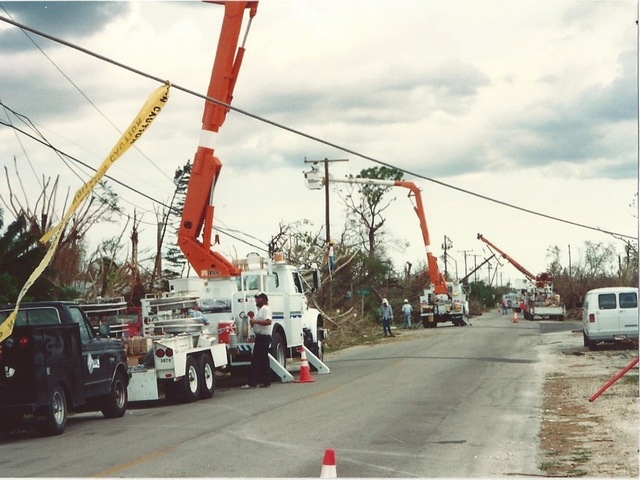
We had been through a number of minor storms but this was “the big one.” Homes all around us were destroyed, schools were closed, and there was no water (we had a well, but no electricity to make the pump work so we bathed outdoors with the neighbor’s garden hose).

The Miami Herald ran notices with missing persons’ names, places to bring pets, a department store listing the zip codes of the residences that could hold off paying bills without accruing interest, and banks that were open, even on Saturday and Sunday. There were special places you could cash checks, and big businesses asked employees to call and say they were OK and were offering food, lodging and help. All traffic lights were out and citizens stood at busy intersections directing traffic. The biggest shock was driving five miles north of my home and everything was normal with no sign of how the people in the southern end of town were suffering.

After 35 years of teaching, I retired in 1996. My next venture was as a docent at the Lowe Art Museum and I also joined IRP (Institute for Retired People) to explore new classes.

IRP has evolved into the Osher Lifelong Learning Institute, under the auspices of the University of Miami School of Continuing Education. Hundreds of seniors attend wonderful classes that are devoted to keeping us young, smart and having fun.

One sunny, mid-week afternoon, I arrived at home to family cars parked in the front yard. I did not have to dig for the house key in my bookbag. My father stood in front of the door as if shielding me from something.

As I entered the house, I heard a woman crying. Family members surrounded the crying woman whom I soon realized was my mother. It was the first time I saw her cry as a result of something I didn’t do. I did not have a broken arm or a D on my report card. On that afternoon, my mother had lost her father.

After I kissed her and said nothing, I went to my room and watched MTV when videos were all the rage. I did not understand what had happened. Death was one of those things I heard tossed around in other people’s conversations. I identified death with Friday the 13th movies and drug dealers on the news.

My whole life I had taken pride in the fact that all of my grandparents were alive and well. I wore that on my sleeve and carried it around as if I had won a trophy. Abuelo was not sitting in a Cuban jail cell, waiting in a ration line, and eating other people’s household pets. Abuelo was in Miami, living in a condo, shopping at Publix and eating steak. Now, Abuelo was suddenly gone, from complications related to diabetes, and there was nothing doctors, my family or I could do about it. Life threw us this curve ball and we had to catch it.

It was my first funeral and the only thing I looked forward to was to practice making my own tie. When I arrived at the funeral home, everyone was already there. The place smelled of cigarette smoke and Cuban coffee. Strangers offered their condolences, hugs and spearmint gum. All I could do was smile and walk away.

As I went toward the room, my grandmother sat crying in a chair next to the casket. Beautiful flowers were scattered near her. The reds, whites, yellows, and greens clashed with her black dress. She was surrounded by more strangers with some hovering over her like more of those loser contestants. The rest of them stood in line waiting their turn to comfort her. I thought all the faces were probably the same to her. Her hands always touched their elbows and her tissue almost always fell on the floor.

I went up to my grandmother, kissed her cheek and walked away through the lobby, the glass doors, the parking lot, and into a cafeteria. As I ordered a pastelito and Materva, I saw some of the strangers from the funeral. They didn’t seem so strange anymore. Their faces and voices sounded familiar. The talk of old Cuba, the exile community, Miami, Hialeah, and my family comforted me. Those were things I had heard before and things my Abuelo used to say.

After spending the night at the funeral home, I woke to find the world still around me. Everyone was still talking and whispering comforts in the air like shooting the breeze over a game of dominos. No one slept. They probably feared they would miss out on one of my grandmother’s wails or so-and-so’s daughter or son and how they are still not married.

At that moment, the priest called everyone to pray the rosary. When the prayer was over, I walked outside with my parents, grandmother and brother to look for the limo. In the corner of the parking lot, the limo rested beneath the shade of one of those trees filled with moon-shaped green seeds. I remembered having block fights with those same seeds and that after one of the fights, I walked back home to find my grandparents waiting in the driveway with packages in their arms and smiles on their faces.

Abuelo said in broken English, “Who’s going to pick up the seeds?”

After the priest did what priests do and said what priests say, the cemetery workers rolled Abuelo’s casket to the rear of the mausoleum. My family and I were walking on a back street with a chain-link fence dividing the mausoleum and some kind of factory. The unkempt hedges sheltered some litter scattered close to the fence. The workers opened the side of the building and I caught a glimpse of where Abuelo was going to be. It looked like dusty concrete shelves. Objects were scattered like the litter next to the chain-link fence. I comforted myself by thinking it was better than being buried in just another hole in the ground with other people’s loved ones walking all over him. At least Abuelo had chosen this place for himself.

That night, I found myself sleeping next to my grandmother. It was dark and I realized that I really did not want to be next to her. I started to cry because I knew this is where I had to sleep tonight. My grandmother woke up and as she wiped the tears off my face, she told me, “No lo puedo creer. El gordo no esta aqui.”

She couldn’t believe her fat man was not there with her. I felt guilty for sleeping in his spot and for reminding her that she would not sleep with Abuelo again. As she reassured me that everything was going to be fine, I reached over and touched her face. As the wind and rain howled outside the window, I rubbed her dry face, rolled over and went to sleep.

My maternal great-grandfather’s brother, John Tatem Wofford, homesteaded in Hallandale in the late 1800s when it was still a part of Dade County. Early in the 20th Century, he and his family moved to the wilderness of what became Miami Beach to construct one of the Beach’s first hotels, the Wofford Beach Hotel, at 24th and Collins.

The Woffords were among the first to be buried in the Miami City Cemetery, resting near the Burdine family crypt.

About 1915, my paternal grandmother’s brother, Jacob Decker, and his wife, Addie Mae, moved into a home at 2353 NW 28th St., then known as the Allapattah Prairie. Uncle Jake died in 1971 and Aunt Mae lived there until the early 1980s, when she moved to Naples. Their house still stands. I was born into the Central Florida branch of my family, so I never visited Miami until my teenage years.

In my mind’s eye, I had painted a vision of Miami Beach as a tropical Disneyland, helped along by the intro to The Jackie Gleason Show. On my first trip up Collins Avenue, I was very surprised to discover supermarkets and even a McDonald’s existed there! Miami Beach’s late publicist Hank Meyer had done his job on me quite well.

On my first trip to Miami in 1976, I drove all night from Daytona to get here. I-95 at the time ended in Vero Beach, where you picked up U.S. 1. to the east or Florida’s Turnpike to the west.

I arrived in town about sun-up. That memory of driving into Miami Shores with the majestic Royal Palms lining Biscayne Boulevard is one I will never forget. Today as a Miami Shores resident, I relive that moment each time I drive south on Biscayne.

I arrived just in time to witness all of our growing pains. From the laid-back metropolis of the late 1970s, we came through riots, the Mariel boatlift, the Dadeland Mall Shootings and Hurricane Andrew.

That said, many wonderful things have happened along the way. The birth of the Miami Beach Art Deco District, Christo’s Surrounded Islands, Biscayne Boulevard MiMo and its surrounding neighborhoods, Midtown Miami and the Design District, Art Basel — and people living downtown again!

At 25, I bought my first home, a little cottage at 1011 NE 72nd St. The house was small, but I had a wonderful unobstructed view of Biscayne Bay and Miami Beach. I could sit on my front porch and watch the time and temperature change on Lincoln Road.

No one in 1984 was sure what would become of the East of Biscayne neighborhoods. Many thought I had made a terrible investment by buying there.

That same thought raced through my mind on August 23, 1992, with the prospect of being washed away by a 16-foot storm surge from Hurricane Andrew.

Our neighbors to the South took the hit that was originally predicted to come ashore in North Dade. That neighborhood today is known as the Bayside Historic District and I’m proud to have played a role in seeing it historically designated.

In the early ’90s, I moved to higher ground in Miami Shores.

In 1978, I started in banking as a teller at Chase Federal Savings and Loan Association in Surfside and moonlighted at Burdines on 163rd Street to make ends meet.

It’s hard to imagine today, but there was a time when banks actually had to pay people a higher salary if they would agree to work on Miami Beach. Jokingly called ‘Combat Pay,’ it was because the mostly elderly population of the Beach could be quite demanding at times.

My having grown up around many elderly people served me well. After a 10-year government career stint with Dade County, I joined Northern Trust Bank, where I’m proud to say I’ve been for the past 16 years.

Along the way, there have been many changes to Miami. Gone are The Miami News, shopping at Burdines, Jordan Marsh, J. Byron’s and Richards, the Orange Bowl and its parade, a meal at the S&S; Diner on Northeast Second Avenue when the Cavallaris family still owned it. They’ve all been replaced by new ‘rocks’ and institutions along the way.

And yes, those tall Coconut Palms are still my favorite trees and they surround my MiMo home in Miami Shores.

Miami isn’t for everyone. Many will never understand why we choose to be here nor what is this great magnet that keeps us from leaving. Much more than the balmy weather, I think we all have a pioneering spirit that drives us to embrace diversity and combat adversity. We would die of boredom otherwise.?

Translate »